
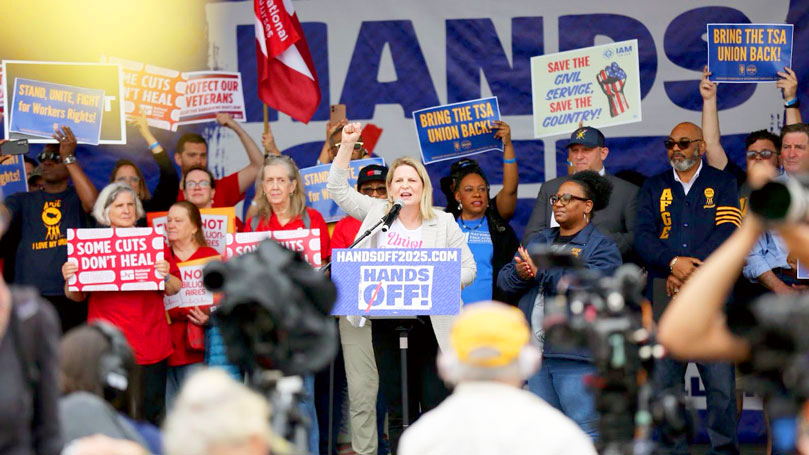
TRUMP’S rosy picture is disconnected from workers’ reality, the AFL-CIO trade union federation says.
Tuesday’s statement from AFL-CIO President Liz Shuler on President Trump’s State of the Union address, said: ‘President Trump’s speech tonight was a fever dream, completely divorced from the economic reality working people feel every day amid rising costs and vanishing jobs.
‘We know Trump’s billionaire-first agenda is all about fattening the bottom line of the extremely wealthy while the rest of us scrape for crumbs.
‘Every time we check out at the grocery store, open a utility bill or look at our pay cheques, working people see this economy for what it is: A struggle that suffocates us day after day.
‘From day-one, this administration has made working people’s lives more expensive and less free: Attacking immigrant workers and our communities, giving Big Tech CEOs free rein, ripping away federal workers’ collective bargaining rights while weakening the laws that protect our pay cheques.
‘Meanwhile, the cost of living for working people continues to rise.
‘President Trump boasted about a “golden age” for workers, but he spent the past year rigging the rules for billionaire CEOs and Big Tech companies while kicking millions of Americans off their health care.
‘Rather than raising wages and lowering costs, the president has attacked unions and workers, ripped away workers’ collective bargaining rights and stalled job-creating projects.
‘And every day, the Trump administration is pushing to pit working people against each other: Deporting immigrants and ripping people from their families, trying to strip people of their status and work permits, and making it more difficult for working people to vote.
‘The labour movement isn’t falling for it. Even as the state of our union is under attack, workers are banding together to fight back.
‘These relentless attacks on our freedoms and our livelihoods have made working people hungrier than ever to join a union, who organised to put the number of unionised workers to its highest level in 16 years.
‘In 2026 we will organise, we will fight and we will vote for a country that works for us, not the billionaire bosses.’
American Federation of Teachers (AFT) President Randi Weingarten issued the following statement, reacting to President Donald Trump’s State of the Union address: ‘Trump is a master of theatre, but he lacks empathy and unity.
‘So if you can’t make ends meet, or your housing or child care or healthcare costs are too high, this speech told you that you don’t matter.
‘He has declared that he’s made America great again, so for the millions of Americans struggling or striving, there’s not one word of help.
‘For millions of children, not one word about their future. For working people, the same. A State of the Union address should be about how we help each other, and that was sorely absent.’
Last Wednesday 18th February, the AFT and Protect Borrowers unveiled new findings from a survey of more than 7,500 AFT union members, revealing the dire financial situations working families face under President Donald Trump’s failed economic policies.
The vast majority of respondents (74%) report they live month to month, pay cheque to pay cheque, and more than a third (36%) are unable to cover all of their monthly bills.
The survey sheds light on a troubling reality: Thousands of AFT members – educators, healthcare workers and public services employees – are resorting to debt to cope with rising costs.
Matthew, a teacher from Texas, said his electricity was cut off for the first time in December. ‘I have been teaching since 2007 but with debt from my child’s (special needs) medical debt and high energy costs we had to be late on energy bills then we got really behind and power was disconnected before Christmas,’ he said, responding to the survey.
The 1.8 million-member AFT and Protect Borrowers released the survey during a news conference in Orlando, Fla., which included US Rep. Maxwell Frost, the Debt Collection Lab at Princeton University, and AFT members who shared their debt stories.
In response to the affordability and debt crisis facing working families across the country, the AFT simultaneously launched its Fight for Affordability campaign on Wednesday (18th February).
The campaign will include a suite of new consumer empowerment tools and expanded debt and financial literacy clinic offerings, starting with a focus on medical debt, to help workers navigate rising costs and predatory financial practices.
The AFT’s new Fight for Affordability webpage allows visitors to register for a debt clinic, view short informational videos on topics like how to navigate your credit report or appeal a medical bill, and use an AFT Debt Navigator tool created with the Debt Collection Lab that guides users to the resources that are most relevant to them.
‘Working people are getting squeezed from every direction,’ said AFT President Randi Weingarten.
‘Our survey shows that’s true for the educators, healthcare workers and public service professionals who keep our communities running.
‘In this economy, AFT members no longer feel like they have a shot at the American dream, and Donald Trump’s failed policies aren’t helping.
‘That is why we are launching the AFT’s Fight for Affordability. This campaign will empower our members by helping them navigate the debt and cost-of-living issues that stand in the way of them building a better life.
‘Working people deserve an opportunity to thrive, not just survive.’
‘Families are being crushed by an affordability crisis while big banks pull in record profits. People are putting groceries, rent, even medical care on credit cards with sky-high interest rates, and debt has hit an all-time high,’ said Rep. Maxwell Frost (D-Fla.).
‘I applaud the AFT for releasing this stunning survey showing the growing economic challenges facing too many educators, healthcare workers and other public service workers.
‘It is long past time we stop letting corporations profit off people’s struggle and start building an economy that puts working families first.’
Jodi, a nurse from Oregon, said: ‘The constant struggle and pressure of not having enough money to pay the household bills and buying food are affecting me physically, mentally and emotionally.
‘I am losing hope that I will be able to retire and survive this financial instability.’
Karla, a civil servant from New York, said: ‘I am doing everything I can to stay afloat, but I am struggling to afford basic necessities like food, rent, gas and the costs of continuing my education.
‘I recently had to file for bankruptcy, which was an extremely difficult and humbling experience.
‘I often find myself needing to borrow money from my mother just to cover essentials, and that adds stress not only to me but to my family as well.’
The survey findings underscore that working families are increasingly struggling to keep up with rising costs of living and price surges of basic essentials.
As a result, families are taking on more debt to stay afloat – with debt burdens now approaching the highest levels seen since the depths of the Great Recession.
Key Findings
The survey findings underscore that working families are increasingly struggling to keep up with rising costs of living and price surges of basic essentials.
As a result, families are taking on more debt to stay afloat – with debt burdens now approaching the highest levels seen since the depths of the Great Recession.
The vast majority (74 per cent) of AFT members who responded to the survey report living month to month, pay cheque to pay cheque, and more than one-third (35 per cent) report being unable to afford to cover all of their monthly bills.
Sixty per cent of respondents said they are concerned about costs rising faster than wage growth.
More than half reported being worse off financially since Trump returned to office.
The hallmarks of middle class American life – home ownership, higher education and a secure retirement – are slipping beyond reach for many.
Nine in 10 AFT members said they cannot save enough for retirement, and more than 8 in 10 identified housing costs as a challenge. One in 4 members described the high cost of housing as a ‘major challenge’.
Energy costs are squeezing working families across the country.
Rising energy costs ranked second on respondents’ list of the largest drivers of financial distress.
More than 7 in 8 respondents cited rising utility bills as a challenge, and nearly 1 in 4 respondents described these costs as a ‘major challenge.’
Families are turning to debt – largely credit cards and ‘buy now, pay later’ loans – to stay afloat.
Sixteen per cent reported taking on buy now, pay later loans, 25 per cent borrowed money from family or friends, 29.3 per cent delayed payments due on other bills, and more than half paid only the minimum monthly payment on credit cards.
Nearly 1 in 3 respondents (30 per cent) reported using a credit card to pay utility bills.
One in 5 (20 per cent) reported using a credit card to make a payment on another debt. One in 8 (12 per cent) reported using a credit card to pay the rent.
Our broken healthcare system is driving families deep into debt.
Forty-nine per cent of respondents reported paying for medical or dental care with a credit card over the past 12 months.