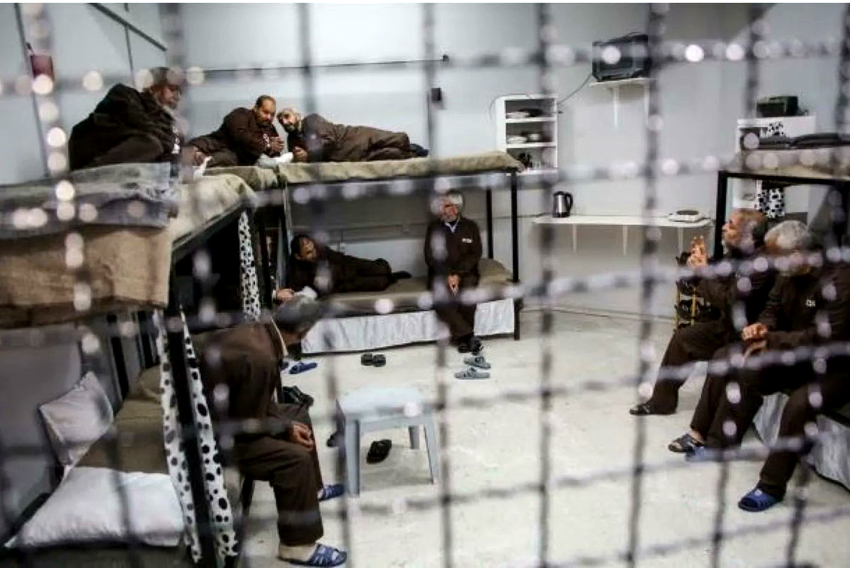
THE Israeli Ganot prison administration is still denying medical treatment to detainees from Gaza, especially those injured during a crackdown on October 7th, leaving prisoners with fractures and other injuries without care, said the Asra Media Office (AMO) .
The AMO said one prisoner suffered broken ribs and a head injury during the latest assault but had not received treatment.
It added that prison authorities refused to give painkillers to another prisoner with a broken leg fixed with metal plates, despite his request.
The denial of treatment also affects prisoners with chronic illnesses.
According to the AMO, one detainee suffering from thalassemia and high blood pressure is not receiving blood pressure medication and has lost around 50 kilos since his arrest because of the lack and poor quality of food.
Prisoners with scabies and fungal infections are also suffering pain and itching that prevents them from sleeping, amid shortages of medicine and cleaning materials.
The AMO said prisoners are allowed to wash their clothes only once every 10 days, and for a period too short to serve everyone.
The Office held Israel responsible for the deteriorating health of detainees and called on international institutions and the International Committee of the Red Cross to intervene to ensure treatment for sick and injured prisoners.
The latest reports come just days after the Office revealed details of the October 7th assault on Gaza prisoners in Ganot prison, saying repression forces used rubber bullets, gas, pepper spray, sticks and batons, and brought police dogs into prisoners’ rooms.
According to a statement published on October 8th, the assault caused fractures in several prisoners’ hands, burns to one prisoner’s hand after he was hit by a gas canister, and renewed injury to a detainee’s previously wounded leg, which is fixed with metal plates.
His request to be taken to the clinic was ignored.
The AMO said prisoners suffering from scabies and boils were also beaten, causing their wounds to bleed.
It added that detainees were denied breakfast, had lunch delayed and were prevented from using the bathroom during the crackdown.
The health crisis in Ganot predates this latest assault.
In August, the Commission of Detainees and Ex-Detainees Affairs reported continued beatings, repression, lack of health care and shortages of personal items in the prison, based on visits and prisoners’ testimonies.
The Commission said some rooms held 12 prisoners despite having only 10 beds, forcing two detainees to sleep on the floor.
It also documented the removal of mattresses from morning until evening count and restrictions on washing clothes, creating worsening conditions for prisoners already facing injury, disease and denial of treatment.
Two Palestinian civilians were killed and two others injured in an Israeli strike in the Gaza Strip on Monday, amid ceasefire violations in different areas.
An Israeli strike near Muawiya Mosque in the al-Mawasi area of Rafah killed two young men and injured two other citizens.
Additionally, widespread military activity, including shootings, artillery shelling, drone overflights, and demolitions, was reported in other areas of Gaza.
On Sunday night, three civilians were killed and six injured in an Israeli airstrike that targeted a cellphone charging point in al-Buraq neighbourhood of Khan Younis.
The Israeli military blockade on several towns and villages in southern Nablus has prevented 59 teachers and three principals from reaching their schools, disrupting classes and depriving thousands of students of education.
‘The closure of roads and gates, along with restrictions on the movement of educational cadres, poses major challenges to maintaining regular school attendance,’ Samer al-Jamal, director general of education in southern Nablus, said.
Al-Jamal’s remarks came during a visit to the village of Madama, south of Nablus, on Monday morning to support teachers and inspect conditions at local schools affected by military closures.
Jamal accused the Israeli occupation army of directly targeting the educational process and denying Palestinian students their right to reach their schools.
‘Our schools will remain open, we will continue to stand by our teachers, and we will not allow the siege to deprive our students of their right to education,’ he emphasised.
The Israeli occupation forces closed the entrances of Madama village at dawn Sunday, blocking access to and from the village, including its northern entrance, the road linking it to Burin, and the two roads connecting it with Asira al-Qibliya, restricting the movement of residents, students and educational staff.
Israeli authorities began demolishing homes and a mosque on Monday in the Abu Wadi neighbourhood of al-Dahiyya, an ‘unrecognised’ (i.e. by the Israeli occupation) village in the Negev, threatening to displace around 80 Palestinian families.
The demolitions were carried out under heavy Israeli police protection and targeted homes belonging to the Abu Wadi family, after the Israeli District Court in Beersheba rejected a request by residents to freeze the demolition orders.
According to available information, the orders target around 60 homes inhabited by nearly 400 family members, including women, children and elderly people, leaving dozens of families at risk of losing their shelter.
Members of the Abu Wadi family say they are determined to remain on their land in al-Dahiyya, where they have lived for decades and inherited land from generation to generation.
The family owns around 630 dunums in the area, including 550 dunums that were used for agriculture until recent years, before Israeli restrictions intensified, according to the Palestinian Refugees Portal.
Israeli authorities have proposed moving residents to alternative housing in Rahat’s 10th neighbourhood, but residents reject the plan and demand recognition of their village and planning arrangements that would allow them to stay on their land.
The Higher Steering Committee for Arabs in the Negev had earlier called for public and official action to support the villagers, warning of the serious impact of demolitions on hundreds of residents and urging recognition of the village.
Rahat Municipality also criticised Israeli authorities for failing to reach a planning agreement that could have regulated the village’s status.
The demolitions come as part of a wider crisis facing Bedouin Arab communities in the Negev, especially villages not recognised by Israeli authorities.
Residents often face demolition orders over alleged unlicensed construction, while planning frameworks needed to regulate building and secure housing rights remain unavailable.
The al-Dahiyya demolitions have renewed Palestinian concerns over displacement and land seizure, as residents insist on staying in their village and demand recognition and protection of their housing and land rights.
The Israeli occupation forces (IOF) stormed different West Bank areas on Sunday night and at dawn on Monday, raiding homes and kidnapping a number of Palestinian citizens.
According to locals, the IOF kidnapped a young man from al-Tur area of Nablus City following raids on homes, and there are also media reports that two citizens were taken prisoner during an IOF raid in Nablus, without specifying the exact area of the arrests.
Israeli forces also stormed the village of Salem in eastern Nablus and showered homes with tear gas canisters.
In Jenin, they kidnapped two brothers and three sisters from the family of Sa’abneh during raids in the town of Fahma and two young men from the village of Zububa.
In Qalqilya, the IOF kidnapped four citizens from their homes during raids in the city.
In Jerusalem, Israeli police forces kidnapped two citizens from the towns of Qatanna and Eizariya.
In al-Khalil, five citizens were kidnapped by the IOF from al-Khalil City, the village of al-Tabaqa, and al-Arroub refugee camp.
In Tulkarem, a young man was taken prisoner following an IOF raid on his home in the town of Deir al-Ghusun.
In Bethlehem, the IOF seized three citizens from the town of Janata and another one from the village of Husan.
Israeli forces also stormed the village of al-Arouj in the east of Bethlehem and detained and interrogated several young men following raids on homes.