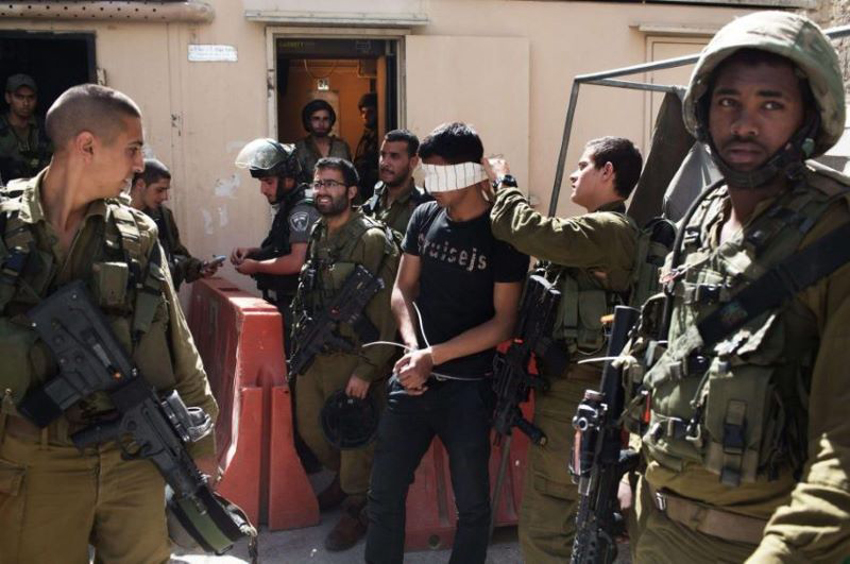
ISRAELI soldiers seized two boys aged 13 and 15 from their homes in the Arroub refugee camp between Hebron and Bethlehem at about 2.30am on 25th January, assaulted them in the back of army jeeps, interrogated them and returned them to their families the next day, in a night raid of the kind the occupation army has carried out almost every night in the West Bank for nearly six decades.
Around 370 Palestinian children were held in Israeli prisons in August, most of them in Megiddo and Ofer, among more than 9,400 Palestinian prisoners and detainees.
At the end of last year, when the Israel Prison Service put the figure at 351, more than half of those children, 180, were in administrative detention without charge or trial, the highest number and the highest proportion since Defence for Children International Palestine began counting in 2008, and the prison service figures leave out children held at military interrogation centres, for which no data exists.
Israel has barred the International Committee of the Red Cross from visiting any Palestinian detainee since 7th October 2023.
In August alone, the occupation detained about 500 Palestinians across the West Bank and Jerusalem, 31 of them children, in campaigns accompanied by raids on dozens of homes, property damage and field interrogations after which most were released having been humiliated, beaten and threatened.
The Arroub raid was reported in detail by The Electronic Intifada, which interviewed the two boys, named as Hassan and Ibrahim at their request for fear of retaliatory arrest.
An army watchtower looms over the camp’s entrance.
Masked soldiers kicked in doors, smashed furniture and went room to room searching for a handful of teenage boys.
Hassan, 13, had already been shot by the army in 2023 while walking home from a cafe where he had been playing billiards, and showed the reporter a scar running from the top of his outer leg down his thigh.
Once inside his family’s home the soldiers shouted in Hebrew, demanding to know where he was.
‘When I told them I’m Hassan, they grabbed me, slapped me, threw me to the ground and started cursing at me,’ he said.
His mother tried to hand him a jacket as he was dragged out into the January cold and was stopped.
She stood and watched as the soldiers carried him off into the dark.
A few doors away Ibrahim, 15, was made to stand against a wall with his family while around 20 soldiers held them at gunpoint.
‘Before I even finished saying my full name, he grabbed me,’ he said. A soldier cursed at his sister.
The two boys were thrown into jeeps and their parents had no idea where they were being taken or whether they would see them again.
Soldiers kicked and punched Hassan in the back of the vehicle; in Ibrahim’s case the driver slammed on the brakes to send him flying into the door.
Both were subjected to interrogations that included beatings, mockery and attempts to coerce confessions.
The power to do this rests on the Order Regarding Security Provisions, one of thousands of military orders issued after the 1967 occupation, which allows soldiers to search or invade homes without a warrant, a power the Israeli rights group Yesh Din describes as unparalleled in any modern judicial system.
Lawyers for Palestinian Human Rights counted more than 170,000 search or arrest incursions across the West Bank between 1967 and October 2023, a large share of them at night.
A 2013 UNICEF report found that some 7,000 Palestinian children had been detained, prosecuted and at times imprisoned over the previous decade.
The report identified night arrest as a common method and called on Israel to end it.
The army’s response was a pilot scheme, announced by the then chief military prosecutor for the West Bank, under which wanted Palestinians would receive written summonses instead.
Six years on, the Israeli rights organisation Hamoked collected affidavits from 81 teenage boys who had been detained.
More than 70 per cent had been arrested at night, and of the 58 taken at night only one family had received a summons beforehand.
Asked about the promised reform, the army and police said they had not kept comprehensive data.
Hamoked concluded that ‘no effort is made to enforce them and they appear to be no more than a dead letter’.
Hamoked took the matter to the Israeli high court, and in 2021 the army and police announced a new procedure that would ‘minimise the harm to the civilian population’.
The following year Military Court Watch found that of 50 arrested children who gave testimony, half had been taken at night and a summons had been issued in one case.
The raids have only multiplied. The UN Office for the Coordination of Humanitarian Affairs recorded more than 3,400 search and arrest operations in the West Bank in 2022.
In the first nine months of 2025, there were nearly 7,500 raids by day and night, 37 per cent more than in the same period of 2024, itself a sharp rise on 2023.
The most extreme escalation, codenamed Iron Wall, began in January 2025 and emptied the Jenin, Tulkarm and Nur Shams refugee camps in the northern West Bank.
More than 33,000 Palestinians were forcibly displaced by a weeks-long assault of raids, home demolitions, torn-up roads and sabotaged water and power supplies.
The three camps remain emptied of their populations, and a recent UN report warned that displacement on that scale and of that systematic character can amount to the crime against humanity of forcible transfer.
Alexandra Saieh of Save the Children said her organisation had ‘not seen any significant reform over the last several decades’ and that ‘over the last two years the conditions that detained children are facing have actually deteriorated’.
Of the lasting damage, she said: ‘We’ve heard children say things like they have trouble sleeping after being detained, they are scared of going to bed, they are scared of separating from their parents.’
Night raids have spread to Gaza, where before October 2023 they were rare because Israel had withdrawn its soldiers and settlers in 2005, subjecting the Strip instead to a blockade and repeated bombardments.
Since the genocide began, raids targeting children have been added to the drone strikes, sniper fire and carpet bombing.
Of 491 Gaza detainees released in the prisoner exchange of February 2025, 44 were minors, and accounts from other released children indicate the true number taken is far higher.
Amnesty International documented the case of a 14-year-old from Jabaliya seized in January 2024 and held for more than three weeks in the Sde Teiman detention centre with over 100 adults, where he said he was burned with cigarette butts and was denied any contact with his parents or a lawyer.
The contrast with the treatment of settlers is total.
The UN recorded 190 settler attacks on Palestinians in the first four months of 2026 alone.
Settlers are rarely arrested, and when they are they come under Israeli civilian law, which requires a warrant to search their homes and permits an unannounced raid only if a crime is believed to be underway on the premises.
Israel says it raids at night to avoid clashes. Its own promises of reform show the army knows the harm the practice inflicts.
A joint report by Yesh Din, Breaking the Silence and Physicians for Human Rights Israel found that one purpose of unannounced invasions is ‘mapping’, the collection of information about the lay-out of a home and its occupants, and the army has staged mock raids and arrests on families purely to train soldiers.
Former soldiers have testified that the aim is ‘deterrence’, the belief that a frightened population is less likely to rebel.
Titi Carmel, chief executive of Parents Against Child Detention, an Israeli group monitoring the occupation forces, said the helplessness of parents during these state-sanctioned abductions ‘breaks the sense of safety, not only in your home, but also in your relationship with family’.
She added: ‘It creates this environment of fear where your house is not a safe place, you can always be taken and your children can always be taken.
‘To me it’s just a form of terrorising the population and weakening the young generation from rising up.’
As Hassan told his story, Muhammad, a young man from the camp who had dropped in to listen, interrupted to mimic the soldiers carrying the boy over a shoulder ‘as if he was a purse’, and everyone laughed, Hassan included.
The raids have been normalised to the point where they can be joked about.
The scars remain. ‘It makes me feel sad that I have to grow up in such a situation,’ Hassan said.
Ibrahim compared what was done to him to torture.
The raids go on almost nightly, and even the empty promises of reform have receded into memory.