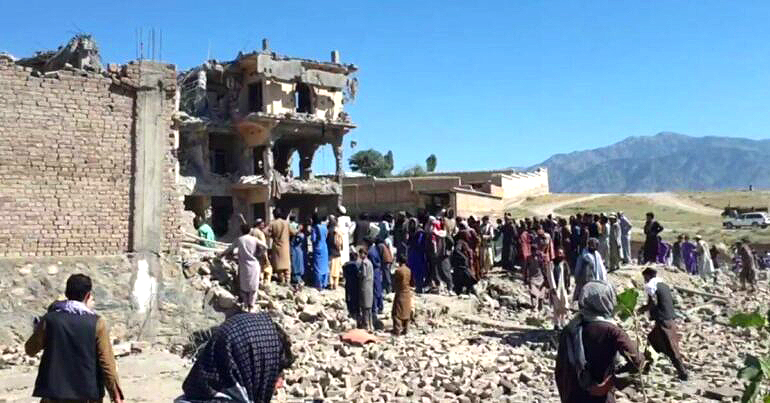
14 people, including two children and two women, were killed in Israeli strikes on Lebanon on Sunday alone, and at least 37 were injured.
On Sunday afternoon, Zionist warplanes launched a series of raids targeting the southern Lebanese villages of Burj Qalawiya in the Bint Jbeil district, Toulene in the Marjeyoun district, as well as the roundabouts of Kafr Tibnit, Mayfadoun, Zawtar al-Gharbiya, Zawtar al-Sharqiya, and Shoukin in the Nabatieh district, in Israel’s ongoing aggression against the region.
Following these latest attacks, Hezbollah Secretary General Sheikh Naim Qassem stressed that now ‘the negotiations between the Lebanese authorities and the Israeli enemy are entirely irrelevant and of no concern whatsoever.’
In a statement on Monday, Sheikh Qassem said: ‘No matter the scale of threats, we will neither retreat nor yield, and we will not be defeated.
‘Issue your threats as you will – those on the frontlines do not bow their heads and remain resolute in the face of tyranny.
’We will stand united with all honourable forces, alongside the Amal Movement, national political factions, and figures from across all regions and sects.’
The Hezbollah leader called on the Lebanese authorities to rescind their March 2nd decision ‘which criminalises the resistance and its people, who represent more than half of the Lebanese population.’
He affirmed that the resistance group won’t return to the pre-March 2nd era and will press ahead with its defensive resistance to protect Lebanon and its people.
He also vowed ‘not to forsake the blood of the martyrs,’ especially assassinated Hezbollah leaders Sayyed Hasan Nasrallah, Sayyed Hashem Safieddine, and all those who fell.
‘Nor will we forget the suffering of the wounded, the anguish of the prisoners, or the sacrifices of our people in displacement – their steadfastness, their giving, and all they have endured.
‘Do not question our capabilities for they are not measured in months or years. They rest on an enduring triad: faith, will, and capacity. This triad is ever-renewing. Look instead to the steadfastness of the fighters, the resilience of our people, and the promise of victory to those who remain firm.’
Addressing the Lebanese nation, Sheikh Qassem declared: ‘Let history record this: the Israeli enemy will not remain on a single inch of our occupied land, and our people will return to their lands, down to the last inch of our southern border with occupied Palestine.
‘And to our people, just as we resisted together, we will rebuild together.’
The Hezbollah leader also thanked Iran for its stand by the Lebanese people against the Israeli aggression.
‘The ceasefire would not have been possible without the Islamic Republic of Iran’s intervention in the Islamabad talks, following the legendary steadfastness of the resistance and its people in Lebanon. Thank you, Iran.’
Sheikh Qassem concluded: ‘All support for Lebanon, its liberation and reconstruction, is welcomed and valued, while any alignment with the enemy’s demands or attempts to undermine the country’s strength are firmly rejected.’
Elsewhere in the statement, Sheikh Qassem stressed that the Israeli enemy had failed to eliminate Hezbollah and its resistance since the beginning of Uli Al-Ba’s (Formidable in Might) battle in 2024.
‘The enemy was taken aback during Operation Eaten Straw by the resistance fighters’ steadfastness, diversity of their tactics, and their skillful management of the battlefield.
‘The enemy has reached a dead end; this resistance is continuous, strong, and cannot be defeated.’
He also noted: ‘Against this backdrop of sacrifice, dignity, and the enemy’s defeat, the authorities hastened into a gratuitous and humiliating concession – one that was neither necessary nor justified, and appeared aimed at submission without securing even the slightest return.
‘We categorically reject direct negotiations, and those in power must understand that such steps serve neither Lebanon nor their own interests.
‘What the Israeli-American enemy seeks from them lies beyond their capacity, and what it demands will not be granted.’
He stressed that five points must be achieved before anything else:
- Halting the aerial, ground and naval Israeli aggression;
- Israeli withdrawal from the occupied territories;
- The release of prisoners;
- The return of the people to all their villages and towns;
- Reconstruction.
He stressed: ‘The Lebanese authority cannot persist while it dissipates Lebanon’s rights, compromises its land, and turns against its own resistant people.
‘It must return to its national base and work to unite the people around a shared purpose, so that it is not seen as the authority of a faction, but as the authority of the nation as a whole.’
Sheikh Qassem affirmed that a constructive framing of the solution begins from the premise that the core issue is aggression itself, and that resistance emerges as a response to that aggression rather than its source.
‘In this view, the weapon of resistance is intended to repel attacks and serves, at this stage, as a defensive instrument for safeguarding existence under conditions of continued Israeli occupation and broader expansionist objectives linked to the so-called notion of “Greater Israel” and the occupation of Lebanon.’
Sheikh Qassem vowed that the resistance won’t relinquish its means of defence.
‘The field experience has demonstrated the resistance’s readiness to embody an enduring epic of steadfastness and sacrifice, like those of Karbala battle. The sacrifices are immense, yet they are understood as the price of liberation and of preserving a dignified life.’
Meanwhile, head of Hezbollah’s Loyalty to Resistance bloc at the Lebanese Parliament, MP Mohammad Raad, said the continued resilience of Iran in the face of the US-Israeli war has revealed a deep miscalculation in Washington, highlighting a structural gap between American military power and its claimed values.
In an article published in Al-Akhbar, MP Raad argued that former US President Donald Trump reacted with ‘astonishment, shock, and anger’ to Iran’s refusal to surrender despite the heavy losses inflicted during the aggression including the loss of the former Supreme Leader of the Islamic Revolution Imam Sayyed Ali Khamenei and a number of military, security and political commanders, as well as the widespread destruction.
Raad said Washington and its allies ‘could not have imagined’ that Iran would continue to resist after strikes targeting senior leadership and key infrastructure; instead, Tehran had responded with ‘unwavering confidence and unprecedented popular participation.’
According to the Lebanese lawmaker, this resilience stems from a misreading of the Islamic Republic’s internal structure, noting that the Iranian system is built on ‘tightly interwoven ideological, organisational, and societal ties’ between leadership and the public, who form ‘the cornerstone’ of national sovereignty.
He stressed that ‘the Iranian people are not merely a population tossed about by politicians,’ but rather ‘an active and serious producer of power,’ enabling the state to absorb major blows and maintain cohesion.
MP Raad further argued that US policymakers equate superiority with military dominance, while ignoring legitimacy, but true power must be grounded in ‘principles and values of international and humanitarian law.’ Without this, he added, any claim to superiority collapses into ‘bullying and transgression.’
He pointed to US President Donald Trump’s rhetoric, including threats that the whole Iranian civilisation would ‘die’, as evidence that Washington ‘stripped away the pretense of superiority’ and revealed itself as ‘a force for threatening, demolishing, and destroying.’
The Lebanese lawmaker also drew parallels with developments in the region, stating that both the United States and the Zionist entity were similarly shocked by the ability of resistance forces to recover quickly after leadership losses, including Hezbollah in Lebanon.
He argued that such resilience contrasts with the ‘artificial systems’, which would collapse under comparable pressure, asserting that cohesive ideological environments are more capable of sustaining prolonged confrontation.
‘What unfolded in Gaza, and what the environment of Hezbollah and the Islamic Republic of Iran endured, would have led any artificial state or fragile system to collapse under similar pressure.
‘In such a scenario, white flags would have been raised over buildings and towers. Yet events have taken a different course – one that defies conventional expectations.
‘The steadfastness of Iran and the resilience of the resistance in Lebanon are two illustrative examples of this equation,’ he wrote, adding that their experience could inspire similar models elsewhere.
Raad concluded that the core failure of US policy lies in ‘the fundamental imbalance… between power and values,’ which, he said, continues to undermine American influence despite its military capabilities.