Palestinian resistance movement Hamas has condemned the treatment of Palestinians by Israeli forces at the Rafah border crossing, calling it collective punishment and a form of organised terrorism.
In a statement released on Tuesday, the group said the ‘mistreatment, abuse, and deliberate extortion’ faced by Palestinians returning to Gaza through Rafah ‘constitutes fascist behaviour and organised terrorism.’
‘This confirms that what is happening is not “crossing procedures” but rather systematic violations aimed at instilling fear and deterring people from returning to their homes,’ the statement added.
Hamas said the long-awaited reopening of Gaza’s southern border crossing with Egypt was meant to ease the territory’s punishing military siege.
However, the group said field testimonies have exposed ‘degrading practices, including the abduction of women among travellers and their blindfolding.’
‘Israeli forces subjected Palestinians at the crossing to prolonged interrogations with irrelevant questions, threatened some with their children, and attempted to coerce one individual into collaboration,’ Hamas added.
The resistance group also called on the international community and human rights organisations to document the violations.
Israeli authorities, however, continue to enforce tight security restrictions and a complex bureaucratic process that allows only a small number of people to travel in either direction.
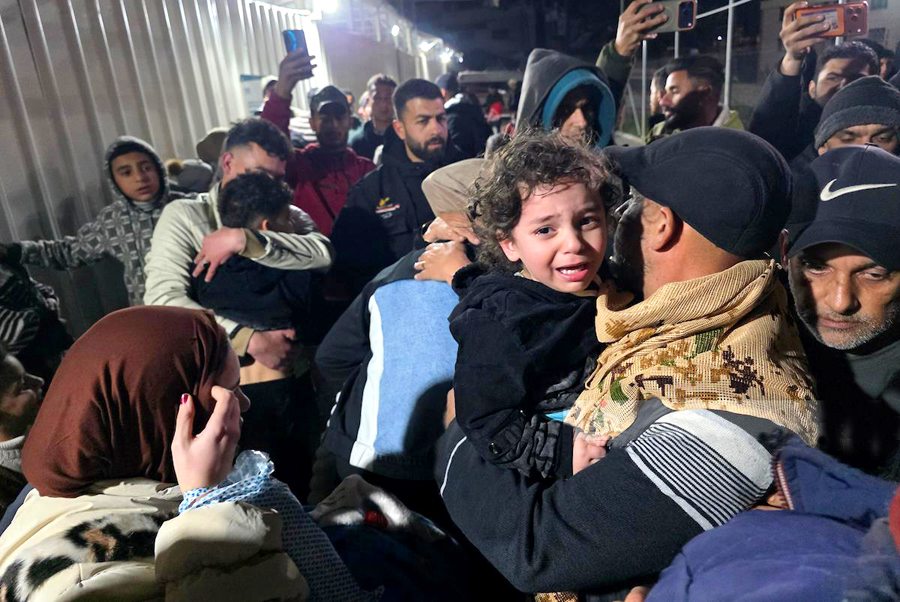
Media reports said Palestinians lined up on Tuesday on both sides of Gaza’s border with Egypt, after the long-awaited reopening the previous day, was marred by delays and uncertainty over who would be allowed through.
On the Egyptian side were Palestinians who had previously left Gaza for medical treatment during Israel’s genocidal war.
On the Gaza side, Palestinians in need of treatment were transported by buses from the Palestinian Red Crescent headquarters in the besieged territory.
On Monday, it took more than 10 hours for only about a dozen returnees and a small group of medical evacuees to cross in each direction.
Palestinian Red Crescent spokesperson Raed al-Nims said on Tuesday that just 16 patients with chronic conditions and war wounds were transported from Khan Younis to the Gaza side of Rafah.
The World Health Organisation (WHO) said it is supporting medical evacuation efforts. UN spokesperson Stéphane Dujarric stated on Monday that adequate humanitarian supplies must be allowed into Gaza, with obstacles at Rafah and other crossings significantly reduced.
Ramiz Alakbarov, the UN resident coordinator in the occupied Palestinian territory, described the reopening of Rafah Crossing in both directions, a vital link for humanitarian supplies that has been closed for two years.
However, many now fear that Israel could use the crossing to push Palestinians out of Gaza.
The UN on Tuesday also expressed concern over continued Israeli air strikes and reports of civilian deaths over the past two days.
Israeli strikes have killed more than 500 people since the ceasefire came into effect in early October.
Since October 7, 2023, nearly 71,800 people, mostly women and children have been killed in Israel’s ongoing genocide in the besieged territory.
The humanitarian situation for more than two million people in Gaza remains dire, with most displaced and many living in tents with minimal sanitation amid harsh winter conditions.
- Israeli forces and settlers carried out 1,872 attacks against Palestinians and their property across the occupied West Bank in January, a new report reveals, highlighting a sharp escalation in violence, displacement, and settlement activity.
Out of these attacks, 1,404 were carried out by Israeli military and security forces, while 468 were conducted by settlers, often under the protection of Israeli troops, according to figures published by the Colonisation and Wall Resistance Commission on Tuesday.
The incidents took place in various West Bank governorates, including al-Khalil, Ramallah, al-Bireh, Nablus, and al-Quds.
According to Palestinian officials and human rights monitors, the attacks suggest a systematic policy aimed at displacing Palestinians and strengthening Israeli control over strategic areas.
Palestinian Bedouin communities were also disproportionately affected, with at least 125 families forcibly displaced from three communities during the month.
The report documented 349 cases of vandalism and theft by settlers, including the destruction, poisoning, or uprooting of 1,245 olive trees, which are crucial for Palestinian farmers.
Israeli authorities also accelerated settlement construction and land appropriation, seizing a total of 744 dunums of Palestinian land in January and advancing or reviewing 21 settlement master plans involving 2,729 new housing units.
Additionally, Israeli forces carried out 59 demolition operations, destroying 126 Palestinian structures, including 77 inhabited homes, while issuing 40 new demolition orders, most of them in al-Khalil governorate.
Israeli forces intensified daily raids and movement restrictions across the West Bank, including blocking agricultural roads in Sebastia, conducting patrols and shop raids in Silwan and Hizma, and carrying out armed attacks in Khirbet al-Kharaba.
These actions threaten to further fragment Palestinian territory, isolating communities and limiting access to farmland, education, and healthcare.
Officials from the Colonisation and Wall Resistance Commission said January’s figures reflect a deliberate policy of de facto annexation implemented through violence, displacement, settlement expansion, and impunity.
Despite repeated international criticism, Israeli authorities continue to deepen control over Palestinian land, they said, undermining the social, economic, and geographic foundations of Palestinian life in the West Bank.
By the end of 2025, Palestinian authorities estimated over 1,102 Palestinians killed and 9,034 wounded in the West Bank amid intensified military operations and settler attacks. The violence has surged in tandem with the ongoing war in Gaza, which began on October 7, 2023.
Over 700,000 Israeli settlers currently live in more than 230 settlements established following the 1967 occupation of the West Bank and East al-Quds.
The international community views these settlements as a violation of international law and the Geneva Conventions because they are built on occupied Palestinian territories.
The UN General Assembly and the UN Security Council have consistently denounced Israel’s settlement activities through various resolutions.
- UN Secretary-General Antonio Guterres has warned that Israel’s ‘unlawful’ plans to expand settlements in the E1 area of the West Bank could sever its northern and southern parts, dealing a serious blow to Palestinian statehood.
‘The recently published tender by Israel for 3,401 housing units in the E1 area, alongside continued demolitions is profoundly alarming,’ Guterres said on Tuesday at the opening session of the UN Committee on the Exercise of the Inalienable Rights of the Palestinian People (CEIRPP).
‘If carried forward, it would sever the northern and southern West Bank, undermine territorial contiguity, and strike a severe blow to the viability of a two-state solution,’ he added.
In August last year, Israeli occupation authorities approved the E1 project, which involves building 3,400 new settlement units in the occupied Palestinian territory, primarily near the existing Maale Adumim settlement. The plan also covers around 12 square kilometers to the east of al-Quds.
The settlement corridor threatens to divide the West Bank into isolated cantons, undermining any possibility of a contiguous Palestinian territory. Bedouin communities, including the village of Khan al-Ahmar, also face forced displacement under the plan.
Guterres further noted that over 37,000 Palestinians were displaced in the West Bank in 2025 alone, a year that also saw record levels of Israeli settler violence.
‘In the occupied West Bank, relentless illegal settlement expansion, demolitions, displacement, and evictions are accelerating,’ he said.
Such actions, including Israel’s continued presence in the occupied Palestinian territory, are ‘deeply destabilising’ and ‘unlawful’ under international law, as recalled by the International Court of Justice (ICJ), the UN chief added.
In July 2024, the ICJ ruled that Israel’s prolonged occupation of historic Palestine was unlawful and called for the removal of all settlements in the occupied West Bank and East al-Quds.
Guterres also strongly condemned Israel’s recent attack on the headquarters of the United Nations Relief and Works Agency for Palestine Refugees (UNRWA) in occupied al-Quds, as well as the destruction of UNRWA buildings.
UNRWA reported last month that Israeli forces stormed its compound in the Sheikh Jarrah neighbourhood, confiscated staff equipment, forcibly expelled employees, and demolished buildings within the premises.
Guterres denounced laws passed by Israel that further restrict UNRWA’s ability to operate and carry out its humanitarian mandate.
The remarks come as Israel has revoked the licenses of at least 37 international organisations, effectively banning their aid operations in Gaza and elsewhere across the occupied Palestinian territories.
Human rights groups have warned that Palestinians face a growing threat of ethnic cleansing amid the ongoing violence.