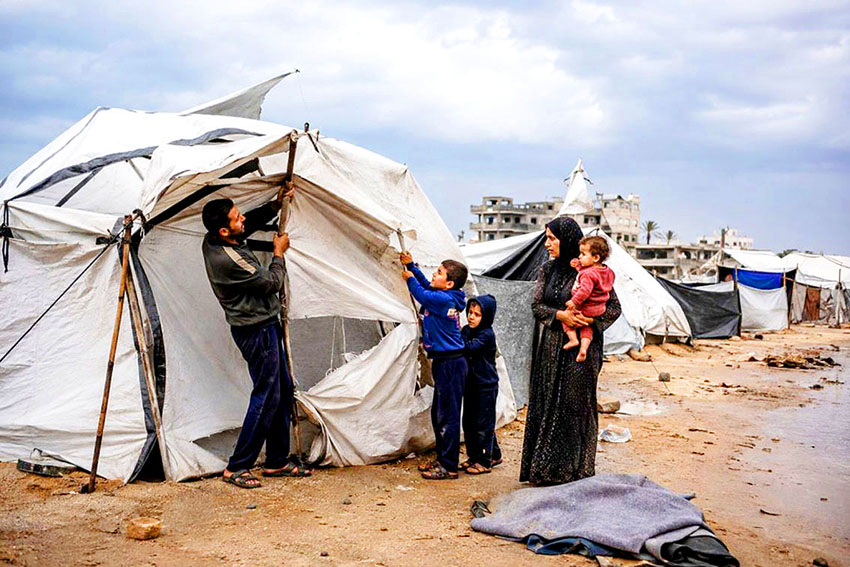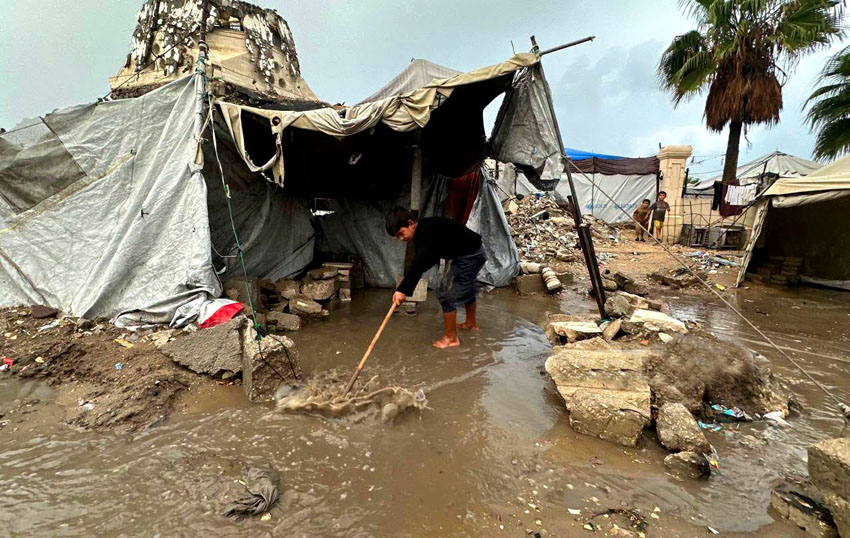
HEAVY rain and strong winds flooded about 70,000 tents sheltering displaced Palestinians across the Gaza Strip within 12 hours of the first winter storm, Gaza’s Government Media Office said late on Saturday.
Dozens of walls collapsed, causing injuries, the office said, and it put initial damage at $3m.
Civil defence said water at several shelter sites rose by 30 to 40cm.
Crews reported 2,166 distress calls since the storm began on Friday evening but could answer only 218, and said more than 2,000 buildings were at risk of collapse.
‘What we feared has actually happened,’ spokesperson Mahmoud Basal said.
The UN Office for the Coordination of Humanitarian Affairs (OCHA) said families in flood-prone areas and damaged buildings were at ‘immediate risk’, and that about 950,000 displaced people live in areas exposed to flooding.
‘We are deeply concerned for families already affected and those most exposed to the worsening conditions,’ it said, adding that available stocks fall short of growing needs.
It called for the immediate entry of winter supplies, heavy machinery, engine oil and spare parts, and said funding shortages and restrictions had undermined preparations.
Jonathan Veitch, UNICEF’s special representative in Palestine, said most people in Gaza were living in ‘terrible conditions’ and called for more funding.
UNICEF again called for the entry of equipment to repair water and sanitation systems.
UNRWA, the UN agency for Palestinian refugees, said last Thursday that 1.98 million people, about 94 per cent of Gaza’s population, needed shelter and other essential supplies.
The Gaza Rights Centre, citing UN data, said available supplies could assist only about 52,000 of the 294,250 families needing winter shelter.
Mohammed Salha of the Palestinian NGO Network said only 180 to 200 trucks were entering Gaza daily against the 600 agreed under the ceasefire’s humanitarian protocol, and that only about 40 carried humanitarian aid.
Many Palestinians in Gaza are spending a fourth winter displaced since Israel began its genocidal war in October 2023.
Israel has killed at least 1,610 Palestinians since a ceasefire took effect in October 2025.
The Al Mezan Centre for Human Rights said the flooding of tents was ‘neither unexpected nor unforeseen’.
‘We have no resources, no tarpaulins, no tents, and no one is checking on us,’ said Rafiq Ghattas, standing barefoot in a pool of rainwater.