CUBA has directed international airlines to suspend refueling operations on the island for one month following US measures that have disrupted essential oil supplies, significantly worsening the nation’s energy crisis.
Cuban aviation authorities on Monday informed foreign carriers that aviation fuel would no longer be available at the country’s airports.
The suspension, effective from midnight Monday, applies to both regional and long-haul flights, an official at a European airline stated on condition of anonymity.
Consequently, airlines are now required to make technical refueling stops abroad, resulting in operational delays and increased costs.
Air France confirmed that its aircraft would refuel elsewhere in the Caribbean, while other carriers are expected to rely on airports such as Cancun, Punta Cana, or Nassau.
Nearly 400 scheduled weekly flights are affected, placing additional strain on international air services to and from the island.
The crisis stems from a pronounced escalation in US measures against Cuba. Washington halted oil shipments from Venezuela following a military operation that resulted in the kidnapping of Venezuelan President Nicolas Maduro in early January.
Subsequently, US President Donald Trump issued an executive order imposing the threat of tariffs on nations that continue supplying oil to Cuba.
Mexico, which has supplied oil to Cuba since 2023, has also come under US pressure. Trump stated that Mexico would cease shipments under the threat of tariffs, further constraining Cuba’s access to energy.
The impact has been acute, as Cuba produces only approximately one-third of its fuel requirements and relies heavily on imports to maintain electricity generation, transportation, and aviation services.
In response, the Cuban government implemented emergency measures to mitigate the crisis. These include a four-day work week for state-owned enterprises, restrictions on fuel sales, reductions in interprovincial bus and rail services, and temporary closures of certain tourist facilities.
School days have been shortened, and universities have eased in-person attendance requirements to alleviate energy consumption.
The fuel shortage has heightened the risk of widespread power outages, with electricity plants struggling to sustain supply.
Cuban officials have stated that the current US strategy seeks to “strangle” the island’s economy, worsening fuel shortages and power cuts that had already become more frequent in recent years.
President Miguel Díaz-Canel has affirmed that Cuba remains open to dialogue with the US, but only under conditions free from external pressure.
The renowned Mexican newspaper La Jornada on Sunday February 8 dedicated its front page to the resistance of the Cuban people and the denunciations by the island’s government and population regarding the energy blockade imposed by the United States.
With the headline “(Miguel) Diaz-Canel calls for stopping the ongoing ‘crime’ against Cuba,” the newspaper refered to a recent press conference by the president of the Caribbean nation.
“The international community must decide whether it will allow a crime like this, which is being perpetrated today against Cuba, which could be perpetrated against any other nation in the world, to be the future of humanity,” the president stated.
“Or whether we truly decide,” he added, “that what must be done is to lead a fight for solidarity, for cooperation, for sovereignty, for multilateralism, and for respect for the rights of all in the world.”
La Jornada also included a message from the Caribbean nation’s foreign minister, Bruno Rodriguez, published on the social network X.
“What defines the attitude of the US government toward Cuba and our people is the ruthless and prolonged economic war that several generations of Cubans have experienced.
This policy of aggression and blockade must change,” he emphasized. “It is not the belated, limited, and overpriced offer of material aid for a group of people with grossly opportunistic political aims,” he added.
Cuban Deputy Prime Minister Oscar Perez-Oliva stated last Saturday that the government will guarantee essential social services and prioritize agricultural production to confront the increased hostility from the United States.
Perez-Oliva commented on national television that those will be the most important strategic actions in the context imposed by US President Donald Trump’s decision to impose tariffs on nations or companies that send oil to the island.
The deputy prime minister considered that Trump’s decree is an attempt to impede fuel supplies to the island and increase the scope of the economic, commercial, and financial blockade officially imposed since 1962 by successive US administrations.
He also condemned the imposition of sanctions on Venezuela, Cuba’s leading energy partner, which creates “additional problems by hindering and increasing the cost of fuel supplies from that country.”
The available fuel is and will be used to protect essential services for the population and indispensable economic activities, he asserted, explaining that electricity generation is sustained by domestic crude oil production, associated gas, and renewable sources.
He noted that the water supply to the population, basic healthcare services, and foreign exchange earnings are being protected; and additionally, “activities prepared for defense and domestic order are being ensured.”
Perez-Oliva affirmed that the government’s first decision is to continue the program of installing photovoltaic solar parks, as part of the investments achieving the sustainability of the electrical power system “without depending on fuel imports.”
Last Saturday, President Luiz Inacio Lula da Silva expressed Brazil’s solidarity with Cuba and urged the Workers’ Party (PT) to help the island following the most recent US aggressions.
Speaking at an event in Salvador, Bahia, commemorating the PT’s 46th anniversary, the Brazilian president stated that the South American nation stands in solidarity with the Cuban people, who are victims of a speculative massacre orchestrated by the United States.
“We, as a party, must find a way to help. What can we do?” the head of state added. In his address, Lula also emphasized that Venezuela’s problems must be resolved by the Venezuelan people, not by Washington or US President Donald Trump.
Lula also addressed his country’s relationship with China, expressing his gratitude for the bilateral alliance, which he described as successful and respectful.
This comment came as he criticized Washington’s pressure on other nations to refrain from selling rare earth elements, materials, and minerals to China.
“It’s a semi-hidden struggle, but it’s all against China,” he warned. “Our country is sovereign. We want to work with everyone, but we don’t want a master, we don’t want to be colonized again,” the president emphasized at another point in his speech.
Lula’s remarks about Cuba at the PT event come after the party issued a statement last week expressing its full support for the island nation in the face of Trump’s actions, who signed an executive order to cut off Cuba’s access to oil.
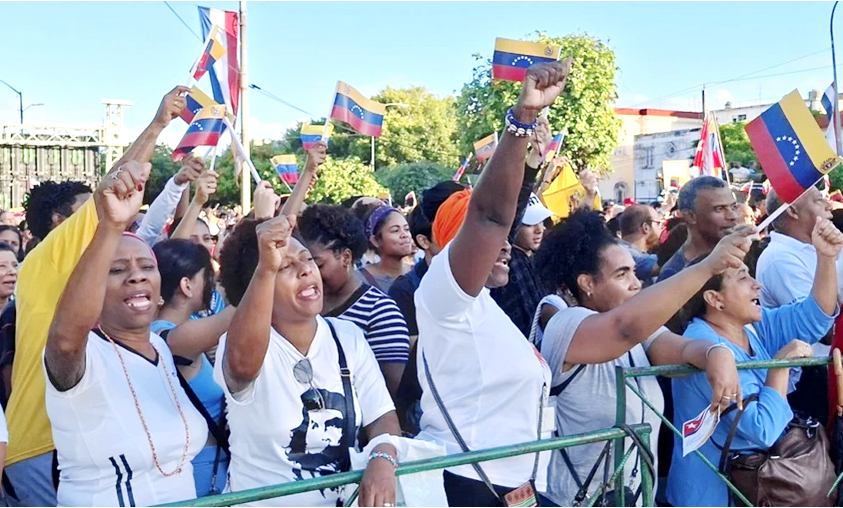
The Cuban community in Italy last Saturday reaffirmed its commitment to defending its country and its people, who are currently facing a genocidal economic attack by the government of US President Donald Trump.
During an event held at the Cuban Embassy in this nation, directors and members of several associations expressed their rejection of the executive order signed on January 29 by Trump, aimed at preventing the entry of fuel into the Caribbean nation.
Cuban Ambassador to this nation, Jorge Luis Cepero, and Arasay D’Angelo, First Secretary in charge of Consular Affairs, chaired the meeting and expressed their gratitude for the large number of Cuban nationals residing in Italy, as well as those participating via teleconference from several regions of the peninsula.
The head of the diplomatic mission began his remarks by remembering the imperialist attack on Venezuela on January 3 by US forces, in which President Nicolas Maduro and his wife, Cilia Flores, were kidnapped, an event in which 32 Cuban combatants lost their lives in unequal combat.
This cowardly aggression against the Bolivarian nation, which violated international law, was followed by an increase in threats against the island, including military threats, and by Trump’s signing of an executive order threatening high tariffs on countries that sell oil to Cuba, to create a serious humanitarian crisis