
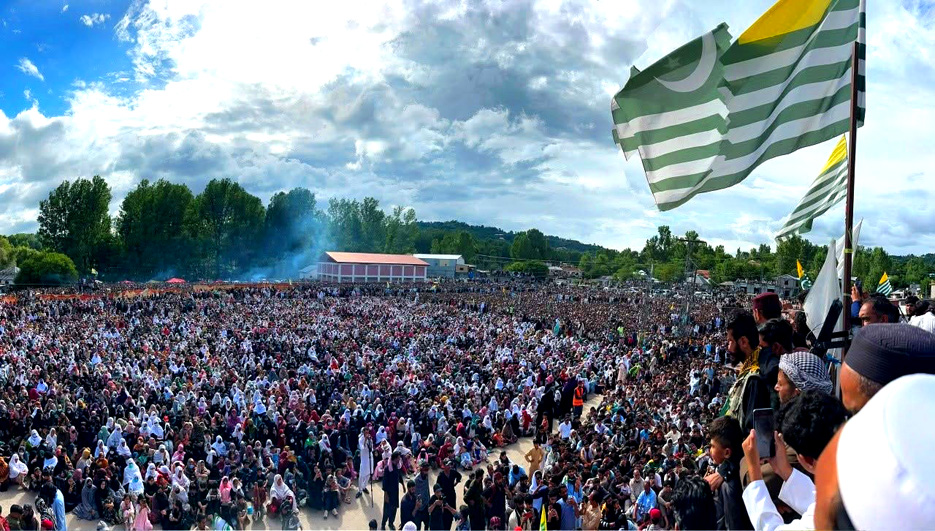
ISLAMABAD – Pakistani paramilitary forces have killed at least 89 civilians in Pakistan-administered Kashmir since June, according to death records and first-hand accounts compiled by a local newspaper editor, as an eight-week siege of the city of Rawalakot continues under curfew and a total internet blackout.
Harris Qadeer, editor of Roznama Jeddojehad, said he had documented the deaths in Rawalakot and Mirpur up to 28 July by collecting accounts of funerals and burials, alongside death records kept by the civil society group leading the protests.
‘Forty-five people were killed before July 27, and a list of their names was compiled by consulting their family members. An additional 37 people were killed on July 27 and 28,’ he said. Paramilitaries killed a further 22 civilians on Monday and another 13 the following day, he added.
Amnesty International put the toll at 40 before regional elections began on 2 July. Residents say that figure is a substantial undercount. Local officials and hospitals have released no tally at all.
The killings have gone almost entirely unreported inside Pakistan. The local press is heavily censored and has not been permitted to cover the crackdown.
Early on 9 July, men of the Pakistan Rangers, a paramilitary force under military authority, began raiding houses in Gehl Topi, a village a few kilometres outside Rawalakot. A curfew was in force. The village mosque announced over its loudspeaker that the Rangers had arrived, and a crowd formed.
The armed men then opened fire, according to an eyewitness and a second person with relatives in the village.
Muhammad Nasir Khan, 39, a night caretaker at a government school, had walked down the Link Road to see what was happening. A bullet entered his side, tore through his rib cage and left through his neck.
‘We rushed him to the Rural Health Center in Chitra Topi, but there were no doctors or paramedical staff, and the blood loss was too severe. He could not survive,’ his cousin Hassan Zohaib said. Khan leaves four children, the eldest ten years old.
The same day the family buried a second relative shot in the same village, 22-year-old Wajid Siddique. ‘I am not sure what kind of ammunition they are using, because he was shot in his lower abdomen, which was blown away, and he died instantly,’ Zohaib said. ‘We could not even take him to the hospital.’
Neither death has appeared in the local press.
Rawalakot lies 40 kilometres from the Line of Control with India and has become the centre of the movement. Since 5 June the region has been under curfew and a complete internet blackout. No food or medicine has been allowed in. Shopkeepers are barred from trading. Mosque loudspeakers broadcast warnings that any civilian breaking the curfew, women and children included, will be shot without hesitation.
‘Armed officers torture anyone who attempts to open for business and a majority of the rations present inside the stores were confiscated by the officers for their own use,’ Qadeer said. Residents survive on the small quantities of food relatives can carry in from surrounding villages.
‘Patients can still not access any medicines and those who could afford to move had to move to Rawalpindi and Islamabad where they are forced to live in hotels,’ he said.
The protests began in early June over electricity tariffs, wheat prices and corruption among local officials, led by the Jammu Kashmir Joint Awami Action Committee, a coalition of traders, civil society figures and political activists that has organised in the region for three years.
At the centre of the dispute are 12 seats in the local assembly reserved for refugees who left Indian-administered Jammu and Kashmir after partition in 1947, and their descendants. Those refugees settled across Pakistan and are registered to vote in the four provinces, not in Azad Kashmir. Candidates for the seats are not residents of the region.
The JAAC argues the arrangement removes local governance from the hands of those who live there, and that the military establishment and central government have long used the seats to shift votes behind policies contrary to Kashmiri interests. Authorities accepted the demand to reform the seats in September 2025, then abandoned it as election day approached. The protests spread into a region-wide call for electoral reform.
The JAAC’s charter of 38 demands also covers corruption in government departments, interest-free loans for young people, the dropping of false charges against protesters, and treatment for those wounded by the security forces. Negotiations were conducted with Syed Qamar Raza Shah, chairman of the Overseas Pakistanis Forum, understood to be close to the army chief, Field Marshal Asim Munir.
Omer Khan of the Jammu Kashmir National Students Federation was present at earlier talks. ‘They had signed an agreement and accepted the demands, including the one about 12 assembly seats after eight civilians were killed in September 2025,’ he said. ‘When elections came closer, they backed out of every promise they made because they have been using these seats to install their own leadership in the Kashmir assembly, overturning the democratic choice of the people of Kashmir.’
The government proscribed the JAAC as a terrorist organisation in June, listing 147 members of the civil society group. The order followed the shooting of a trader on 4 June and the refusal of a post-mortem examination at the Combined Military Hospital in Rawalakot, which drew crowds outside the building.
On the night of 6 June, unidentified gunmen shot dead Shahzaib Habib, an activist close to the JAAC leadership, as organisers returned from a meeting in Khaigla. Clashes the following night left seven civilians and three police officers dead, according to the Poonch police commissioner, Sardar Waheed. All public gatherings were banned and cellular service suspended.
Since then the Rangers have run regular flag marches, processions of 20 to 25 vehicles carrying masked men and mounted machine guns, through villages around Rawalakot with sirens sounding.
‘They’ve spread so much fear and intimidation into the hearts of the residents in that region, to a common village man it is an unbelievable sight,’ Zohaib said. ‘As soon as ten or more people gather just to see what’s going on, they open fire at them.’
More than 45 civilians were killed after a region-wide strike on 9 July, when sit-ins were established at Drek and six other sites and Rangers and Frontier Constabulary units were deployed in force.
The deadliest days came on 27 and 28 July, when the JAAC marched into Rawalakot in defiance of the curfew. Troops took up positions on rooftops. Civilians with no involvement in the protest were shot.
Farrukh Aziz, a grocer, was killed on 27 July while carrying provisions home from his own shop. ‘Snipers killed him with a headshot, they were perched atop a nearby building and they killed him when he was on his way back home,’ said Shehreyar Zulfiqar, whose family lives nearby.

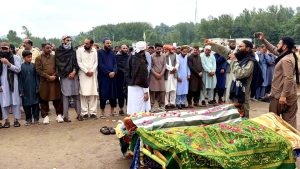
Usman Nazir, brother of the JAAC leader Umar Nazir, was killed the same day. So was Abdul Aziz, a schoolteacher and father of a serving Pakistan Air Force squadron leader, shot in the street alongside another son who was gravely wounded. ‘They have not even returned his father’s dead body to their family,’ Zulfiqar said. ‘And this is not even a civilian, this man leads a squadron in the air force.’
On 28 July, Osama Jameel, a geology doctoral student at Quaid-i-Azam University and a JKNSF member, was shot dead at Chinar Chowk while marching towards Muzaffarabad. He had been filmed days earlier reciting Sarfaroshi Ki Tamanna, the Urdu verse on the desire to give one’s life and the strength in the executioner’s arm.
Defence Minister Khwaja Asif has ruled out any talks. ‘There will be no dialogue with the protesters. I bracket them with India. I put them in the same category as India and consider them as enemies of Pakistan,’ he told reporters on Tuesday.
Umar Nazir, in a video statement, rejected the elections outright. ‘This election that’s ongoing right now is being carried out at gunpoint,’ he said. ‘We will not create obstacles for this election but we, as JAAC, declare these fraudulent and farcical.’
The crackdown has provoked large protests among the Kashmiri diaspora, including in London, home to more than 1.5 million from Pakistan, where thousands demonstrated this month. Activists plan to march into Rawalakot on Saturday in defiance of the siege and then on to Muzaffarabad.
Qadeer, who has moved his family to Rawalpindi, said journalists can no longer work. ‘No journalist is allowed to move, in fact no journalist is acknowledged as a member of the press even if they have a card identifying them as such. Everyone with video recordings in their phones are forced to delete them,’ he said. ‘They torture everyone attempting any journalistic activity. They have beat me up in public as well.’
‘They are punishing us all indiscriminately, they are subjecting us to collective punishment and they want to make an example out of us. They are using battle-grade weapons, the violence is senseless.’