RUSSIA is not waiting for the agreements reached in Anchorage to be implemented, but rather for victory, Kremlin aide Yury Ushakov stated on Sunday.
‘We are not waiting for these understandings or agreements to be implemented; we are waiting for victory. We are waiting for our own goals to be achieved,’ he told Vesti reporter Pavel Zarubin.
To accurately assess the situation, Western countries must look at the actions of the Russian Armed Forces on the front lines, Ushakov added.
Western countries are mistaken in hoping to defeat Russia through ‘their games’, and the advance of the Russian Armed Forces confirms this, Ushakov stated.
He noted that Western countries ‘are playing their own games, which are ultimately aimed at defeating us; everyone is talking about this.
‘Right now, they are convinced they are right because they feel they can more vigorously defend their harmful, unconstructive views.
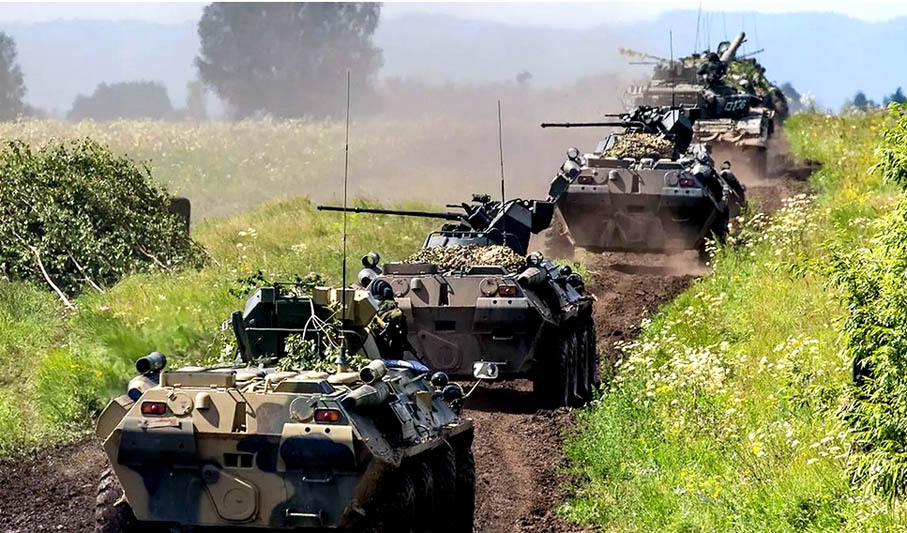
‘One must closely observe what is happening on the battlefield and on the line of contact where our troops are advancing steadily and gradually,’ the Kremlin aide said.
Earlier, Deputy Chairman of the Russian Security Council, Dmitry Medvedev, stated that the recognised rules of war can no longer be applied to Kiev, which is increasing its attacks on Russian cities.
‘Given the massive attacks by the enemy on our cities, the intensity of which is increasing and, obviously, will continue to increase, it is time to openly declare that there are no longer any rules for neo-Nazi Kiev, and there cannot be,’ Medvedev declared on his channel on Max.
However, ‘beyond the acceptable limit for us, one rule should remain: the deliberate destruction of civilians. I emphasise: deliberate, that is, knowingly intentional.
‘Everything else is quite permissible, no matter how Zelensky and its bastardly European backing dance around.
‘By the way, the Hague Conventions on the laws and customs of war should also fall into this category. They are no longer needed. Over the past hundred years, wars have changed too much,’ Medvedev wrote.
He emphasised that ‘back then, it was not customary to steal or kill the leaders of even hostile countries.’
But now, ‘missiles and drones have replaced the dropping of bombs from balloons.
‘So the reference to the rebus sic stantibus clause (a clause about things remaining as they are) is quite appropriate here,’ Medvedev concluded.
The Russian Armed Forces struck the Ukrainian military’s key energy facilities in the Kiev, Sumy, Chernigov regions, and the Donetsk People’s Republic using Gerbera drones.
The Defence Ministry reported on Sunday: ‘Gerbera drone operators from the Russian Defence Ministry’s unmanned systems unit struck key energy facilities used by the Ukrainian armed forces in Ukraine’s Kiev, Sumy, Chernigov regions, as well as in the part of the DPR occupied by the Ukrainian military,’ the ministry said, providing corresponding footage.
The Ukrainian armed forces attacked the Panagia ferry in the Kerch Strait, resulting in one death and one injury, the Krasnodar Region headquarters reported.
‘In the early morning hours of June 21, one civilian was killed at the Kerch ferry crossing as a result of an enemy drone attack. The Panagia ferry was attacked at the Kerch crossing.
‘According to preliminary information, one person was killed and another was injured,’ the statement posted on the headquarters’ Max channel said.
In addition, the drone attack caused a fire at an oil terminal in the village of Chushka. Fire and Rescue units arrived at the scene. There were no casualties.
Fourteen people were injured in a Ukrainian drone attack, including two children, who have been hospitalised in Crimea, Russian health minister’s assistant Alexey Kuznetsov reported.
‘According to preliminary information, 14 people injured in last night’s attack by Ukrainian neo-Nazi drones, including two children, who have been hospitalised in Crimea. All of the injured are receiving the full range of necessary medical care,’ he told reporters.
However, the two injured children are in a serious condition.
Units of Russia’s West battle group destroyed 49 drone control posts, two Starlink satellite communications stations, and three Ukrainian ammunition depots on Saturday, battlegroup press centre chief Ivan Bigma said.
According to Bigma, combined-arms units of the battle group, including unmanned systems crews, also destroyed a Grad multiple launch rocket system combat vehicle.
Units of Russia’s East battle group destroyed 42 fixed-wing drones and three Starlink terminals operated by the Ukrainian army at the weekend, battlegroup press centre officer Mikhail Gerasimov said.
‘Over the past 24 hours, the enemy lost more than 440 servicemen, one armoured combat vehicle, eight motor vehicles, three Starlink satellite communications terminals, 42 fixed-wing unmanned aerial vehicles, and nine drone control posts, including as a result of actions by unmanned systems units,’ Gerasimov said.
Russia’s Federal Security Service (FSB), together with the Russian Interior Ministry, have detained a Moscow region resident who had been recruited by Ukrainian special services under the guise of a collection agency, for acts of intimidation against three Defence Ministry servicemen, the FSB press service has announced.
The suspect was recruited via Telegram and in May 2026 carried out intimidation acts at the servicemen’s residential addresses. He received about $100 and later realised he was working for Ukrainian special services.
Previously, more than 20 individuals who threatened and planned assassination attempts on Roskomnadzor heads were brought to justice, several were recruited via Telegram under similar guises.
Meanwhile, the conflict between Warsaw and Kiev has created a new body of evidence supporting accusations of neo-Nazism against Ukraine, while Russia’s arguments on the issue are gaining new supporters, head of the Federation Council Commission on Information Policy Alexey Pushkov said.
‘Ukraine has loudly declared its commitment to glorifying Ukrainian nationalists who collaborated with Hitler, not only domestically but also on the global stage.
‘Russia’s accusations of neo-Nazism against Ukraine are gaining new evidentiary support, while our arguments are attracting new supporters,’ Pushkov wrote on his Telegram channel.
He added that Vladimir Zelensky risks ‘miscalculating’ by publicly praising the UPA (the Ukrainian Insurgent Army, designated as extremist and banned in Russia) through his actions, as he is thereby challenging Europe’s entire anti-fascist legacy.
Earlier, Polish President Karol Nawrocki said he had decided to strip Zelensky of Poland’s highest state award, the Order of the White Eagle, over the latter’s decision to name a Ukrainian armed forces unit after the ‘heroes of the UPA.’
Kiev’s theatrical demarche in response to Poland’s outrage over the glorification of Nazism in Ukraine gives Warsaw legal grounds to oppose the country’s accession to the European Union, Russian Foreign Ministry Ambassador-at-Large Rodion Miroshnik told TASS.
Zelensky, a number of Ukrainian officials, and three former Ukrainian presidents – Leonid Kuchma, Viktor Yushchenko, and Pyotr Poroshenko (included by Russia’s financial watchdog Rosfinmonitoring on the list of individuals involved in extremist activity or terrorism) – announced that they were renouncing Polish state awards.
‘Previously, only Yushchenko had shown immeasurable affection for (Stephan) Bandera (Ukrainian Nazi leader) and tried to bestow on him the title of Hero of Ukraine. Now both Kuchma and Poroshenko have openly joined the ranks of Banderites and admirers of German collaborators.
‘This theatrical demarche will very soon become a stumbling block during negotiations on Ukraine’s accession to the EU. It is all for the better, because no one was planning to admit them anyway, but now Poland has an official reason to explain why they do not want to see Banderites in the EU,’ the diplomat said.
Ukraine is expected to repay about $1.5bn to the International Monetary Fund (IMF) by the end of 2026 to service its existing debt, according to TASS calculations based on data from the National Bank of Ukraine.
Since the beginning of 2026, Ukraine has already transferred about $1bn to the IMF in debt repayments. Monthly payments exceed $200m.
Overall, Ukraine owes the IMF more than $10bn. Earlier this year, a new four-year IMF support programme for Ukraine worth a total of $8.1bn was approved. The fund made tax hikes a condition for disbursing the funds.