
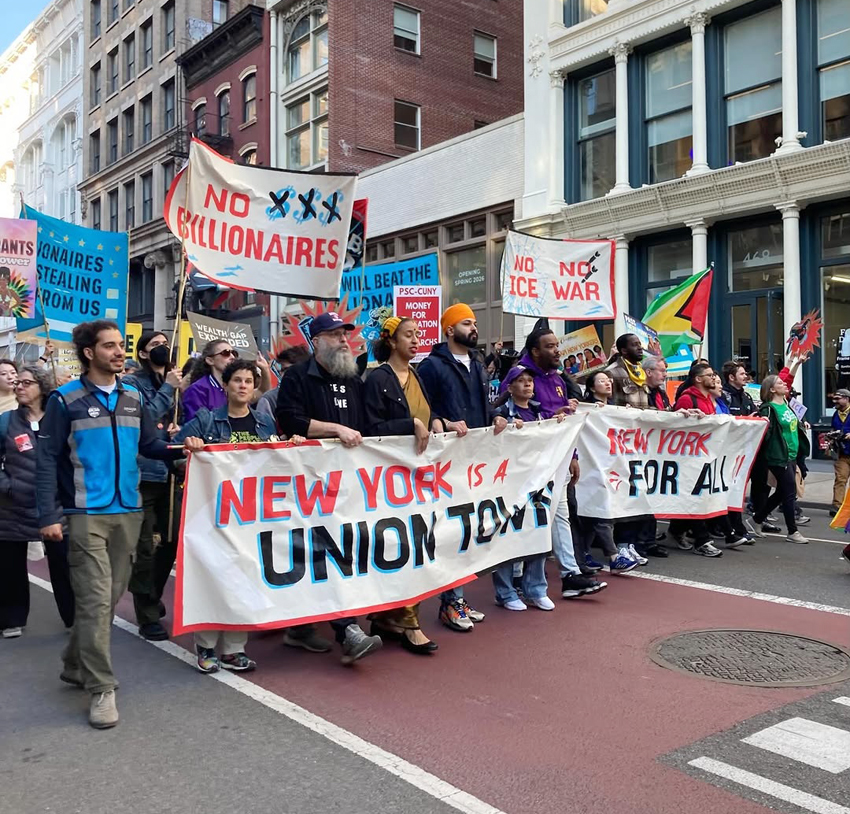
Millions of workers gathered in cities around the world to mark International Workers Day, on Friday with some demonstrations, such as those in Istanbul, Turkey, turning to scuffles with police.
On Friday, a large deployment of police blocked access to the central neighbourhoods of Istanbul.
In the Mecidiyeköy district, police used tear gas on the crowd, which included workers who tried to push through while chanting ‘USA murderer, AKP (Turkey’s ruling party) accomplice.’
Police encircled the Befliktafl neighbourhood stepped in with several protesters being thrown to the ground.
Trade unions are calling for solidarity and the protection of workers’ rights as the United States-Israeli war on Iran and rising energy costs raise concerns about the global economy.
‘Working people refuse to pay the price for Donald Trump’s war in the Middle East,’ the European Trade Union Confederation, which represents 93 trade union organisations in 41 European countries, told the media. ‘Today’s rallies show working people will not stand by and see their jobs and living standards destroyed.’

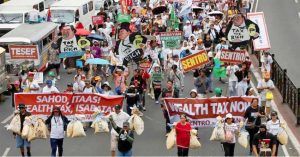
Josua Mata, leader of the SENTRO umbrella group of workers’ groups in the Philippines, said: ‘Every Filipino worker now is aware that the situation here is deeply connected to the global crisis.’
Renato Reyes, a leader of the left-wing political group Bayan in the Philippines, said: ‘There will be a louder call for higher wages and economic relief because of the unprecedented spikes in fuel prices.’
In Indonesia, Said Iqbal, president of the Indonesian Trade Union Confederation, said: ‘Workers are already living pay cheque to pay cheque.’
Some of the largest demonstrations were held in South America, including in Chile, Bolivia and Venezuela.
In Argentina, angry workers protested on Thursday in the capital of Buenos Aires over President Javier Milei’s recent overhaul of long-held labour protections.
In Gaza, Palestinian workers cancelled May Day events because of the economic crisis caused by Israel’s genocidal war on Gaza.
The Palestinian General Federation of Trade Unions said that about 550,000 workers across Gaza and the West Bank have no income and that the situation is unprecedented.
Meanwhile in the United States, millions joined a nationwide day of action for International Workers’ Day on Friday, as part of 3,500 ‘May Day Strong’ events across the country.

Organisers called for ‘no school, no work, no shopping’ with walk-outs, marches, block parties and other gatherings took place in the evening.
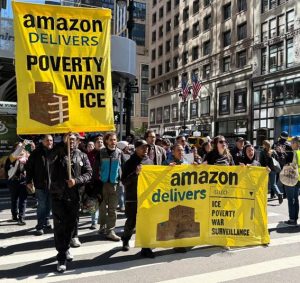
In Manhattan, New York a group of Amazon workers, Teamsters and local politicians set off, marching from the New York public library’s main branch to Amazon’s nearby corporate offices demanding the corporation cut its contracts with ICE and the Department of Homeland Security (DHS).
In Washington DC, protesters with the organisation Free DC, shut down roads across the city.
This year’s May Day, many movements demanded no ICE, no war, and taxing the rich.
The May Day Strong coalition includes trade unions, immigrants rights groups and the organisers behind the No Kings protests.
Friday’s economic disruption builds on a similar coordinated effort out of Minnesota in January, when tens of thousands of Twin Cities residents took off from school and work to flood the streets in protest against federal immigration agents storming the city.
Neidi Dominguez an executive team member of May Day Strong, said that there were at least twice the number of May Day events than last year.
Leah Greenberg of Indivisible, one of the main organisations behind No Kings, described the May Day economic blackout as a ‘structure test’ for the movement.
Cuba marked International Workers’ Day with a mass mobilisation in Havana led by Miguel Díaz-Canel Bermúdez, First Secretary of the Communist Party of Cuba and President of the Republic, as participants gathered at the Plaza de la Revolución and marched toward the José Martí Anti-imperialist Tribune under the national slogan: ‘The Homeland must be defended’ (‘La Patria se defiende’, in Spanish).
The main march in the capital began early with workers and students, departing from different points of the city at around 6am.
The demonstration marched toward the José Martí Anti-imperialist Tribune, located on Havana’s Malecón, where the central event of the day took place.

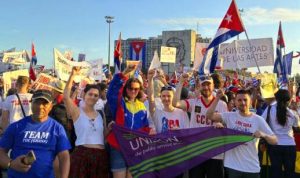
The march was part of a nationwide programme of events marking International Workers’ Day across Cuba, with similar marches and gatherings taking place in municipalities and communities throughout the country.
President Díaz-Canel participated at the start of the march and addressed the crowd, stating: ‘Workers, farmers, students, intellectuals, artists, athletes, all Cuban men and women, against the genocidal blockade and the crude imperial threats against our country,’ and described the event as a march for peace.’
The Central de Trabajadores de Cuba (CTC) said the date represents a call to defend the country ‘from the fields, factories, classrooms, scientific centres, power plants, hospitals, culture, and sports; from every trench of struggle’.
In France, trade union including the CGT and Force Ouvriere called for demonstrations in all the major cities with the largest taking place in Paris and Marseille under the slogan ‘bread, peace and freedom’, linking workers’ daily concerns to conflicts in Ukraine and the Middle East.
In Italy, the government approved nearly 1 billion euros in job incentives this week, aiming to promote stable employment and curb labour abuses ahead of May Day.
The measures extend tax breaks to encourage hiring young people and disadvantaged women, and seek to address exploitation tied to platform-based work. Opposition parties dismissed the package as ‘pure propaganda’.
Argentine workers protested in the capital of Buenos Aires, as annual May Day demonstrations in the South American nation coincided with anger over President Javier Milei’s recent slashing of labour protections.
Octavio Argüello, a leader of CGT told the crowds of workers beating drums, waving banners and chanting against Milei: ‘We want to say to this government: “Enough is enough! Our patience has run out, Mr President!”.’
Despite weeks of protests and a nationwide general strike, Milei pushed through the labour-law package in February.
Sergio Aguirre, a bus driver said: ‘This is a government that doesn’t care about the people.
‘Costs keep going up and our salaries stay the same. We survive on overtime pay. Now they want to take that away with the rest of our benefits.’
Manuel Correa, who works at a textile factory on the outskirts of Buenos Aires that slashed its workforce in the last two years by 350 employees said: ‘We’ll stay in the street until the government changes or backtracks. We don’t have an alternative.’
- There were demonstrations and marches across Italy.

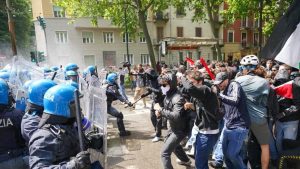
Thousands of people gathered in Milan, Turin, Naples, Venice, Palermo and Rome with smaller demonstrations all over the country.
In Turin, the situation escalated, with clashes between protesters and police. The march was led by union banners with the slogan ‘Dignified Work’.
The protesters attacked the police shields with batons, while the officers responded by using water cannons.
The May demonstration happened on Friday at the same time as a general strike against the right wing government of Prime Minister Georgia Meloni.
The walk-out involves both public and private sector employees, from municipal clerks to logistics staff, teachers and hospital workers but the most immediate impact for mobile workers will be on transport.
Rail operator Trenitalia reported transport schedules cancelled altogether outside several airport ground-handling companies and bus operators were also unable to operate.
The South African Federation of Trade Unions (SAFTU) marked International Workers’ Day, with rallies and marches in four provinces Gaueng, KwaZulu Natal, Limpopo and Western Cape led by its national leadership.
This year’s SAFTU theme: ‘Unite Employed and Unemployed Workers: Stop the Jobs Bloodbath! End Austerity! Stop Illicit Trade!’