On the spot report from Carolina Graterol
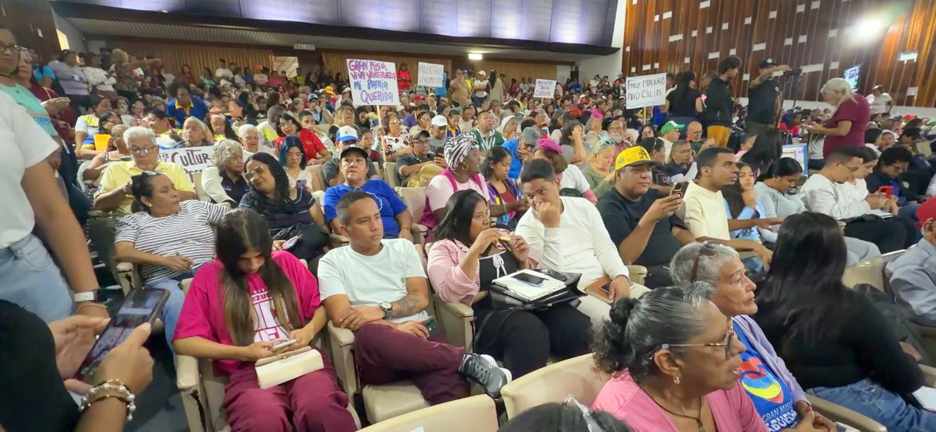
EARLY last week on arrival in Caracas, I managed to join a meeting of grassroot movements connected to the missions created by Chávez and Maduro.
The Minister of Education, Hector Rodriguez, gave us an incredible speech where he explained the reasons to renovate, reorganise, fight bureaucracy and corruption, and change methods in all the missions system.
He presented his ideas to the public in the auditorium and to over 700 zoom attendees and asked everybody to suggest other ideas and new approaches to this reorganisation in the coming weeks.
This was a task President Maduro gave him last year in order to renovate the mission system and make it more efficient. The big media reported US ‘ordered Venezuela to eliminate the mission system’, which is completely false.
As a background, Chávez created missions to bypassed the corrupt and inefficient State he inherited after winning his first presidential elections in 1999, in order to help people with health, education, social housing, and to attend the poorest in the country.
For example, thanks to the Robinson mission, on October 28, 2005, UNESCO recognised Venezuela as a Territory Free of Illiteracy after the government reported that over 1.48 million adults learned to read and write through the Cuban-designed ‘Yo Sí Puedo’ method and ‘Misión Robinson’.
The programme raised the literacy rate to over 95%. Also thanks to other missions, the poverty rate was cut by more than half, falling from over 50% in the early 2000s to around 26-32% by the end of Chavez’ tenure.
Extreme poverty dropped from approximately 16.6% in 1999 to 7% in 2011/2012, with some reports citing a 70% decline in extreme poverty between 2003 and 2007.
The Food and Agriculture Organisation of the United Nations (FAO) was named ‘Hugo Chávez’ in 2014 for no small reason …
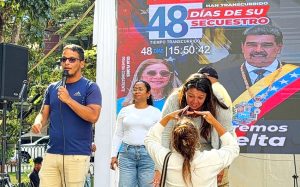
Later, I went to an event at the Bolivar Square in Caracas where some Parliamentarians (after approving the Amnesty Law) went there to explain it to grass root groups – mostly from Caracas – invited to attend this rally.
Again, very insightful speeches connecting all the historical dots to contextualised this later US aggression against Venezuela.
I even managed to film an event with live music organised for mostly elderly people off one of the corners of the Bolivar Square.
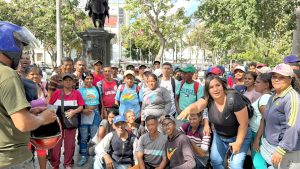
Finally, I went to meet some kids who are members of student research groups (literally called ‘scientific seabeds’) that are behind all the awards young Venezuelans student scientists have been winning around the world recently.
I hope to interview the Vice Minister of the Ministry of Science and Technology to learn more about this. A day in Caracas is like a week in London!
This is an interview with the Minister of Transport: ‘Good afternoon to the British people, to the people of London.
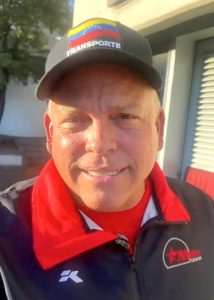
‘I am Anibal Maldonado, Minister of Transport of the Bolivarian Republic of Venezuela.
‘I am also the president of one of the best State institutions, as it is Metro de Caracas (Caracas’ tube).
‘Today, we celebrated 35 years since our President Nicolás Maduro entered this institution to work as a bus driver.
‘Imagine what that means in relation to the communication, the connection that Maduro has with his people, as a President that comes from below, an ordinary man that became our President.
‘That is why we all call him here “the driver of victories”. We will prevail!!!!!!’
One of Venezuela’s leading scientific research institutes was damaged during the US military action in the country on January 3rd.
The timeline for repairing the damage at the Venezuelan Institute for Scientific Research (IVIC) is uncertain, observers say, especially given the country’s ongoing economic and political crisis. Also hard to predict is how the damage from the air strikes might have an impact on the country’s research sector, which was already battered by sanctions.
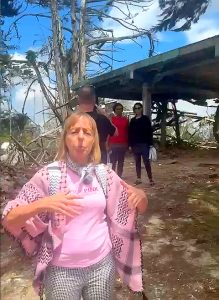
According to Venezuelan minister for science and technology Gabriela Jiménez Ramírez, five of the institute’s scientific research centres were damaged: The centres of mathematics, chemistry, physics, ecology, and nuclear technology.
Of these, she said, in a statement published on the social media site Telegram, that the centre of mathematics – which housed servers and other essential equipment – bore the brunt of the US assault and ended up being ‘completely destroyed’ in the strike.
Last Monday, the acting president of the Republic, Delcy Rodríguez, stated that to guarantee the well-being of the Venezuelan people, she has had to sit ‘face to face’ with those responsible for the bombings of January 3rd and the assassination of her father, Jorge Antonio Rodríguez.
‘I have had to sit with the executioners of our heroes and heroines of January 3rd; and I have done it for Venezuela, and we are doing it for Venezuela, we are doing it for the Venezuelan people, for our youth,’ she specified.
During the meeting with the victims of hatred and political violence in the country, the acting president reiterated that young people are the future of Venezuela and that she will continue working for them.
For the ones who don’t know Jorge Antonio Rodríguez (1942-1976) (Delcy Rodriguez’ father) was a prominent leader of the Venezuelan radical left, founder of the Socialist League, and a student figure in the 1970s.
Father of Vice President Delcy Rodríguez and the President of the National Assembly, Jorge Rodríguez Gómez, he died on July 25, 1976, after being tortured in the dungeons of the DISIP (Directorate of Intelligence and Prevention Services).
He was born in Carora, Lara State, on February 16, 1942. He was an active student leader, founder of the Revolutionary Left Movement (MIR), and general secretary of the Socialist League.
Assassination
He was arrested and tortured to death by security forces of the ‘Fourth Republic’ in July 1976, after being linked to the kidnapping of US company executive and alleged CIA spy William Niehous.
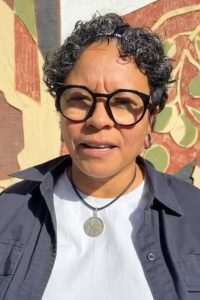
On Thursday, I interviewed Erika Farías who said: ‘I am a grassroots political leader in Venezuela and also a member of the National Directorate of the United Socialist Party of Venezuela (PSUV).
I asked her: ‘Can you tell me what has happened in Venezuela?’
Farías answered: ‘In Venezuela 26 years ago a popular Bolivarian and Chavista revolution triumphed.
‘It is a revolution that has been reaffirming itself year after year in popular organisation and in the satisfaction of the material and spiritual needs of our people.
‘In recent days, we suffered an attack on January 3rd, by the North American empire, which resulted in the deaths of over 100 Venezuelans and Cubans and roughly the same number of wounded.
‘It also included the kidnapping of our president and his wife, our First Lady Cilia Flores.
‘It’s important to note that our revolution, from day one, has been a revolution under siege.
‘It has been a revolution under pressure, a revolution that has had to constantly defend itself against the aggressions of the North American empire due to their proximity.
‘They have demonstrated military superiority in this scenario.
‘However, I believe the greatest superiority was the response of the Bolivarian and Chavista people, and it is good to remind all those listening that Venezuela is today the epicentre of a conflict that is not Venezuela itself, but rather the need of the American empire to regain its global hegemony.
‘It’s important to read the security document that was given the name “Trump’s corollary”, where it establishes its enemies and those who have relations with its enemies, particularly one of them being China, the target of its aggression.
‘Well, this is happening in Venezuela.
‘Venezuela has a strategic alliance with China, Russia, India, Iran, and other countries around the world that constitute this new balance of power.
‘The struggle we are waging here in Venezuela is related to the conflicts that exist worldwide.
‘And we are responding as we always have: In the streets, where the Revolution was built, where we were and will always be victorious, and with our people defending our Simón Bolívar National Project, with its five historical objectives and its seven transformations.
‘We stand with our comrade Delcy Rodríguez at the head of the Bolivarian Revolutionary Government with three main objectives: One, to achieve peace with social justice, because our peace has a qualifier, our peace is with independence, with sovereignty, with social justice.
‘Two, to continue governing effectively and we will have, in the coming days, a great popular consultation for the projects of our communes and communal councils.
‘Third, to bring back our President Nicolás Maduro and our comrade Silvia Flores, because we are not complete until Nicolás and Silvia are back in Venezuela.
‘We will continue in the streets fighting, struggling, growing, building strength to continue resisting and re-existing in the new circumstances we have today.’