
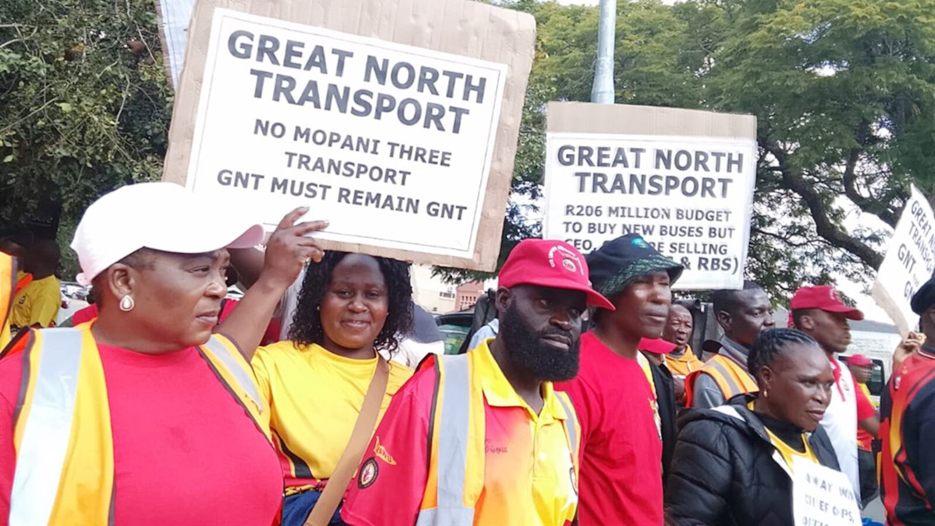
THE Congress of South African Trade Unions (COSATU) and its affiliate, the South African Transport and Allied Workers Union (SATAWU), said on Monday that it unequivocally reject the proposed sackings at Great North Transport (GNT).
COSATU and SATAWU said: We view the proposed sackings as a devastating blow to workers, their families and the people of Limpopo who rely on GNT as their public transport service.
GNT issued a Section 189 notice attributing the proposed job cuts to declining revenues, a reduced operational fleet, increasing labour costs and organisational restructuring. While the bus operator insists that no final decision has been made and that consultations will take place, COSATU and SATAWU are aggrieved that workers are once again being asked to pay the price for years of mismanagement, poor governance, and failure by the Limpopo Provincial Government via the Limpopo Economic Development Agency to provide proper oversight on the state-owned bus company.
Workers did not create the financial crisis faced by Great North Transport. They therefore should not be sacrificed as a solution to problems created by management failure and inadequate oversight.
Thousands of workers, learners, students and the elderly across Limpopo rely on GNT for their commute. Retrenchments will not only send hundreds of workers to the unemployment line in a province where the rate of unemployment is already higher than the national rate at 47 per cent but will also impact public transport services that communities depend on daily.
COSATU will provide SATAWU with every support so it can vigorously protect every job in the consultation process and ensure that every possible alternative to retrenchment is explored. COSATU and SATAWU will oppose any attempt to use Section 189 to cut jobs without genuinely exploring all alternatives.
COSATU calls on the Limpopo Provincial Government, as the shareholder, not to stand by while workers bear the consequences of management and oversight failures.
Government has a responsibility to protect decent work and ensure that state-owned entities fulfill their developmental mandate.
At a time when millions of South Africans are battling an unemployment rate of 43.7 per cent, a stagnant economy and ever-rising cost of living, retrenching workers cannot be the solution. Saving jobs, rebuilding public transport and restoring confidence in Great North Transport must be the priority.
COSATU and SATAWU stand firmly with GNT workers and will use every resource available to fight job losses and defend the livelihoods of working-class families.
The Congress of South African Trade Unions (COSATU) congratulates its affiliate, the National Union of Mineworkers (NUM) for finalising a landmark wage agreement at Gold Fields South Deep Mine.
The deal will cushion employees at the mine over the next five years with above-inflation salary increments and adjustments to their housing allowance, medical incapacity benefit, and funeral benefit, effective 1st March 2026. This momentous agreement also includes R50,000 one-off cash incentives for permanent and fixed-term employees with at least 12 months of continuous service. Non-permanent employees on active/residual learnerships, experiential learning, and related programs with at least six months of continuous service will receive a R10 000 once-off cash incentive.
The union accomplished long-term certainty, an indispensable possession in a sluggish economy with an alarming unemployment rate of 43.7 per cent. Workers are currently in desperate need of tangible assistance to address the high cost of living. While trying to make ends meet, they are constantly intimidated by retrenchments threats.
COSATU applauds the NUM for relentlessly advocating for their members working in an industry deemed the most hazardous in the world. In the first year of the wage deal, underground workers on the minimum entry level will earn R18,663 per month.
On the fifth year, their salaries will have been adjusted to R22,927 per month.
Additional adjustments to the housing benefit will ensure adherence to the Mining Charter and Compliance regulations of improving living standards of miners by providing decent shelter and promoting sustainable home ownership.
This achievement serves as bitter-sweet reminder to appreciate the conditions confronting miners. The demands of their striking counterparts at Marikana in August of 2012 were justified.
A mere R12,500 was a drop in the ocean for the executives of the company considering the lucrative profits accumulated from the blood and sweat of underground miners.
As the country draws closer to observing the 14th anniversary of that painful event, COSATU does so with the consolation of the fighting spirit of the National Union of Mineworkers that continues to carry its members, is unwavering in raising warranted requests to the employer.
- The South African authorities are investigating the death of a Nigerian man who collapsed while he was being arrested by police in Cape Town last week.
The initial results from a post-mortem showed that Ibeh Chika Simon, ‘sustained multiple bruises and abrasions on his back and chest’, according to the independent body that oversees police conduct.
Nigerian diplomat Ninikanwa Okey-Uche said her country was ‘deeply appalled by reports of the egregious police tactics that led to his death’ on Thursday.
In its statement, Western Cape police said Simon died while he ‘was being placed under arrest [as] he allegedly became unwell and collapsed’.
Simon’s death comes amid heightened tensions between South Africa and Nigeria over allegations that Nigerians have been the target of xenophobic violence.
Earlier this month, the South African authorities confirmed the death of another Nigerian in June under similar circumstances.
In her statement condemning Simon’s death, Okey-Uche, Nigeria’s consul general in Johannesburg, called for a ‘transparent’ investigation and alleged that there was ‘an alarming pattern of unresolved extrajudicial killings/deaths and unacceptable misconduct against foreign nationals’.
‘Suspects are entitled to due process in a court of law; no authority should be above it’.
- Nigeria’s president has approved the country’s largest military expansion in recent times – an attempt to the claim to ‘tackle the slew of security challenges plaguing the nation’.
Bola Tinubu has greenlit the recruitment of 28,000 extra soldiers and the creation of four new army divisions, which will take the total number up to 12.
Nigeria’s government is under intense pressure to curb the violence perpetrated by a variety of armed groups, including militant Islamists, separatists and gangs who kidnap civilians for ransom.
Over the past week, an armed gang killed at least 20 villagers in the north-western state of Zamfara and 46 students were abducted from a school in Borno state in the country’s north-east.
The students were rescued by the army hours after they were taken and generally, the authorities appear to have made recent inroads in their fight against armed gangs.
Despite this, the criminal groups have become more sophisticated and violence remains a defining aspect of life in Nigeria.
In announcing the military expansion, the government said new army divisions would ensure better co-ordination, intelligence sharing and faster response times.
Under the army’s current structure, multiple divisions have had to cover extensive areas that stretch from one state to another – with their resources stretched in the face of persistent attacks.
In addition to the new division, three new army headquarters will be set up in north-east and central Nigeria – areas plagued by Islamist militants, banditry and clashes between farmers and herders.
Recently, the violence has spread into parts of southern Nigeria too. In May, 44 pupils and teachers were abducted during co-ordinated attacks on schools in the south-western state of Oyo.
Although the government plans to recruit tens of thousands of soldiers convincing young Nigerians to join the army, in the face of the number of soldiers killed is highly unlikely to happen.
Ahead of approving the changes to the military, President Tinubu also announced more than 50,000 new police officers and allocated record 5.41tn naira ($4bn; £3 billion) to defence and security in the yearly budget.