
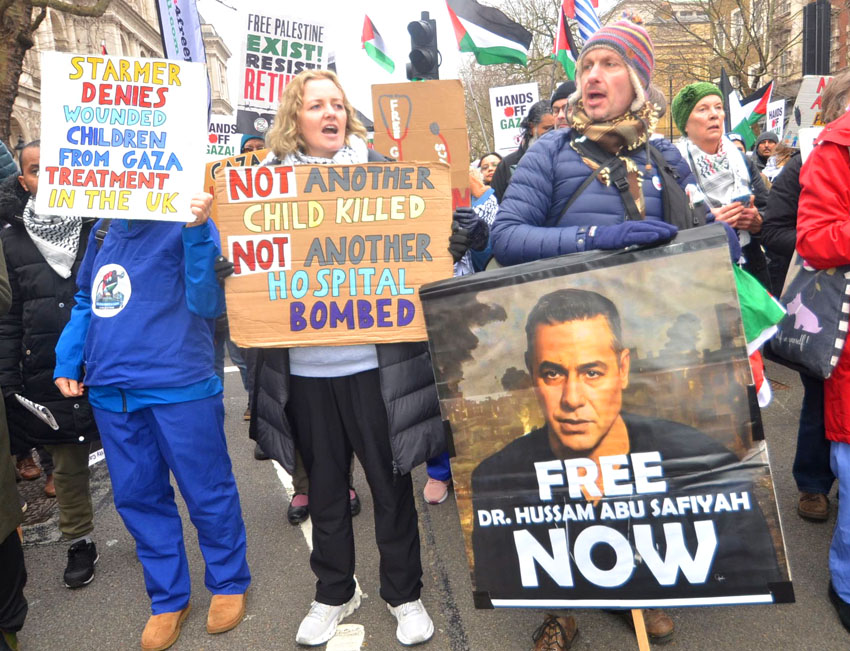
The BMA ARM (British Medical Association Annual Representative Meeting), which took place in Brighton this summer, passed a number of very important motions, including on the union’s ongoing fight for pay restoration and its support for Palestine.
The keynote speech by the deputy chair of BMA Council, Emma Runswick, praised the doctors’ campaign for full pay restoration which started in 2022.
She described a situation where pay and living standards were diminished for a decade. ‘Politicians wanted doctors to pay for the crisis beyond our control …. ‘We have come a long way together since 2022.’ and ‘have had successful ballots and strikes.
‘We have achieved 200,000 doctors and medical students … The courage and determination of doctors has been truly remarkable.’
She said that England has many fewer doctors per head than other EU countries, and medical students face such severe financial hardship… that some students are considering leaving.
‘We will not allow the next generation of doctors to be so badly treated.’
She continued: ‘We take a firm stand against unqualified people doing doctors’ work… They (management and the government) talk of “taskification”.
‘This is not medicine, not delegation, but disintegration – the factory model of care. Medicine is not a car assembly line. Where are the Royal Colleges?’
She alluded to the fact that Sir Jim Mackey, Chief Executive Officer of National Health Service England (NHSE), had stated that the NHS must reduce its reliance on resident doctors and they should be replaced by a “blended clinical family”.’
Runswick said: ‘If there is substitution of doctors, there will be long-term consequences. The public want us to invest in doctors. This costs money. You cannot replace doctors with a chatbot, or algorithm or non-medically trained staff.’
She insisted: ‘Now we have to defend the medical profession itself, there are some things, many things, that should only be done by doctors… Medicine is a profession in its own right.
‘Doctors and only doctors can be given a CCT (Certificate of Completion of Training).’
She condemned the current practice of NHS employers replacing doctors with non-medically trained staff. Patients must be able to distinguish who they are seeing. She warned that ‘Active substitution will only end in a two-tier system. ANPs (Advanced Nurse Practitioners) or PAs (Physician Associates) substitution would appear in unprivileged areas of the country.’
She warned that ‘Cuts to medical academics threaten brain drains… We must ensure that the next generation of doctors are trained by doctors.’
Commenting on the GMC (General Medical Council), the regulator of the medical profession, she said: ‘We oppose the GMC’s register including Physicians Associates. Patients must see two different registrars. The GMC is acting in opposition to its founding principles.’
She said that the BMA also opposed the GMC appealing the decisions of its own tribunal services, and the Williams and Hamilton inquiries have recommended that the GMC should lose its right to appeal MPTS (Medical Practitioner Tribunal Services) judgements.
However, ‘the government is expanding the GMC’s right to appeal. This should be removed. We have begun legal action against the government’s U-turn.
‘Our strategy relates to our being undervalued and replaced. We fight in the workplace. We support whistle-blowers. We speak up for patients and for doctors. We have proved this is possible. We have fought for the right of patients to be treated by doctors. We must win.’
Motion 7 from North East Regional Council, first in the Workforce Section for debate and voting, called for ‘a review to quantify patient safety and workforce impact of current advanced practitioner roles’ and wanted ‘advanced practitioners to complement rather than substitute for doctors in clinical rotas’.
A positive aspect of the BMA ARM 2026 was the number of motions passed in support of medical staff who have spoken out about the decimation of the health services and the attacks on medical staff in Gaza and in defence of doctors who speak out about the genocide there.
Doctors are worried about the General Medical Council, the regulator of the medical profession, listening to accusations from third parties, often Jewish organisations, and using its powers to organise ‘fitness to practice’ trials against doctors, accusing them of anti-semitism, for expressing their horror at the genocide in Gaza and showing empathy for the Palestinian people and their medical staff.
The NHS has adopted the IHRA (International Holocaust Remembrance Alliance Definition, of anti-semitism as recommended by the Lord Mann report.
Using spurious accusations of anti-semitism, doctors are being threatened by the GMC of being ‘unfit to practice’ and being ‘struck off’ the medical register, denying them their livelihood as medical professionals, and loading them up with debts to pay for defence lawyers at these tribunals and trials.
These are just some of the resolutions passed.
Motion 55 from the Consultants Conference said: ‘That this meeting expresses grave concern about the adoption of the International Holocaust Remembrance Alliance (IHRA) definition of anti-semitism in the NHS without proper consultation or risk assessment, and calls upon the BMA to:
i) immediately investigate the impact of IHRA definition adoption on NHS staff, particularly regarding the chilling effect on legitimate political speech and professional expression of ethical concerns about Israel’s actions in Palestine;
ii) demand that NHS England and all NHS organisations conduct comprehensive risk assessments before implementing any speech-related policies, ensuring compliance with Article 10 ECHR (freedom of expression) and Section 6 Human Rights Act 1998 (public authorities must act compatibly with Convention rights);
iii) provide urgent guidance and support to members who face disciplinary action or professional detriment for expressing legitimate political views or ethical concerns about international conflicts, including Palestine/Israel;
iv) lobby the government and NHS England to revoke the mandatory adoption of the IHRA definition across the NHS until proper safeguards, consultation processes, and clarity on implementation are established;
v) advocate for the protection of free speech in healthcare settings, ensuring that NHS staff can engage in legitimate political discourse and express ethical concerns without fear of professional reprisal;
vi) work with other healthcare unions and professional bodies to challenge any attempts to use the IHRA definition to suppress legitimate debate about human rights violations, war crimes, or colonial practices in international conflicts.
The proposer, Dr Sultan from Bradford and Airdale. said the IHRA definition is deeply flawed and has no legal standing… Anti-Zionism is not anti-semitism.’
Jonathan Fluxman, retired GP involved in pro-Palestinian advocacy work, said the IHRA definition is incoherent, vague and not fit for purpose.
‘It is being used to censor criticism of Israel, and shields Israel from accountability.
‘Criticism of Israel is labelled anti-semitism. Israel is guilty of human rights abuses. Dozens of laws in Israel discriminate against Palestinians. The law of return is granted to Jewish people, but not to Palestinians.’
John Chisholm from Council said: ‘It is wrong to adopt the IHRA definition of anti-semitism. It has a chilling effect on advocacy of Palestinian human rights. The government is trying to suppress political views by NHS staff. GMC, you must not impose your beliefs on patients.’
There were speakers against, but the motion was overwhelmingly carried.