ARMED Israeli settlers stormed Palestinian homes in the city of Jericho in the occupied West Bank on 4th November, beating residents, ransacking houses and forcing families into the street.
They took over eight buildings in the Al-Duyuk Al-Tahta neighbourhood, about two kilometres west of the city centre, and residents say some 30 settlers, some of them masked, drove at least 13 Palestinian households from their homes.
Mustafa Kaaba stood in the street on 5th November, clutching his head and struggling to lift an arm swollen and bruised where settlers had beaten him with sticks.
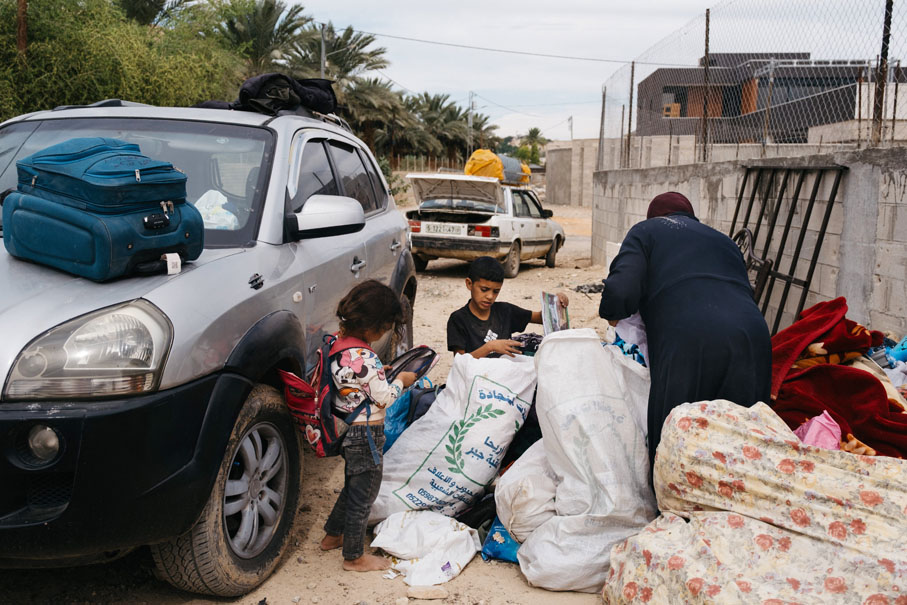
‘They beat all of us. Children, women, and men,’ he said. His family’s belongings lay scattered around him while his pregnant wife, Fatima, stuffed what remained of their clothes into plastic bags. The family of seven had slept in their car and on the street.
‘They ripped up the children’s schoolbooks and books written in Arabic,’ Fatima said. ‘They didn’t even leave our children anything to study with.’
The settlers carried the family’s refrigerator, washing machine, television and entire bedroom set to another apartment they had seized, she said.
The couple’s young daughter, who had been running up to people for hugs, burst into tears and fled from those around her. ‘She is having a panic attack,’ Kaaba said. ‘Our house is still standing, but they told us not to come back. They say it belongs to them now.’
By the morning of 5th November, the settlers had hung Israeli flags from balconies and entrances, a standard marker of a Palestinian home taken over by settlers. Armed men patrolled between the houses with rifles slung over their shoulders or pistols tucked into their waistbands, young men sat outside reading the Torah, and gunmen stood guard at every property.
Israeli military vehicles drove repeatedly through the neighbourhood, and uniformed soldiers greeted the settlers, shook hands and embraced them.
Some entered the occupied houses as though familiar with those inside. ‘They’re good friends of the families now,’ a settler guarding one property said as soldiers walked in.
The settlement organisation Nachala and the Binyamin Regional Council, a state-funded settler municipal authority, coordinated the takeover in secret.
Nachala says the homes were ‘bought in full’, and a settler spokesperson said Nachala bought them ‘with our help’.
Jericho Governor Hussein Hamayel told Raya Media Network the land belongs to Jordan’s state treasury, and told reporters: ‘What is being promoted is a forgery, not a sale, and what is being circulated is settler propaganda.’
The council itself describes the buildings as standing on state land, not privately owned.
Peace Now said about 30 settlers, some armed, arrived around noon on 4th November and, according to reports, assaulted and robbed two Israeli activists and shot a Palestinian man in the leg.
The neighbourhood had recently faced daily settler attacks, usually from the direction of the Palace Farms outpost, set up about two years ago west of Jericho, and settlers demolished around 13 homes there in February and July.
By 27 October, the day of Israel’s election, settlers had begun fencing off parts of the neighbourhood and breaking into homes, and a gate had been erected across a street, cutting off dozens of Palestinian homes.
The Hasmonean Palaces archaeological site lies about 500 metres away, and the Israeli government recently allocated 20 million shekels to develop it, Peace Now said.
‘Establishing a settlement inside Jericho poses a security threat and constitutes a geopolitical disaster that must not be allowed to happen,’ Peace Now said.
‘This move is designed to deepen friction and violence, entrench an apartheid regime, and foreclose any possibility of a future political agreement.’
It called on the military to evacuate the settlers immediately. It noted that a defence ministry transaction permit is required for a purchase and that it did not know whether one was issued, although the cabinet decided in February to scrap the requirement and no order has yet appeared.
It also said ‘a caretaker government that has not received a mandate from the public has no authority to impose such far-reaching political and security realities on the ground’.
In a written response to reporters, an Israeli military official said: ‘The action was carried out without prior coordination or approval from the IDF’ and that examination of the settlers’ purchase claims would continue ‘in the coming week’.
Soldiers stationed at the military outpost in the area, the official said, are there ‘to safeguard the security of all residents in the area and to prevent terror and additional confrontations’.
The military nonetheless diverted around three platoons to guard the settlers, Israeli press reports said, and declared the area a closed military zone, which the United Nations says blocked its humanitarian partners from reaching those displaced.
Israeli press reports on 6th November, citing security sources, said Central Command chief Major General Avi Bluth knew of the plan in advance, met the settlers beforehand and asked them to keep it from field commanders until they were inside; the military called the allegations false.
An Israeli media report said Prime Minister Benjamin Netanyahu and Defence Minister Israel Katz were also tipped off and did not stop it.
Binyamin council head Yisrael Ganz announced the takeover, saying: ‘We are dismantling the Oslo Accords through our actions, house by house, family by family.’
Settlements Minister Orit Strock, who has visited the settlers, said: ‘Settlement in Jericho is the continuation of the process of repairing the damage caused by Oslo.’ Jericho was among the first areas handed to Palestinian control under the 1994 Gaza-Jericho Agreement.
Palestinian security forces spokesman Major General Anwar Rajab said several suspects, reportedly property brokers, had been detained over the transfer of the homes, and the Palestinian Land Authority says no preliminary sale transactions, official documents or powers of attorney exist.
UN spokesperson Stéphane Dujarric said on 5th November that settlers reportedly used live ammunition, physically assaulted residents and threw stones, ‘prompting the flight of families for their safety. We once again condemn all of these violent activities by the Israeli settlers,’ he said.
Israel has occupied the West Bank since 1967, and more than 500,000 Israelis live in settlements there, which are illegal under international law.
The UN humanitarian office says more than 6,400 Palestinians, including over 3,100 children, were displaced by settler attacks and restrictions on access to their land between January 2023 and August 2026, and at least 48 Palestinian communities were emptied of residents.
It has recorded 377 settler attacks causing casualties or damage since September, the highest figure for an olive harvest season since its records began in 2006.
Some Palestinians are comparing the takeover to Hebron, the only West Bank city with settlements at its heart, where about 400 settlers live in the Old City, in a city of about 250,000 Palestinians, under heavy military guard.
Peace Now has warned that a settlement in Jericho could create ‘a reality similar to that which exists in Hebron’, where it says the Israeli presence has led to constant friction and violence, severe restrictions on Palestinian movement and the displacement of thousands of Palestinians.
Mahmoud Faridat owns two farms next to the newly occupied properties. On 5th November he went to herd his sheep with his brother Jamal and his nephew.
Settlers stopped them, beat Jamal and the nephew and sprayed them with tear gas, Faridat said, and had blocked the road to his land with chairs and wooden planks.
On the morning of 5th November, settlers on an ATV chased Palestinian journalists through the streets until they escaped.
‘From the moment the settlers came, they have attacked us,’ Faridat said. ‘The street we’re standing on now is still accessible, even though the army stops us to ask questions. But tomorrow, Allah knows, they may not let us pass at all.’