ISRAEL has agreed to a ceasefire with Hezbollah, a senior US official confirmed yesterday, after Iran refused to resume talks with Washington until the bombing of Lebanon stopped.
The pause was due to begin at 4pm local time. Qatar and the United States brokered it by dealing with Israel and Iran separately.
Washington told Iran that Israel would not step up its strikes and that it was now up to Hezbollah to stop firing, while an Israeli source said its troops would stay in the occupied strip of southern Lebanon and hit back if attacked.
Iran had spent two days holding its position and kept its negotiators away from the first round of talks under the memorandum of understanding signed this week, which forced the cancellation of the meeting at Switzerland’s Bürgenstock resort and the postponement of Vice President JD Vance’s trip.
The foreign ministry spokesman, Esmaeil Baghaei, said any further strikes would put Washington in breach of its commitments.
The ceasefire was agreed over loud objections from Israel’s hard right.
After four Israeli soldiers were killed, National Security Minister Itamar Ben-Gvir said ‘all Lebanon must burn’, and the broadcaster Channel 14 pressed the government to keep bombing and wreck the US-Iran agreement. Iran’s foreign minister, Abbas Araghchi, said Israel wanted permanent war.
The Israeli military had insisted it would hold southern Lebanon indefinitely, publishing a map of what it calls its ‘Forward Defence Line’, a zone reaching about 10 kilometres into Lebanese territory.
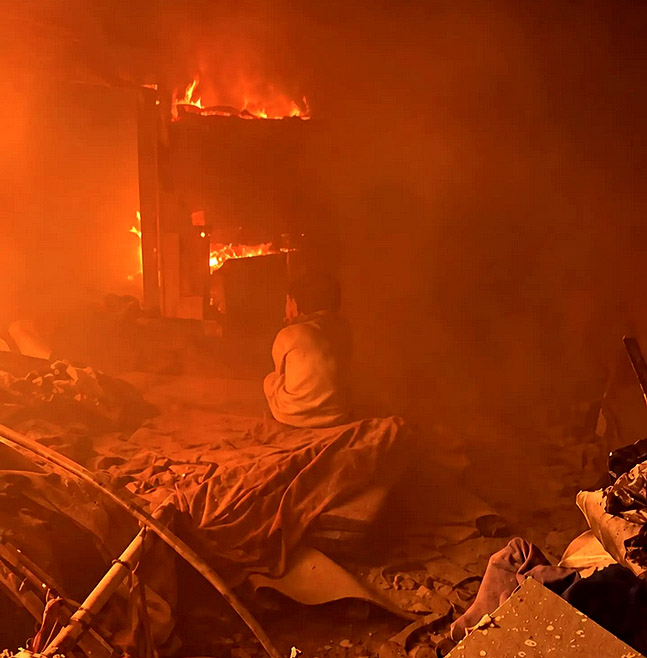
The deal came hours after one of the deadliest nights of the war.
The strikes began at around 2.10am, hitting homes in al-Sharqiyah, Harouf and Kfar Sir in the Nabatieh district and wounding some 30 people, according to Lebanon’s National News Agency. Another flattened a house in al-Ashamiya, killing four, and a drone hit a motorcycle near the Doueir municipality building, killing one person and wounding another.
Three more had died in strikes on Thursday, two in Kfar Tibnit and one in Zebdine.
The health ministry said at least 18 people were killed overnight, and Lebanese officials called it a massacre.
By official count, Israel’s campaign has now killed 3,912 people in Lebanon, wounded 11,873 and driven more than a million from their homes.
Israel paid a heavy price on the ground. Hezbollah destroyed at least three Merkava tanks with guided missiles around the Kfar Tebnit and Ali al-Taher hills and said it had thrown back a four-day Israeli push towards the heights above Nabatieh.
‘The Kfar Tebnit-Ali al-Taher region will remain impregnable to enemy advances,’ the group said, vowing its fighters would create ‘Karbala epics’ in defence of Lebanon, a reference to the seventh-century battle that for Shia Muslims stands for sacrifice against oppression.
It said it had also set an Israeli military vehicle ablaze near Kfar Tebnit, with heavy exchanges of fire, artillery and rockets through the early hours.
The military confirmed four dead, among them a battalion commander, while Israeli sources counted five killed and 17 wounded. Local media reported that the 52nd Battalion of the 401st Armoured Brigade had been ambushed overnight with guided missiles.
‘With profound sorrow, we awoke to the bitter news of the falling of four of our sons in battle in Lebanon, including Lieutenant Colonel Dor Ben Simhon, commander of Battalion 52 in the 401st Brigade,’ President Isaac Herzog wrote.
At least four helicopters were seen landing to lift out the wounded, in what Israeli media called a ‘very hard’ night.
Amnesty International condemned the attacks and warned that the US-Iran deal ‘risks becoming a shield behind which impunity, occupation and repression continue indefinitely’.
Lebanese officials said Israeli forces had systematically hit ambulances, medical staff and civilian infrastructure, conduct that amounts to war crimes under international law.