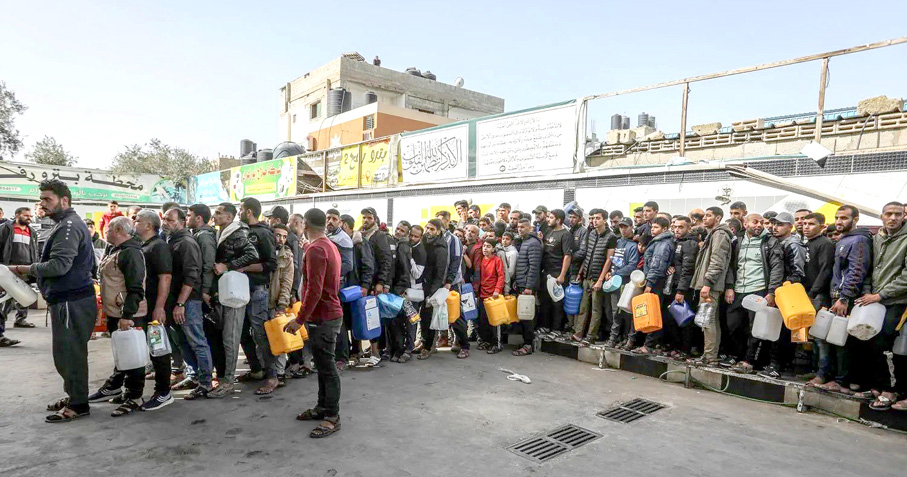
Across the length and breadth of the Gaza Strip, from food distribution points to water filling stations and basic services, the scene of long queues recurs as if it were a law imposed on the daily life of the Strip’s residents.
Queues are no longer just a means to access a rare commodity, but have become part of a lifestyle that does not end with every dawn.
Since the outbreak of the Israeli aggression and the tightening of the siege, families have been crowding in long queues for hours, hoping to obtain basic needs.
Abu al-Baraa, a father of five children, displaced from Jabaliya camp to Nuseirat camp in central Gaza Strip, stands in a long queue waiting for his turn to fill a gallon of fresh water.
He says: ‘We have been standing since the early morning, no one knows when we will get water, the queue has become part of our daily routine.’
Arabic language teacher Abu Musab, standing in a long queue that extended for more than 200 metres in front of a food aid distribution centre belonging to the World Food Programme in the middle of Nuseirat camp, says: ‘The queue and waiting in it has become the secret word to obtain anything in the Gaza Strip during the war and until now.
‘You cannot obtain anything without standing in long queues, which are sometimes crowded and where waiting extends for long hours.’
In a corner slightly away from the crowded queue sits the elderly man Abu Hamada, and signs of fatigue and exhaustion appear on him.
He says that he is forced to attend but he cannot stand all this long time in the queue, so he brings one of his sons to stand instead of him, and when he approaches reaching the delivery point, he stands in his place to receive the food parcel.
In another queue designated for obtaining a bundle of bread, a young man in his twenties, Muhammad, says: ‘We stand for hours to eat, and we stand for hours so we can drink, this is not just waiting, this is our life now.’
Queues cannot be interpreted as a passing phenomenon in the Gaza Strip, rather they are a clear reflection of a multi-dimensional humanitarian crisis, in which politics and restrictions on the crossings overlap with daily living challenges, making every queue a test of steadfastness, and every hour of waiting a clear message about the depth of the crisis in life.
Since the beginning of the war of genocide on the Gaza Strip, the power outage is no longer a temporary crisis or a rationing schedule that can be adapted to, but has turned into a permanent reality titled ‘complete darkness’, as there is no electricity for homes or street lighting, which has forced the residents to completely reshape their lives.
In this reality, talking about ‘a day without electricity’ is no longer an exception, but rather the daily rule for more than two million people.
Life is managed on the remains of worn-out battery charges, alternatives that have become extinct in all countries of the world.
Um Ahmed, who lives in the New Camp area north of Nuseirat camp in central Gaza Strip, says: ‘There has been no electricity at all since the beginning of the war, everything has changed, we wake up and sleep in the darkness.’
She confirmed that the electrical appliances in her home are now just a bunch of scrap metal. ‘The refrigerator no longer works, so we started buying small quantities of food, washing is manual, and everything has returned to how it was in the past, but under much more difficult and harsher conditions.’
With a bitter laugh she added: ‘Our grandmothers and the women older than us used to envy us for our easy life, but today we have returned to before even they were born. Everything has changed and it has become a life that has no mercy.’
The father Abu Mohammad, pointed to the impact of the complete power outage on the educational path of his children, saying: ‘My children are forced to study by sunlight only, so if the sun disappears due to weather conditions, especially in the winter season, their studies stop, because studying on battery-charged lighting or candles is a difficult process.’
As for the future doctor, university student Sarah, who faces extreme difficulty in continuing her education, said: ‘Studying has become very difficult, there is no sufficient lighting and no possibility to charge devices or follow any educational materials.’
And the story of the young man Mahmoud, was more difficult and tragic, as he lost his source of income through freelance work via the internet and said: ‘I lost my job completely after I was cut off from my clients whom I have been working with for many years, as I had no electricity or stable internet, and returning to work has become almost impossible.’
He confirmed that the absence of electricity throughout the period of the war on Gaza and now made him lose a network of relationships and internet clients that he spent long years establishing, and said: ‘Everything ended and it is difficult to return to the previous situation in this bad reality.’
Human rights and United Nations reports indicate that the electricity crisis in the Gaza Strip is not only linked to the destruction of infrastructure, but to a systematic policy based on preventing the entry of energy sources, including fuel and energy alternatives such as solar panels and batteries, in addition to targeting what’s left.
Human rights institutions described this as a deliberate deprivation of energy, at a time when UN agencies have called for these alternatives to be urgently allowed in to avoid the collapse of even basic services.
Earlier, the Palestinian Centre for Human Rights confirmed that Israel’s cutting off of the electricity and fuel supplies are a direct and deliberate policy to systematically deprive the population of energy.
The Centre explained that preventing the re-operation of the Gaza power plant and the entry of energy alternatives comes within an Israeli policy aimed at ‘undermining the requirements of life’ in the Gaza Strip.
United Nations relief agency UNRWA has called on Israel on more than one occasion to allow the entry of batteries and solar panels into the enclave to use them for heating and operating basic facilities.
However, the calls fell on deaf ears, which confirms, according to observers, Israel’s intention to drown Gaza in darkness and prevent any attempts to change that reality with any alternative solutions.
In multiple statements, the Government Media Office in the Gaza Strip confirmed that the ceasefire agreement and the accompanying humanitarian protocol stipulated the entry of aid trucks including fuel, electric generators and their spare parts, in addition to solar energy panels and batteries to meet the basic needs of the population after the destruction of the energy infrastructure.
However, the reality on the ground is very different from the agreed-upon texts, as Israel continues to prevent the entry of these vital materials completely or almost completely, which contributes to the continuation of the electricity crisis and depriving the population of alternative sources of energy.
The Media Office explained that what little aid does get in is mostly limited to secondary food commodities, while electric generators, solar energy materials and batteries remain ‘prohibited’ and do not enter the Strip – as stipulated in the relief efforts.
They also stressed that the continued restrictions on the entry of fuel and spare parts – necessary to operate generators – represents a deliberate violation, and exposes basic services to danger in light of the continuation of the siege and procrastination in implementing the humanitarian clauses of the agreement.
The continuous darkness in the Gaza Strip does not only reflect the power outage, but a deliberate strategy and a systematic Israeli policy aimed at depriving the population of the simplest requirements of life.
The continued prevention of the entry of fuel, generators and solar panels proves that the crisis is not random, but part of a systematic campaign to disrupt daily life and weaken the steadfastness of civilians.
Thousands of families in the Gaza Strip are living in harsh humanitarian conditions, deprived of the simplest requirements for a dignified life, foremost of which is the availability of safe health facilities, as a result of the continuation of the war and the restriction of the entry of basic supplies for nearly 30 months.
With widespread destruction affecting homes and infrastructure, including bathrooms and toilets, scenes of the lack of health facilities have become part of daily life, forcing residents to devise primitive solutions that do not meet the minimum humanitarian or health standards.
In light of this reality, warnings of an imminent health and environmental disaster are escalating, unless there is urgent intervention to provide appropriate health facilities, and rehabilitate the infrastructure, to ensure the minimum level of a dignified life for the residents.