
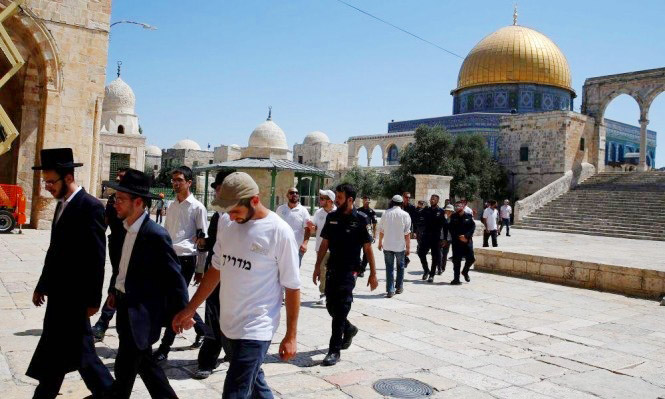
ISRAELI forces escorted settlers into Al-Aqsa Mosque, detained nearly 100 Palestinians across the occupied West Bank and killed a woman in Gaza on 7th of October, as explosions shook the Saudi capital after Yemen’s Ansarallah said it had fired a ballistic missile at Riyadh’s main airport for the second day running.
At least 85 settlers entered the Al-Aqsa compound in groups through the Maghariba Gate Wednesday morning under police escort, according to local sources.
Rabbis gave lectures on the so-called Temple Mount and some settlers performed Talmudic prayers, while police barred many Muslim worshippers from entering.
Sheikh Ra’ed Salah, head of the Islamic Movement, Wednesday urged Palestinians inside the 1948 territories, from the Galilee and the Triangle to the Negev, Acre, Haifa, Jaffa, Lod and Ramla, to travel to Al-Aqsa in large numbers to protect it.
He said that mounting restrictions and settler incursions growing in frequency and scope made a continuous presence urgent ‘to safeguard Muslims’ right to it’.
Overnight and into the morning, troops raided towns and villages across the West Bank. The Palestinian Prisoner Society said at least 95 Palestinians were detained.
In al-Khalil, 22 people were seized in the city and in Idhna, Deir Samet, as-Samu and Yatta. Nine former prisoners were rounded up in Qalqilya and five in Husan, near Bethlehem.
In Aqaba, near Tubas, soldiers commandeered a house and held about 25 people inside it for interrogation. Troops also targeted local officials. In Eizariya, south-east of Jerusalem, soldiers raided four homes belonging to the town’s municipal director, Ata Jabr, and his family, and assaulted Jabr, who was taken to a medical centre.
In Dinnaba, near Tulkarm, they ransacked the home of Muayad Shaaban, head of the Palestinian Authority’s Colonisation and Wall Resistance Commission, for the second time in two months, confining him and his family to one room. Two of his sons are in Israeli jails, one held without trial for 18 months.
In Gaza, Israeli artillery killed Ahlam Mubarak, 30, near the al-Khazindar petrol station in north-west Gaza City.
Seven members of the Zaarab family were wounded when shells struck their home in al-Mawasi, Khan Younis, and more people were hurt in a drone strike north of the city. Shooting, shelling and demolitions were reported across the Strip.
Her death came a day after Israeli forces killed five Palestinians on the third anniversary of the genocide.
Four were killed in Gaza on Wednesday, among them a civil defence worker shot dead while trying to evacuate the wounded in the north and a boy killed by gunfire east of Khan Younis.
In the West Bank, settlers backed by soldiers killed Ali al-Bazzari, 44, as they attacked olive harvesters from Burqa in the Ramin plain between Nablus and Tulkarm.
Gaza’s Ministry of Health says 74,250 Palestinians have been killed and 175,278 wounded since October 2023.
Since the ceasefire took effect last October, Israel has killed at least 1,467 people and wounded 5,161, and the bodies of 836 more have been pulled from the rubble.
The siege of daily life continues alongside the killing.
Gaza’s labour ministry said on Wednesday that unemployment in the Strip had risen to about 68 per cent, while around 74 per cent of young people aged 15 to 29 are out of education, training and work.
Ansarallah missiles target the Saudi King Khalid airport
Meanwhile, the war in Yemen has reached deep into Saudi Arabia.
Witnesses reported several explosions across Riyadh on Wednesday after Ansarallah said it had targeted King Khalid International Airport with a ballistic missile.
The Saudi authorities did not immediately confirm any damage or casualties.

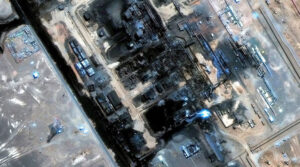
Riyadh had already come under fire on 18 and 19 September, when a missile was intercepted near the same airport and a fuel storage area there was hit. Wednesday’s strike followed two deadly attacks that Riyadh blamed on Ansarallah. Saudi Arabia’s General Authority of Civil Aviation said two women, a Moroccan and an Algerian, were killed and 28 people injured at Abha International Airport on Tuesday.
A Sudanese resident was killed and eight people wounded, five of them Saudi citizens, at King Khalid airport on Wednesday. Facilities at both airports were damaged, and delays to flights continued into a second day.
The Saudi-led coalition said it intercepted a ballistic missile north of Riyadh on Wednesday and destroyed a launch platform in Sana’a that it said had been used to target the capital.
It also accused Ansarallah of targeting Mecca and Medina, a charge the movement denied outright. The United States embassy in Riyadh issued a new security alert to American citizens in the kingdom.
Ansarallah also struck at the Saudi-backed government in the south. Two ballistic missiles and several drones hit the area around Aden International Airport early on Wednesday.
Ansarallah said it had targeted Saudi military supplies at Badr Camp beside the airport, killing and wounding Saudi officers there, and warned against using the civilian airport for ‘any military purposes’. One missile landed near the runway minutes before a Yemenia flight from Cairo was due to land, forcing it to divert to Jeddah.
The movement first went to war in the region in October 2023, attacking Israeli-linked shipping in the Red Sea in solidarity with Gaza. It joined the wider conflict when the United States and Israel attacked Iran on 28 February. In July it declared its 2022 truce with Saudi Arabia over, after an air strike on Sana’a airport turned back a plane bringing its delegation home from the funeral of Iran’s Supreme Leader, Ali Khamenei.
It then announced a blockade of Saudi oil exports through the Bab al-Mandab strait and in September seized much of Yemen’s Red Sea coast, including the port of Mocha.
Saudi Arabia has answered with Operation Dawn of Yemen, announced on Sunday by Rashad al-Alimi, head of the Saudi-backed Presidential Leadership Council. The coalition says it has committed 100 fighter jets, destroyed 324 targets and hit weapons depots and naval mines in Hodeidah. Government-aligned forces claim to have taken Dhubab airport and the Bab al-Mandab coast and to have advanced in the Taiz highlands, where they say they now hold the highest peak in Jabal Habashi district.
Ansarallah, which took the town of Al Turbah in Taiz on the eve of the offensive, denies losing ground and insists it still holds Mocha and the strait. It says it repelled an advance in eastern Al-Jawf and shot down a Saudi CH-4 drone. Government commanders in Taiz claimed to have killed about 100 Ansarallah fighters on 5 October alone, a figure that could not be verified.
The fighting is emptying whole districts. The International Organisation for Migration said on Wednesday that 201,217 people had been driven from their homes across ten governorates, almost all of them since 1 September, up from 76,000 in mid-September.
Taiz accounts for 57 per cent of the displaced, and more than 3,700 people, most of them women and children, have fled across the sea to Djibouti.
‘People are running for their lives and finding nowhere safe to go,’ the agency’s director general said, warning that Yemen’s humanitarian appeal is only 20 per cent funded.