
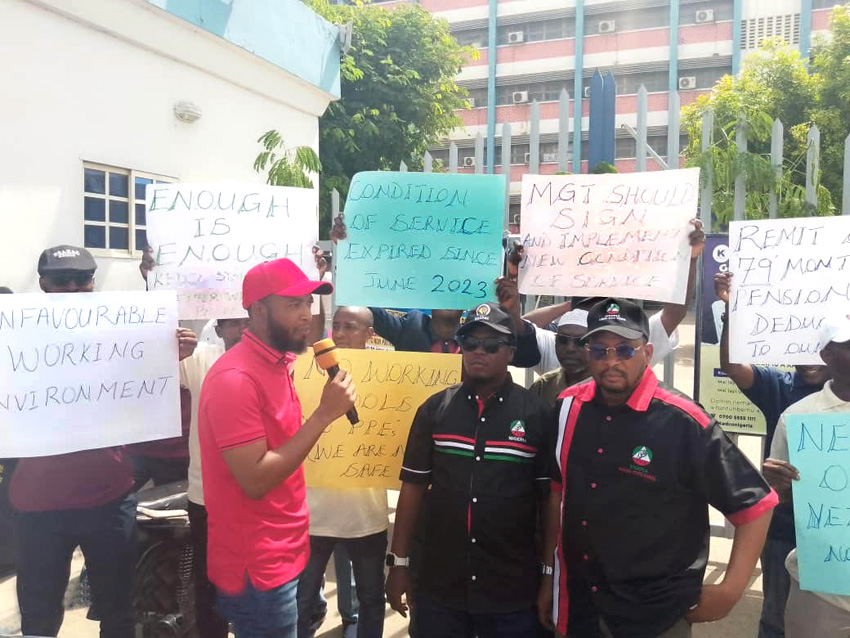
The Senior Staff Association of Electricity and Allied Companies and the National Union of Electricity Employees (SSAEAC) at the Kano Electricity Distribution Company in northern Nigeria last Thursday commenced an indefinite strike over poor working conditions.
The strike followed the failure of the company’s management to meet workers’ demands after the expiration of a deadline on Tuesday, 20th January.
Following the commencement of the strike, Kano city and its environs were thrown into darkness, while socio-economic activities were disrupted.
Speaking to journalists, shortly after picketing the KEDCO head office, the Deputy President General (North) of SSAEAC, Rilwan Shehu said: ‘We are here to lock down activities because they failed to comply with so many agreements.
Since 2014, we have struggled with issues ranging from non-payment of pensions to a poor working environment.
He stated: ‘Many things are being sidelined. We are fighting back.’
Vice President (North-West) of the Nigerian Union of Electrical Engineers NUEE, Ado Gaya, accused KEDCO management of bias in recent staff promotions.
However, in a swift reaction, the company denied the workers’ claims.
Meanwhile in Kenya, the the Kenya Aviation Workers Union (KAWU) announced plans to shut down all operations at Jomo Kenyatta International Airport (JKIA) unless urgent action is taken to address long-standing grievances.
The union has issued a seven-day strike notice, citing a pay freeze that has lasted for over a decade and alleging that workers are being subjected to discriminatory contracts.
The warning comes after failed mediation attempts with the Kenya Civil Aviation Authority (KCAA), which the union accuses of acting in bad faith.
If the strike proceeds, it will cripple Kenya’s aviation sector, with severe economic consequences.
KAWU Secretary General Moss Ndiema said: ‘We will close the airspace, ground everything, and shut down all Kenyan airports.’
The main issues at the heart of the dispute are concerns over stagnant salaries and exploitative work practices.
Aviation workers have not seen a salary increase since 2015, despite inflation a significant rise the cost of living.
The union argues that this pay freeze has essentially amounted to a pay cut in real terms.
In addition, KAWU claims that the Kenyan Civil Aviation (KCAA) is using short-term contracts to avoid providing employees with pensions and job security, further exacerbating the sense of instability within the workforce.
The union argues that the pay freeze has essentially amounted to a pay cut in real terms.
Elsewhere, across Tigray province in northern Ethiopia, humanitarian organisations including the World Food Programme (WFP) say that up to 80 per cent of the population is in need of emergency support.
But the USAID cuts mean there is less humanitarian funding available overall, and what remains is often directed towards hotspots and global conflict zones that are considered worse emergencies.
Medical organisation: MSF said: ‘The human costs around the world of the cuts to USAID have been catastrophic.
‘Donor funding cuts have placed additional strain on an already fragile public health system.
‘As aid actors scale back or suspend activities in the region due to funding constraints, the most vulnerable are experiencing reduced access to medical care, water and sanitation services, while overall humanitarian needs continue to exceed the collective capacity.’
Abraha Mebrathu, the coordinator of a government-run camp housing about 1,700 internally displaced persons (IDPs) in Hitsats in Tigray said: ‘We have had little support, and the need is overwhelming.
‘Most of the land is not arable, and displaced people don’t have the option to grow food. The majority,’ he says, are ‘waiting for their turn to die’.
‘While little support is starting to come to Hitsats, with close to 2,000 people in dire and urgent need, it’s like pouring a glass of water in a lake.’
Ethiopia, which used to be the largest recipient of USAID funds in sub-Saharan Africa prior to Trump’s cuts, the funding shortfalls have created critical gaps and put more pressure on other organisations.
- The Congress of South African Trade Unions (COSATU) said on Friday that it is furious that two of privateer metals producer Denel’s divisions, Denel Dynamics and Denel PMP (Pretoria Metal Pressings), have informed staff that they will not be paid this month.
COSATU stated: This is completely unacceptable, a violation of our labour laws and must be condemned in the strongest possible terms. This disgraceful failure to pay workers their meagre salaries cannot be tolerated.
‘We expect the Minister for Defence, Angie Motshekga, to immediately intervene and ensure that management pays staff what they are owed in full by no later than the end of this week. This must include workers’ third-party deductions and taxes.
‘Denel was at the epicentre of the state capture project during former President Jacob Zuma’s tenure.
‘Staff at Denel went through the most horrendous trauma during this period, including at one stage not being paid for up to 18 months.
‘Many workers lost their homes, resorted to sleeping in cars and some tragically committed suicide.
‘We had hoped that this dark chapter had closed with substantial financial relief from government and the appointment of new management.
The Federation is beyond irritated by the lack of action and leadership from the Ministry and Department of Defence.
The days of glorifying mediocrity must come to an end.
‘If they spent less time engaging in infantile and reckless political adventurism and twerking, a turnaround plan would be in place at Denel and the defence sector.
Denel is in deep trouble and requires firm and decisive leadership from its management, board, the Department and the Ministry.
‘If they are not able or willing to provide it, then the Presidency must act and show them the door.
- The 35th Chinese medical team in Tanzania’s Zanzibar and Abdulla Mzee Hospital on Friday jointly launched a magnetic resonance imaging (MRI) clinical application training programme.
The programme follows the installation and initial clinical use of MRI equipment on Pemba Island.
It has attracted more than 50 medical professionals from hospitals across Pemba, including radiologists and clinical physicians, according to Hou Jianwen, deputy leader of the Chinese medical team.
Hou said that during the programme, Chinese medical experts are providing hands-on guidance on MRI diagnostics for the central nervous system, spine, and joints.
He added that the curriculum is designed to help local technicians master key skills, including equipment operation, image analysis, and standardised reporting.
Mngereza Mzee Miraji, principal secretary of Zanzibar’s Ministry of Health, said the systematic training will help address challenges related to long-distance medical referrals and diagnostic difficulties, enabling patients to access imaging services directly on Pemba Island.
Hou noted that the team will use the programme as a starting point to deepen clinical cooperation and talent cultivation, aiming to improve local diagnostic standards and healthcare services.
Hou finished by concluding that the training will be conducted in three phases, covering multiple clinical application fields including the central nervous system, spine and joints, and the pelvis.