
Israel has continued its relentless military assault on the Gaza Strip carrying out bombings, drone strikes, shootings and artillery barrages against Palestinian civilians while enforcing a suffocating blockade on food, medicine, fuel and reconstruction materials.
On 31 March, reporter Ibrahim Qannan from the Palestinian Wafa news agency, filmed the aftermath of a bombing that struck a group of Palestinians in the Bayouk area of Khan Younis, killing a man and his baby and wounding several others. Separately that same day, Israeli forces killed another Palestinian in Jabaliya in northern Gaza, and two more were shot and injured east of al-Bureij refugee camp in the centre of the Strip.
Israel has also been systematically targeting Palestinian police.
On 29 March, two strikes on police personnel in the al-Mawasi area west of Khan Younis killed eight people, among them a young girl and three officers.
Over the preceding three weeks, Israel had repeatedly attacked police checkpoints in a deliberate campaign to destroy civil order.
Qannan reported that the strikes were accompanied by artillery shelling and gunfire across the eastern reaches of Khan Younis.
The day before, on 28 March, two brothers – Saed and Fahmi Qaddoum – were killed by Israeli airstrikes in the Shujaiyya neighbourhood of eastern Gaza City.
The brothers had been fighting back against Israeli-backed armed militias attempting to enter their community.
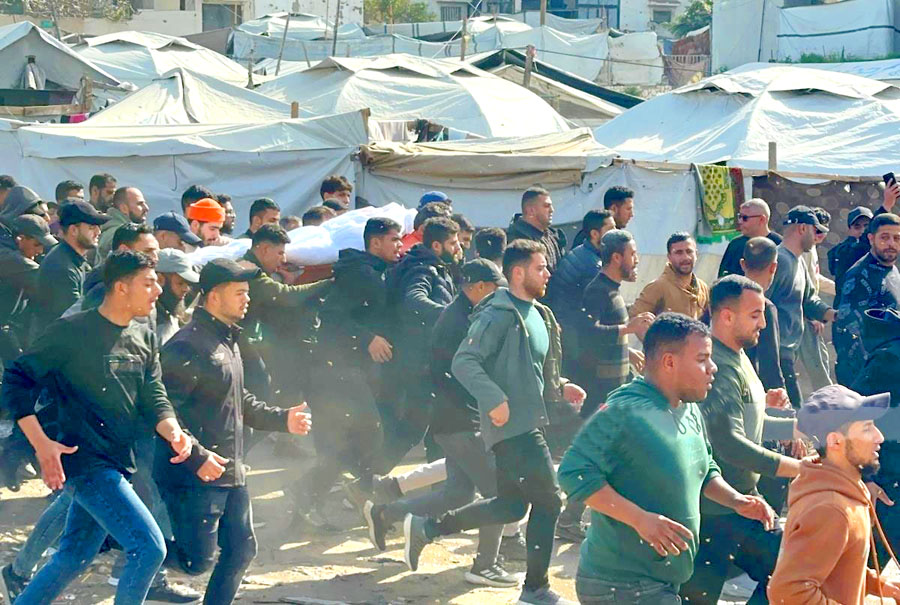
According to reports, the two engaged the militia in clashes and inflicted losses before the Israeli army deployed a swarm of quadcopter drones and a warplane that killed them directly. A massive funeral procession was held for them.
The Palestinian Ministry of Health in Gaza has documented more than 710 Palestinians killed and over 1,900 wounded since the nominal ceasefire began in October 2025.
In a small but agonising sign of what Israel’s genocide has done to the most vulnerable, a group of small children evacuated to Egypt in November 2023 were this week reunited with their families.
Most had been premature infants in incubators at Al-Shifa Hospital’s neonatal intensive care unit. After Israel cut power to hospitals and then bombed medical facilities in the early months of the genocide, 29 babies were transferred out of Al-Shifa and eventually evacuated.
Four died. Israel refused to allow the parents to accompany their newborns. These mothers and fathers had not seen their children since November 2023 — children who left as fragile infants and returned as toddlers.
Dr Muneer al-Bursh, director of Gaza’s Ministry of Health, recounted the ordeal on social media.
Reporters filmed the moment parents received their children from a bus at the Rafah crossing, which had been partially reopened in mid-March to allow a trickle of medical evacuees to leave and others to return.
Even this bare minimum of humanitarian access is under threat.
The Palestinian Civil Defence and the Ministry of Health warned this week that Israel’s blockade on electricity and fuel is pushing health and emergency services to the brink of total shutdown.
On 31 March, the Civil Defence issued an urgent appeal for international pressure on Israel to allow fuel deliveries for rescue and repair operations.
Journalist Ebrahim Badwan has documented how the fuel and spare parts shortage is crippling hospital generators.
The Civil Defence said its staff had received only enough fuel to cover roughly 15 per cent of monthly needs, deepening the humanitarian catastrophe across the Strip.
Rescue workers accused the Israeli occupation authorities of ‘deliberately employing a drip-feed policy’ regarding the entry of fuel into the Gaza Strip – a tactic that negatively impacts humanitarian intervention efforts and intensifies the suffering of the civilian population.’
Meanwhile in the occupied West Bank, Israeli soldiers shot and killed 15-year-old Adam Sayed Saleh Beit Dahman at the entrance to the Dheisheh refugee camp, south of Bethlehem, on the evening of 27 March.
Defence for Children International–Palestine reported that four Israeli military vehicles had arrived at the camp entrance half an hour earlier.
Young Palestinian men and boys threw stones at the heavily armoured vehicles. Soldiers then dismounted and opened fire from approximately 200 metres away, striking Adam in the pelvis.
After shooting the child, Israeli forces surrounded him, beat him and shouted at him.
They prevented Palestine Red Crescent Society paramedics from reaching Adam for roughly 30 minutes. One paramedic was eventually permitted through.
Adam was taken by ambulance to Beit Jala Governmental Hospital, where he was pronounced dead at 10.30pm
The following day, his mother carried his body through the camp during his funeral.
Israeli forces have killed eight Palestinian children in the occupied West Bank so far in 2026 according to official Palestinian reports. In 2025, Israeli forces and settlers killed 56 Palestinian children in the West Bank.
Last Tuesday, Jewish Israeli settlers attacked Palestinians in the town of Taysir in the northern West Bank, injuring at least three people.
Eyewitnesses told the Anadolu news agency that the settlers assaulted Palestinians on their own land on the outskirts of the town with stones and sticks, and set fire to a tractor and other property.
In a codification of decades of de facto policy – killing Palestinians through torture, starvation and denial of medical care in prisons and detention camps – the Israeli parliament last week passed a law permitting the execution of Palestinians by hanging.
The executions are to be carried out by prison guards appointed by the Israeli Prison Service, whose identities will be kept secret and who will be granted legal immunity.
The law enjoys broad public support in Israel, the human rights group B’Tselem noted.
The Palestinian civil rights organisation Adalah said the law establishes ‘clear racial separation,’ as it applies exclusively to Palestinians from the occupied West Bank, including East Jerusalem, but excludes Israeli Jews.
Adalah’s director, Hassan Jabareen, filed a petition against the law just 30 minutes after it passed. ‘While many countries apply the death penalty, this statute is the only law in the world that discriminates between defendants based on ethnicity,’ Jabareen said.
Israel’s national security minister Itamar Ben Gvir – an extremist settler and war crimes suspect who had been wearing a noose pin on his lapel in support of the measure – celebrated its passage by opening a bottle of champagne and, surrounded by fellow lawmakers, toasted the prospect of killing more Palestinians.
More than 9,500 Palestinians remain in Israeli prisons, including 350 children and 73 women, subjected to systematic torture, starvation and medical neglect – practices that have intensified since the genocide in Gaza began in October 2023.
A general strike was called across the occupied West Bank in protest against the execution law. In Gaza, crowds took to the streets holding signs and burning photographs of Israeli Prime Minister Benjamin Netanyahu.
A spokesperson for the tribes and popular committees in al-Bureij refugee camp told the Anadolu news agency that the protest aimed ‘to send a clear message to the occupation that the prisoners are not alone.’
Adopting such laws reflects ‘confusion and failure’, he said, adding that tribal leaders declared that ‘any harm to our prisoners will be met with an unexpected popular and national response.’