
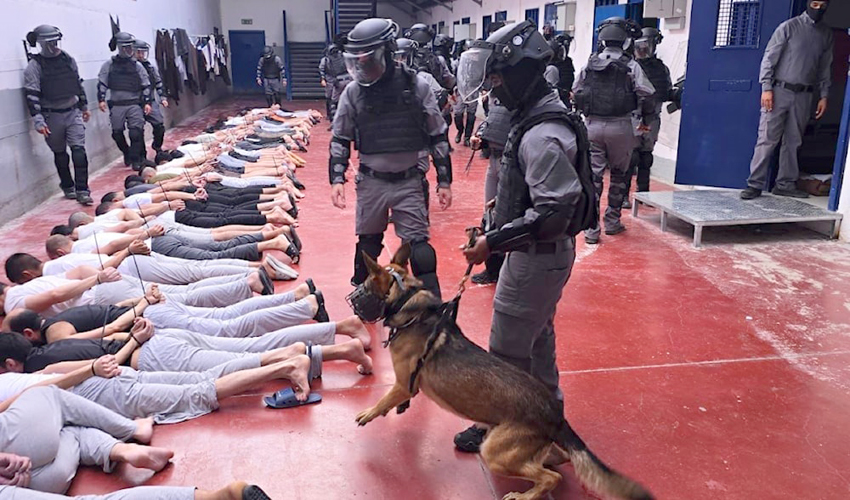
NEWLY released Palestinian abductees have stated that Israeli prisons subject prisoners to horrific conditions, describing the detention centres as ‘graves for the living’.
Their testimonies emerged as groups of released abductees arrived at Shuhada’ Al-Aqsa Hospital in Deir al-Balah, in central Gaza.
A prisoner who spent three months in Sde Teiman detention camp in the Negev, said the period felt like decades because of the torture he endured. He witnessed many forms of abuse inside the prison.
He opened his mouth to show several missing and broken teeth, which resulted from beatings by Israeli guards.
Another freed abductee, Ghith Aliyan Mohammad Abu Aoun, said he works as a fisherman and that Israeli forces kidnapped him in March while he and his colleagues were attempting to fish at sea.
He said conditions inside Israeli prisons are extremely harsh and continue to deteriorate.
Former female abductee Reem Abu Jazar, from the West Bank, said Israeli authorities deported her to Gaza, forcing her to leave behind her sick daughter and ill husband in Ramallah.
She said Israeli forces abducted her in December at a crossing, accusing her of possessing a knife and affiliating with Hamas.
Abu Jazar said Israeli authorities denied her access to a lawyer and never brought her before a court.
She said guards subjected her to strip searches, interrogated her during the night, and deprived her of sleep.
She added that the 20 days she spent there felt like years due to constant humiliation and beatings by both male and female guards, along with continuous surveillance by cameras.
She also revealed that Israeli prisons hold a large number of abducted little girls who were kidnapped over social media posts related to Gaza during the genocide. She said these girls suffer severely inside detention centres.
Abu Jazar said female abductees face degrading treatment, verbal abuse, and physical assault, adding that denial of food and water becomes minor compared to the daily humiliation.
She explained that many women are held under administrative detention without formal charges, with Israeli authorities renewing detention orders every six months.
She called on the international community to pressure Israel to release abducted children held in Damon Prison.
She described the facility as ‘the largest prison of torture’ and once again referred to Israeli prisons as ‘graves for the living’.
Palestinian prisoners’ rights organisations report that since the onset of the genocidal war on Gaza in October 2023, numerous testimonies have been documented highlighting a rise in torture practices.
These accounts describe such actions beginning at the time of abduction, continuing during interrogation, and persisting throughout imprisonment.
Rights groups have previously warned that torture is no longer confined to interrogations aimed at extracting confessions.
Instead, Israeli authorities have reportedly implemented methods and tools that integrate torture into the daily lives of detainees, a practice that has escalated significantly since October 2023.

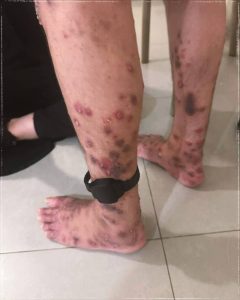
A contagious scabies outbreak is spreading rapidly among Palestinian detainees held at Gilboa prison, amid what prisoners’ advocates describe as an entrenched policy of medical neglect and escalating abuse by Israeli occupation authorities.
In a statement issued on Tuesday, the Asra Media Office (AMO) said the disease is worsening under ‘extremely harsh’ living and health conditions, accusing prison authorities of deliberately denying detainees proper treatment and neglecting basic hygiene measures inside cell blocks.
The amo said the absence of hygiene has fuelled the spread of multiple skin diseases, constituting a serious violation of humanitarian and health standards.
Detainees are also enduring severe cold inside their cells without heating, the statement said.
Prisoners are reportedly forced to wear light, inadequate clothing and are limited to a single change of clothes, compounding daily suffering and accelerating health deterioration.
The AMO further reported a marked escalation in repression, including repeated provocations and physical assaults against detainees, as well as documented cases of electric shocks.
It said the punitive measures are directly linked to the worsening health crisis, amounting to collective punishment.
Living conditions have deteriorated across the facility, the statement added, citing reduced food quantities, fewer loaves of bread, and cuts to outdoor recreation time to just one hour per day.
These measures, it warned, are intensifying malnutrition and illness among prisoners.
Describing the situation as a ‘compound crime’, the AMO held Israeli occupation authorities fully responsible for the dangerous decline in detainees’ health and humanitarian conditions, stressing that medical neglect has become a systematic tool of punishment within the prison system.
Previous reports have documented similar patterns.
The AMO called on international human rights and humanitarian organisations to intervene urgently, press for accountability, and act to save detainees’ lives.
According to Palestinian figures, more than 9,300 Palestinians are currently held in Israeli prisons, including 3,385 under administrative detention, amid growing warnings of a deepening health crisis driven by Israeli occupation policies.
A bill introduced in the Israeli Knesset would allow the execution of Palestinian prisoners by hanging, contradicting the regime’s earlier statements that described lethal injection as the intended method.
Israeli media reports said on Tuesday that the legislation grants the Israel Prison Service commissioner the authority to appoint special officer tasked with carrying out executions.
The bill led by Israeli minister Itamar Ben-Gvir, has now reached its second and third readings.
The Knesset approved the bill in a first reading on November 11 by a vote of 39 out of 120 lawmakers, with 16 voting against.
According to the Haaretz newspaper, the process would be overseen by the prison warden, a judicial representative, and a member of the prisoner’s family.
It allows executions to proceed even in the absence of some of those individuals, citing the need to avoid delays.
The bill also prohibits any commutation, appeal, or cancellation once a death sentence is issued.
Under the proposal, Israeli authorities involved in enforcing death sentences would be granted full criminal immunity.
Trials would be conducted before military judges and executions would be carried out within 90 days of a final ruling.
In addition, the legislation permits death sentences to be imposed without a request from the attorney general.
Prisoners sentenced to death would be held in complete isolation, with visits restricted exclusively to authorised personnel.
Details of executions would be published on the Israel Prison Service’s website, while the identities of those carrying out the sentence would remain confidential.
Since the start of Israel’s genocidal war, the regime has sharply escalated its violations against Palestinian detainees, particularly those from the besieged Gaza Strip, including starvation, torture, sexual violence and systematic denial of medical care.
Late last month, a report by leading Palestinian prisoner advocacy groups said Israel was committing a ‘systematic genocide’ against Palestinians held in Israeli detention.
Rights groups have said that the past two years have witnessed an ‘unprecedented level of brutality and systematic execution of prisoners’, with the death toll in this period matching the number of Palestinians killed in Israeli custody over the past 24 years.
The Palestine Detainees Studies Centre earlier stated that approximately 60 per cent of Palestinian abductees held illegally in Israeli prisons endure chronic illnesses.
A significant number have lost their lives either during imprisonment or shortly after their release, due to the severity of their medical conditions.