
A NEW series of deadly Israeli attacks across Gaza on Sunday killed at least seven Palestinians and injured two dozen more. Ceasefire violations have now reached 2,400 incidents.
The casualties occurred as Israel continues to target residential neighbourhoods and civilian infrastructure in the besieged Palestinian territory, in violation of the ceasefire.
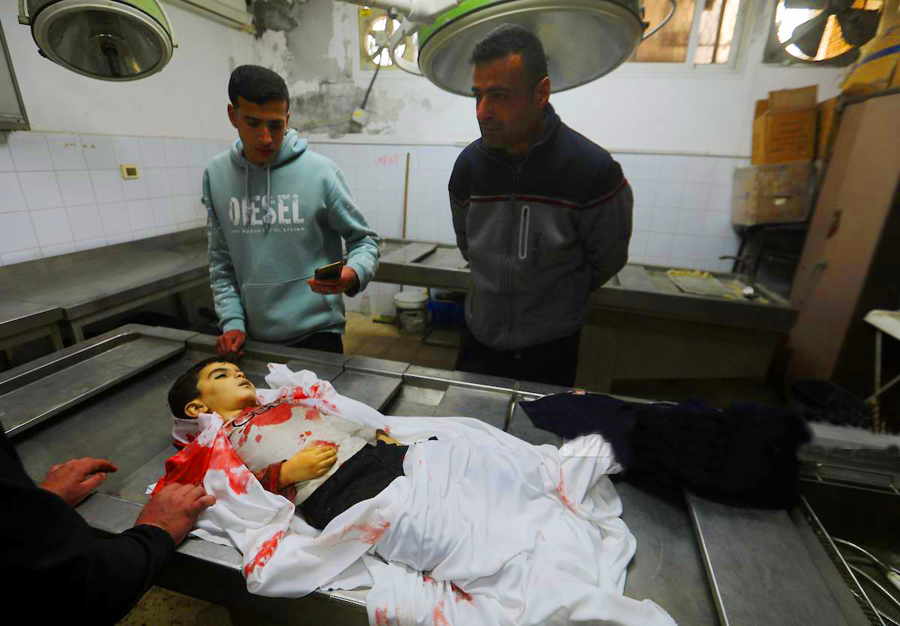
Children were among those killed and wounded in Rafah and central Gaza.
In Rafah, one person was killed by Israeli gunfire, and a child was shot in the al-Mawasi area, where large numbers of displaced civilians are sheltering. Additional injuries were reported in central and southern Gaza.
A 16-year-old boy was seriously wounded in an Israeli drone strike in Deir al-Balah, and a girl was injured by gunfire in Mawasi, Khan Younis.
Medical sources said the boy was rushed to al-Aqsa Martyrs Hospital with severe injuries.
Israeli artillery and gunfire continued to target areas east of Khan Younis, while naval forces shelled coastal zones.
Israel has been violating the ceasefire for over 190 days now, and continues to breach the truce through airstrikes, artillery shelling, and gunfire directed at civilian areas.
Of the 2,400 Israeli violations since the ceasefire took effect in October last year, as of last Sunday, there have been 921 shooting incidents, 1,109 bombardments, 97 incursions into residential areas, and 273 demolitions of homes and buildings, resulting in at least 754 deaths and 2,100 injuries, including 312 children, women, and elderly people.
These developments come as Gaza authorities report that severe restrictions on humanitarian aid and movement continue to worsen conditions across the blockaded Palestinian territory.
Only a limited number of aid and commercial trucks have entered the Strip over the past six months, and the Rafah crossing has operated at reduced capacity.
Israel’s genocidal war on the besieged region has killed at least 72,336 Palestinians and injured 172,213 others since October 2023.
Palestinian resistance forces have discovered and seized a number of Israeli spying devices inside makeshift tents set up by refugees in the southern flank of the Gaza Strip.
According to reports in the Palestinian media, citing an unnamed security officer in the coastal region, Israeli intelligence operatives had camouflaged the devices, in some cases even hiding them inside rocks.
The officer noted that Israeli intelligence forces may have used quadcopters to drop the spying devices in near the tents whilst the refugees were not around.
He urged Gazans not to come close to any suspicious devices and immediately report them to security forces.
Meanwhile, the Palestinian Commission of Detainees’ and Ex-Detainees’ Affairs has reported a sharp and unprecedented deterioration in the incarceration conditions of Palestinian prisoners inside Etzion jail.
This came after the Commission’s lawyer recently visited the prison.
She had insisted on meeting detainees face-to-face rather than relying on video calls, which have been imposed by the Israeli prison administration since the war on Gaza started.
The lawyer managed to visit five out of nine detainees, with additional visits scheduled.
She described the testimonies she received as ‘shocking’.
Prisoners told her that most of them had gone over a month without showering due to the lack of hot water and the absence of basic needs such as soap and towels.
According to testimonies, Israeli jailers have intensified repressive measures inside the prison, conducting cell raids with dogs three times a week, accompanied by shouting and insults, and forcing detainees to kneel for hours, with those unable to comply being severely beaten.
Israeli jailers routinely fire tear gas canisters in the prison yard, causing the detainees, already weakened by hunger and fatigue, to suffocate and collapse.
Despite the harsh detention conditions, the prisoners stressed that what weighs most heavily on them is not just the scarcity of food but the ‘systematic policy of humiliation and maltreatment’ against them.
The Commission called for urgent international action to improve the conditions of Palestinian prisoners and to pressure the Israeli occupation government to uphold humanitarian standards in its jails.
Hundreds march on Downing Street against Israel’s execution law
By Nilly Brook
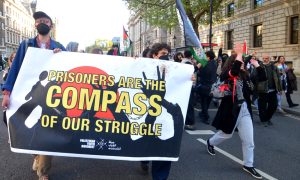
Hundreds marched on Downing Street on Palestinian Prisoners’ Day, last Friday, against Israel’s execution law.
Since 1974, 17th April has been marked as an International Day of Solidarity with Palestinians in their struggle against Israel’s foreign occupation of their land.
There are nearly 10,000 Palestinians currently held in Israeli prisons, many of whom are women and children, subjected to physical and psychological torture.
In a powerful speech at the protest, Yasmine Adam from the Muslim Association of Britain referred to the systematic murder of Palestinians in campaigns of torture, rape and starvation.
This year’s commemoration was marked by Israel’s new death penalty law, an ethno-supremacist law specifically targeting Palestinians convicted of deadly attacks.

Yasmine Adam said: ‘The law loosens judicial processes, enabling swift prosecution that can be passed even by junior judges; a further implementation of Israel’s apartheid.
‘This is not a sovereign state legislating to deter crime, Israel is a foreign occupying force imposing an illegal measure on occupied people – people that have the right to resist.’
Samira Yusuff, a Palestinian activist from Community Camp for Palestine, said the execution of Palestinians is nothing new: ‘Palestinians were being executed by British colonisers back in the 1920s for resisting colonial power then.
‘Now they’re legalising the killing of us only because we’re resisting their occupation.
‘They’ve legalised the killing of Palestinians and only Palestinians, whereas the settlers are committing murders across the West Bank, across colonised Palestine.
‘Those settlers, if we are lucky, they get arrested for a month or two, whereas we are going to be executed.’
Referring to the European Union’s petition to suspend its trade agreement with Israel, she pointed out that European states’ condemnation of the execution law will have no impact.
Tougher measures need to be taken to sever any military, financial or diplomatic support of Israel.

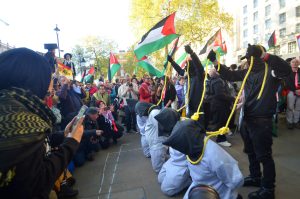
Yasmine, from the Palestine Youth movement referred to the law as an act of desperation from an occupier that knows its time is running out ‘just like the attack on Iran, just like the attack on Lebanon, just like the genocide in Gaza, they are underpinned by the same logic – kill what you cannot subjugate’.
Following her speech, she spoke about the trajectory of the movement and the need to expand understanding of the revolutionary project in Iran.
For Yasmine, this project is undermined by those equating the violence of the Israeli and Zionist project with harm within the Iranian system; ‘you cannot compare a sovereign nation trying to exercise control over its own sovereignty, to maintain decent living standards for its people whilst constantly fending off attacks from the United States and other imperial powers, to a colonial project that is actually designed to displace and ethnically cleanse our region, not just in Palestine, we’re seeing it extend into Syria and Lebanon and the greater Israel project’.
This sentiment was echoed across those gathering at the protest. Sam Weinstein from the International Jewish Anti-Zionist Network (IJAN) wore a placard calling for regime change in the United States.
‘They call the Venezuelan government a regime, they call the Cuban government a regime, they call the Iranian government a regime, but it’s time we start calling the Trump government a regime.’