
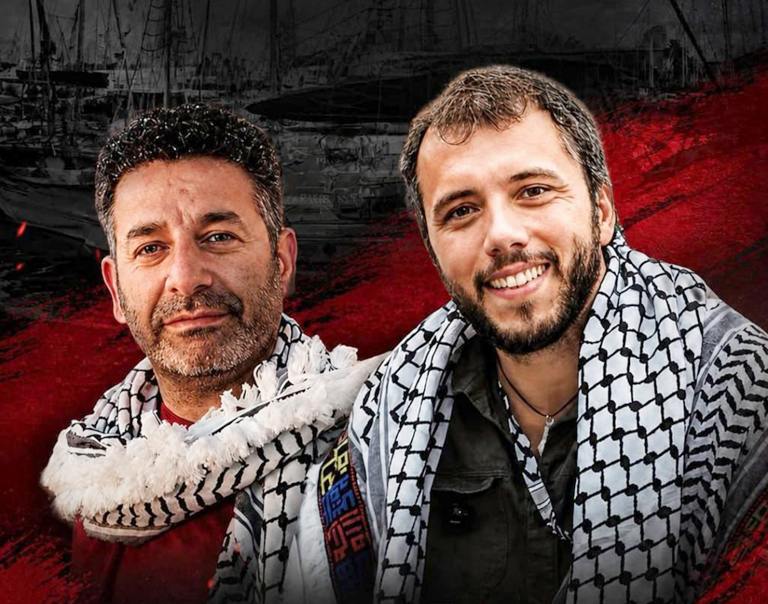
TWO GAZA flotilla activists are on hunger strike after Israel on Tuesday acquired a six-day extension of their detention after they were brought to Israel for questioning.
Saif Abu-Kashk, a Palestinian resident of Spain, and Brazilian national Thiago Avila, who were intercepted near Crete, are on a hunger strike in prison.
The legal rights group Adalah, which represents them, said they are being subjected to psychological abuse and are not receiving treatment.
Attorneys Hadeel Abu Saleh and Lubna Toma of Adalah, who represent the two activists, told a previous hearing at the Ashkelon Magistrate’s Court that ‘they were subjected to severe violence while held by the navy, forced to lie on the floor for two days face down with their hands cuffed behind their backs’.
In Madrid, officials condemned the detention of the two in international waters, calling the move ‘completely illegal and unacceptable’.
The ‘Spring Mission 2026’ of the Global Sumud Flotilla had departed from the Italian island of Sicily on April 26 to break the Israeli blockade on Gaza and deliver humanitarian aid.
Last Wednesday evening, boats carrying activists were subjected to an unlawful Israeli attack in international waters off the coast of Crete.
The initiative was the second mission organised by the Global Sumud Flotilla, following a previous effort in September 2025 that ended with an Israeli attack in October of the same year and the arrest and deportation of hundreds of international activists.
Italy also said on Monday it had opened an investigation into what it described as the ‘kidnapping’ of flotilla activists.
The pair were among dozens of activists who had set sail for Gaza as part of the Global Sumud Flotilla, which was intercepted by Israeli forces in international waters off Greece on April 30.
Organisers say that from 180 activists, the majority of whom were taken to Crete, Abu-Kashk and Avila were taken to Israel for questioning, where they remain in detention.
‘The court’s decision to extend the detention of humanitarian activists abducted in international waters amounts to judicial validation of the state’s lawlessness,’ Adalah said in a statement on Tuesday, adding that it will appeal against the decision.
The extension of the activists’ detainment was based on ‘secret evidence’ that Abu-Kashk, Avila and their lawyers were not permitted to review, Adalah said.
‘Crucially, the court granted the full six-day extension requested by the state without imposing any limitations or judicial constraints on the interrogation period,’ the group’s statement read.
No charges have been filed against the two men, but Abu-Kashk and Avila face several accusations, including affiliation with a ‘terrorist organisation and contact with foreign agents’.
Adalah lawyers Hadeel Abu Salih and Lubna Tuma, representing the two activists, have argued that the allegations against them are baseless and have no legal grounds.
‘Because the activists were abducted over 1,000 kilometres away from Gaza and are not Israeli citizens, Israeli domestic law does not apply to them,’ said the rights group.
The organisation also said both activists remain in ‘total isolation, subjected to 24/7 high-intensity lighting in their cells and kept blindfolded whenever they are moved, including during medical examinations’.
The organisation said the activists are continuing their hunger strike, consuming only water since their abduction on April 30.
The flotilla’s organisers also demanded the release of Abu Keshek and Avila on Tuesday, urging the international community to take action.
‘The Zionist regime has, once again, extended the illegal detention of our friends, Saif Abu-Kashk and Thiago Avila,’ the group said on X.
‘Our organisers have been illegally kidnapped in international waters, subjected to beatings and torture in Greek territorial waters, and forcefully brought against their will to occupied Palestine, where they have been subjected to interrogations, death threats, sleep deprivation and medical neglect.’
Last Saturday, Adalah lawyers had visited the activists at Shikma Prison in Ashkelon, where they gave testimony of ‘severe physical abuse amounting to torture’.
UN Special Rapporteur on human rights in the occupied Palestinian territories, Francesca Albanese, warned that Israel is exploiting Greece’s fears and sense of insecurity to advance its own interests.
Speaking at an event in Athens on Sunday promoting her book When the World Sleeps – Stories, Words, and Wounds of Palestine, Albanese said Greece believes it has chosen to align itself with Israel in pursuit of peace and protection against external threats.
‘But Israel is the one that chose you,’ she said. ‘And it will use your fears and insecurity to serve its own interests.’
She added that Israel uses the Palestinian territories as a ‘laboratory’ to test weapons and surveillance technologies before marketing them to other countries.
Albanese called for accountability for entities involved in arms and trade deals between Israel and Greece, suggesting parliamentary investigations and investigative journalism as tools for scrutiny.
Her remarks came amid growing political and media controversy in Greece over the authorities’ silence regarding the Israeli attack on the ‘Global Sumud Flotilla’ in international waters near Greek shores.
Greek civil society and human rights organisations, including ‘March to Gaza-Greece’, alleged that the attack took place with direct cooperation from the Greek side.
- An extremist Jewish settler stormed the courtyard of a Palestinian school in the town of Silat al-Dhahr, south of Jenin in the occupied West Bank on Tuesday morning, driving his vehicle inside and chasing students while brandishing his weapon.
Eyewitnesses reported that an armed settler suddenly drove into the schoolyard, chasing students while aiming his firearm at them, sending them fleeing in panic.
The witnesses added that the settler withdrew from the school and town shortly afterward, with no injuries reported.
A video clip circulated on social media showed the moment the settler stormed the schoolyard, with students running in different directions to escape.
This incident comes amid a rise in settler attacks across the West Bank, targeting Palestinians and their property as part of Israeli efforts to pressure them to leave their areas to make way for settlement construction and expansion.
- The Hamas Movement has warned of escalating violations against Palestinian female prisoners held in Israeli Damon Prison, describing the abuses as ‘war crimes that cannot be ignored’ and calling for urgent international action to protect detainees.
In a statement on Monday, the Movement said testimonies from inside the prison indicate that female prisoners have been subjected to systematic repression and torture, including being forced to lie face-down, restrained from behind, beaten, kicked, and placed in solitary confinement.
Hamas said these practices reflect a ‘complete absence of moral and humanitarian standards’.
The Movement called for holding Israeli leaders accountable and to act swiftly to ‘rescue prisoners from prisons of death and torture’, stressing that such violations would not break their will or their pursuit of freedom.
Hamas also called on Palestinian factions, human rights organisations, women’s groups, and the public to intensify campaigns in support of prisoners and to push for their release.
In the same context, the Asra Media Office reported that female detainees in Damon Prison were subjected to more than ten assaults in April alone, describing the escalation as systematic.
According to the report, special Israeli units, particularly the ‘Nahshon’ unit, conducted repeated raids on prison sections, using stun grenades and forcing prisoners to lie on the ground while restraining and assaulting them, often away from surveillance cameras. The raids also involved arbitrary isolation and forced transfers between cells.
The abuses extended beyond physical violence to include severe psychological pressure, compounded by harsh detention conditions that have negatively affected prisoners’ health.
The report noted that two pregnant detainees are being held under deteriorating health conditions, with one transferred to hospital amid a lack of adequate medical care.
Living conditions inside the prison have also worsened significantly, with severe overcrowding forcing some detainees to sleep on the floor and a lack of privacy, especially in cells with exposed sanitation facilities.
Restrictions have also been imposed on access to outdoor time and showers, with durations reduced, alongside acute shortages of hygiene supplies, clothing, including summer wear, and basic necessities.
Food provision was described as insufficient in both quantity and quality, leading to noticeable weight loss and health issues among detainees, including digestive diseases.
The report added that the constant presence of prison guards inside sections, particularly at night, creates a harsh environment, forcing detainees to remain fully clothed even while sleeping in hot conditions.
The Asra Media Office said the escalation reflects a deliberate policy aimed at breaking the will of female prisoners, calling on international human rights bodies to intervene immediately to halt the abuses and ensure their basic rights.