
ARGENTINA’S government ended free medical care for non-resident foreigners in national public hospitals and approved the expulsion of migrants who incite hate messages, expanding the anti-immigration agenda of Javier Milei, after the 2026 World Cup final.
The move is being opposed by the Confederación General del Trabajo (CGT) and the Argentine Workers’ Central Union the country’s two trade union federations.
The Resolution 1066/2025 of the Ministry of Health obliges non-resident foreigners to pay tariffs or present an international health insurance to receive routine medical care in public hospitals of the country.
The measure reverses the policies that historically guaranteed free public health in the country.
The new system establishes a detailed list of services with prices and formalises the so-called ‘Operating Procedure for the Healthcare of Foreign Persons’.
Patients must prove legal residency with their national identity document or a sworn declaration of international coverage, pay the corresponding fee in legal currency, and only then receive medical attention.
The text warns that without a health insurance, the service will be ‘cancelled.’
Although the norm mentions a supposed ‘equality of conditions,’ the procedure creates a differentiated system based on migration status.
In emergencies, access cannot be denied to any foreigner regardless of their situation, but non-residents will be billed later while residents will not.
The regulation exempts immediate payment only for critical cases such as heart attacks, strokes, severe trauma, obstetric and neonatal emergencies, or any pathology that represents an imminent risk to life.
The text reads: ‘National public hospitals will tariff health care to foreigners. As of today, the Ministry of Health of the Nation has established that medical care for non-residents is taxed in the usual health benefits of national hospitals.’
The regulation states that when the patient has health insurance, the establishment must notify the insurer of the care provided and issue the electronic invoice for cost recovery.
In cases where they do not have coverage, the hospital must prepare a budget and receive payment of the benefit before it is carried out.
The healthcare measure complements the Decree 366-2025, issued in May, which modified the Migration Law, created a mandatory health insurance for tourists and non-resident foreigners, and introduced fees for public university education.
Days later, the government cut more than 45 million dollars from critical health areas.
In the same framework, the Argentinian government added a decree issued last month after a social media campaign against the country following the World Cup 2026 final.
The measure prohibits entry and orders: ‘The expulsion from national territory of any foreigner who directs or incites messages of hate, discrimination and/or violence against the Argentine people,’ as well as those who ‘outrage the national symbols’.
Alongside trade unions, human rights organisations warned that the broad wording of the decree enables arbitrary interpretations, since concepts such as ‘hate messages’ or ‘outrage to national symbols’ lack precise legal definitions and could criminalise legitimate criticism.
The Centre for Legal and Social Studies (CELS) recalled that migration legislation should not punish opinions and that due process requires concrete evidence of incitement to violence.
The combination of health fees, education charges and expulsion threats dismantles the tradition of Latin American solidarity and open borders that characterised Argentina.
Regional analysts consider that the measure stops a fundamental human right, criminalises the migrant population and deepens the vulnerability of workers, students and families who transit through the country, contradicting the integration commitments assumed in the region.
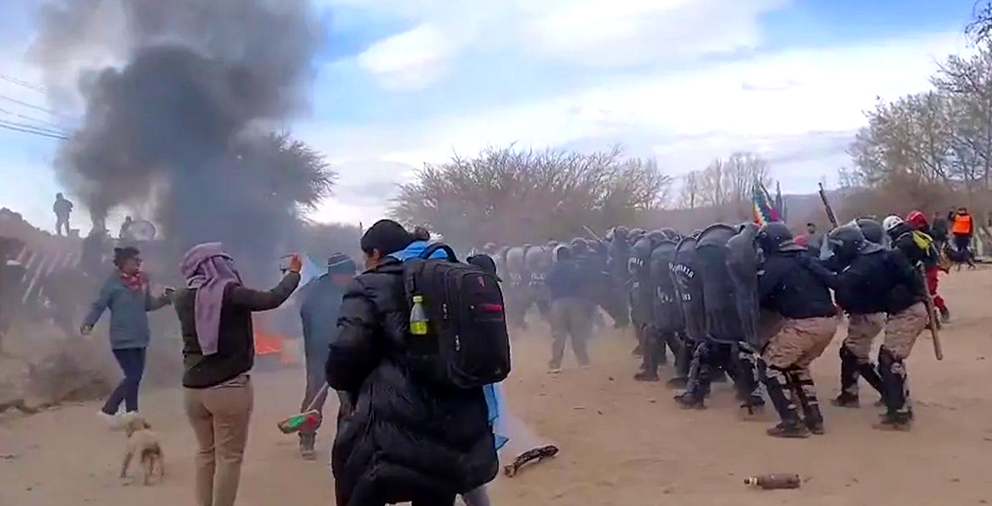
Meanwhile, members of the Santa Rosa Indigenous community in Argentina’s northern Jujuy province said at least 10 people were injured and three homes destroyed during a police eviction operation on Monday, while families were also seeking information about several children taken from the site.
The operation took place in Humahuaca, where infantry forces and police entered land owned by the community.
Residents said officers fired rubber bullets and used tear gas as families tried to prevent heavy machinery from reaching their homes.
Angel Mendoza, vice-president of the Santa Rosa community, described the operation after appearing at a prosecutor’s office to expand a criminal complaint.
Mendoza said: ‘They came in firing rubber bullets and tear gas. There were children, elderly people and people with disabilities.
‘They threw all our belongings outside and, using an unregistered machine, completely demolished the three houses where three families from our community lived.
‘At least 10 people were hit by rubber pellets, including in the face and body.’
Community members said the shots were fired at close range, which they alleged violated police protocols governing the use of non-lethal weapons.
The operation also raised concerns over children who were taken from the area during the eviction. Community members said about eight minors were removed from the site.
Families expressed particular concern over children aged 1, 2, 5 and 7, who they said were taken away without prior notification or authorisation from their parents.
The dispute stems from an internal land conflict between two factions of the same community.
The current community leadership maintains that the opposing claim is based on irregular documents and plans that have not been officially recognised by the Directorate of Real Estate.
Those affected also questioned the legal basis and jurisdiction of the court order that led to the operation, saying it came from a Justice of the Peace court outside the local jurisdiction.
The families left without homes called for urgent assistance from the municipality of Humahuaca and the provincial government, seeking shelter and support following the destruction of the three residences.
- Elsewhere, in Cuba, more than 240 members of social movements from Latin America, the United States, and Europe delivered a donation of medical supplies to Havana’s Institute of Oncology and Radiobiology, as an expression of support for the institution in the face of the difficulties it is experiencing in providing care to its patients.
The donation includes surgical gloves, analgesics, anti-inflammatory medications, povidone-iodine, and other supplies intended to support the centre’s healthcare work.
The Institute is a national leader in the treatment of cancer, sarcomas, and complex pathologies, as well as in conducting clinical trials.
Dr Misleidy Nápoles, Deputy Director of Medical Assistance at the centre, expressed her gratitude for the contribution and emphasised its importance in the current context.
She said: ‘Any donation that arrives, from wherever it comes, helps us a great deal.
‘Now, at this moment when this blockade is so tightened, when practically nothing is arriving, this small contribution helps keep hope alive for our patients.’
Nápoles Morales added that the aid allows for improvements in treatments currently hampered by the shortage of medicines.
The delivery comes in a context marked by the intensification of the United States’ economic, commercial, and financial blockade against Cuba, a factor that hinders the acquisition of medicines, materials, and resources necessary for the functioning of the island’s health system.
Carlos Cabrera, representative of the Federation of Neighbourhood Councils of the Dominican Republic, stated that the commitment to Cuba motivated the brigade members to make the trip despite the recommendations they received against it.
In his opinion, the delivery constitutes an expression of the bonds of solidarity and brotherhood between the peoples of Latin America and the Caribbean.
From Colombia, Sonia López, a member of the brigade, expressed her appreciation for the resilience of the Cuban people.
He stated: ‘We can only thank this people for their active resistance and struggle against imperialism.
‘We can only support and help this people.
‘The materials received will be immediately used to support the healthcare work of the Institute of Oncology and Radiobiology, with an emphasis on the care of paediatric patients and the continuity of cancer treatments.’