
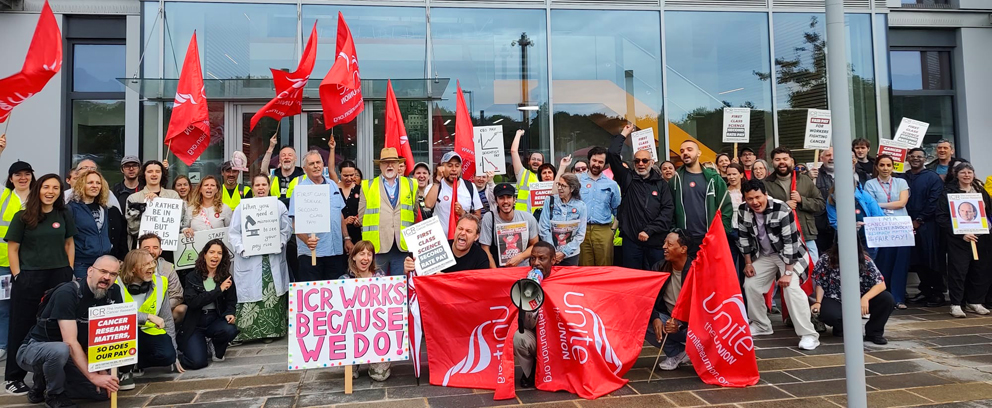
THE ICR (Institute of Cancer Research) strikers have accepted a victory deal after 68 days on strike in which the lowest paid will see a 52% pay increase, while all staff have won pay scale increment progress, with an average total increase of 17.2%.
‘We are ecstatic,’ Liliana Bowler, Unite ICR workplace steward and Rep and one of the leaders of the strike, told News Line yesterday, ahead of today’s mass ‘walk-in’ at 8.30am at the Chelsea and Sutton sites.
She gave a run-down of the history of the strike: ‘We had the dispute over pay in 2025 and the change in our pay model last year resulted in a 16% erosion in our salary.
‘A lot of our staff are on a very low salary and are living in poverty. We tried to explain to management, we tried to say this is not acceptable, these people are working hard, but they didn’t take us seriously.
‘That’s been going on since 2025. This year in June we served them with a notice for a strike. We were very hopeful that management would listen to us and it would be resolved quickly.
‘Our asks were to implement the pay scales, to address the 16% corrosion, to reinstate our canteen facilities and to scrap the new pension scheme that they wanted to introduce for new starters.
‘Out of all these issues that we wanted to address, a very long and tedious process of negotiating emerged, management were clearly dragging their feet, because we thought this could have been resolved a lot sooner.
‘Anyway, needless to say, we have achieved quite a lot, because the canteen is going to be reinstated, management has agreed to discuss options and they have promised us two hot meals every day at a reasonable price of course.
‘The pension scheme has now been removed, so every new member of staff is going to be included in the current system which is the USS University Pension Scheme.
‘We also have the increments reinstated, which means that the people who are at the very low salary base in professional services and in scientific services, those people are going to benefit the most.
‘That was the purpose of the fight all along, that no-one has to live in poverty and struggle to make ends meet.
‘So we’re absolutely ecstatic about that. So our colleagues who are now going to be getting what they should be getting and these are tiers of staff who are going to benefit most and that is fair.
‘So that is a victory. We are happy with the win so far. It has been a very, very long emotionally and physically exhausting process. We all thought that management would meet us at the table much sooner. Serious negotiations started only a couple or three weeks ago, when management was prepared to meet us once a week or twice a week.
‘We’ve received so much support from other workers and unions.
‘Through our misfortune of a common issue, low salary, we have met with a lot of people – bus drivers, we went to their picket, they were fighting for better conditions in their cabins.
‘We went to the Maudsley Hospital picket, where they were fighting for fair pay. We attended the beginning of the V&A Museum strike and they are fighting for fair pay.
‘We have had overwhelming support. We went from short strikes to indefinite strike action in July and it has taken until last Friday for management to sit at the table and come up with something that is acceptable for the majority of the members.
‘I am so proud of all my colleagues and am so happy for the colleagues that I work with every day, that they can now actually afford holidays with their children, can do things they were sharing with us. I couldn’t be happier. We are having a big photo, celebrating with all our colleagues before all walk in together at half past eight, on Monday morning.’