
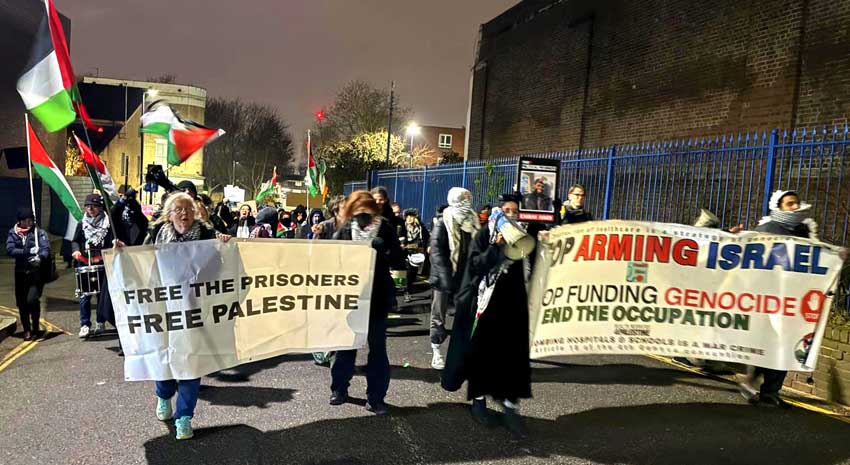
THE hunger strikers are ‘losing the ability to speak and stand’, according to Prisoners for Palestine, with the four remaining hunger strikers adding additional demands to end their hunger strike.
These demands are:
- Heba Muraisi to be transferred back to HMP Bronzefield
- Prisons to drop all non-association orders of prisoners
- Prisoners to be able to access all activities and courses
Since the hunger strike began on November 2nd, a total of seven prisoners have been taken to hospital with four halting the action.
Protester Heba Muraisi, who is on day 54 of continuous hunger striking, has told of the effects the action is having on her body.
In a new statement, Muraisi explained she ‘can feel myself get weaker as each day passes’ with ‘bruising on my arm and constant body ache’.
She also explains she can ‘no longer lie on my side as it hurts my face’ and is losing the ability to ‘form sentences, and struggling to maintain conversation’.
Muraisi indicated she would continue the hunger strike ‘until demands are met’.
In HMP Peterborough, Teuta Hoxha reported no longer being able to stand without blacking out, with dizzy spells and brain fog increasing. This is her second hunger strike, three months after her first one.
On Christmas Day, the biographer of Irish republican prisoner Bobby Sands, who died while on hunger strike in prison, Denis O’Hearn, wrote an open letter to the UK government, and requested they meet the solicitors of the hunger strikers.
O’Hearn noted how ‘even in the case of the Irish hunger strikes of 1980 and 1981, where the prisoners were considered at war with the British state, the government opened a dialogue with the prisoners and their representatives’.
He warned: ‘The consequences of failure to do so now, both the physical consequences for the prisoners but also the historical stain on the current British government, is a violation of human rights that no government should contemplate.’
The government continues to refuse to meet with the representatives of the hunger strikers.
United Nations human rights experts have called on the United Kingdom to safeguard their lives.
The special rapporteurs issued a written statement, saying: ‘We are calling on the United Kingdom to protect the lives and rights of pro-Palestinian detainees on hunger strike.
‘The prolonged hunger strike has resulted in significant deterioration of the detainees’ health conditions.
‘Medical experts warn that the activists now face serious risks, including organ failure, irreversible neurological damage, cardiac arrhythmias and death.’
The rapporteurs emphasised that the British government’s duty of care toward hunger strikers has not diminished but rather increased as their condition worsens.
The UN experts placed the hunger strikes within a wider context of restrictions on Palestinian solidarity activism in the UK. The statement noted that those detained were being held due to their participation in protest activities.
‘Preventable deaths in detention are never acceptable,’ the rapporteurs declared. ‘The state bears full responsibility for the lives and well-being of those it detains. Urgent action is now required.’
The special rapporteurs indicated their readiness to work constructively with the British government and confirmed they would continue monitoring the situation closely.
Among the UN experts who signed the statement were Francesca Albanese, the UN special rapporteur for the Palestinian Territories, and Gina Romero, UN special rapporteur on the freedom of peaceful
assembly.
• See editorial