
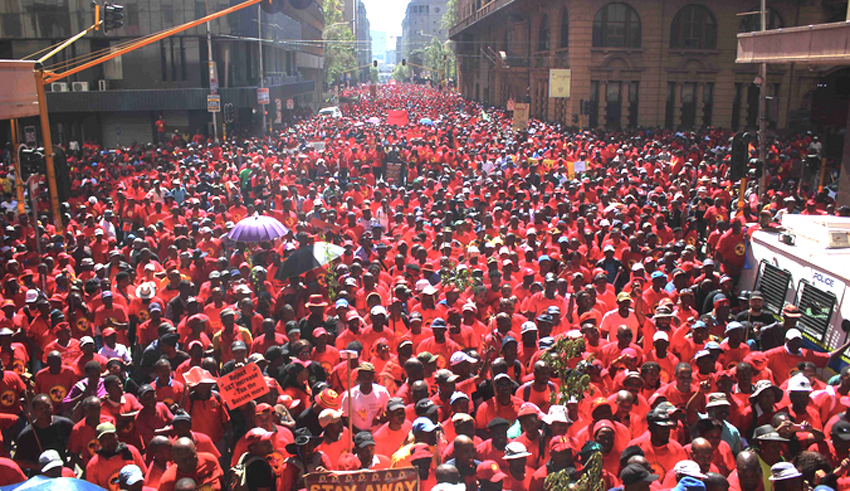
THE South African Federation of Trade Unions (SAFTU) said on Wednesday that millions of South African workers and their families are being plunged into poverty because of the rising global oil price.
SAFTU stated: ‘(SAFTU) notes with outrage the latest fuel price increases that will once again plunge millions of workers and poor households deeper into crisis.
‘These increases come at a time when workers are already drowning under the weight of mass unemployment, stagnant wages, electricity hikes, transport costs, food inflation, debt, and collapsing public services.
‘Every fuel increase triggers a chain reaction across the economy pushing up the prices of food, public transport, electricity generation, production inputs, and all basic necessities.
‘The working class is once again being forced to carry the burden of a global capitalist system driven by war, militarism, speculation and oligarchic greed.
‘The current global fuel instability cannot be separated from escalating geopolitical tensions, military aggression, sanctions regimes, and the domination of the world economy by imperial powers and giant energy corporations.
‘Ordinary workers in South Africa are now effectively subsidising the profits of multinational oil giants, weapons manufacturers, and billionaire oligarchs whose wealth multiplies during periods of war and instability.
‘The United States remains the world’s most powerful military empire, spending more on war and militarisation than the next several countries combined.
‘Every escalation of conflict in strategic oil-producing regions sends shockwaves through energy markets, allowing oil corporations and commodity speculators to make super profits while ordinary people suffer.
‘The reality is that wars have become enormously profitable for sections of global capital. Oil conglomerates, arms manufacturers, hedge funds, commodity traders, and financial speculators thrive on instability.
‘The bloodshed of ordinary people becomes a business opportunity for billionaires.
‘While workers queue for taxis and struggle to buy bread and paraffin, the world’s oligarchs accumulate obscene wealth from war contracts, oil speculation, shipping disruptions, and financial manipulation.
‘The same global capitalist order that lectures developing countries about “fiscal discipline” has no hesitation in pouring trillions into militarisation, sanctions, proxy wars, and corporate bailouts.
‘South Africa’s working class must not be made to pay for imperial rivalries and capitalist profiteering.
‘SAFTU reiterates its previous calls for immediate state intervention to protect workers and poor communities from relentless fuel price shocks.
‘The government cannot continue hiding behind the excuse of “international markets” while imposing one of the heaviest fuel tax burdens on society.
‘Fuel levies have become a mechanism for extracting revenue from workers and the poor instead of taxing wealth, corporate profits and financial speculation.
‘SAFTU therefore demands:
‘
- The total removal of the General Fuel Levy on petrol and diesel;
‘
- Immediate emergency relief for poor households dependent on paraffin, including the suspension of all taxes and levies on illuminating paraffin;
‘
- A temporary fuel price stabilisation intervention to cushion workers from extreme global oil volatility;
‘
- A comprehensive review of the Basic Fuel Price mechanism and the role of private monopolies in fuel pricing;
‘
- Direct intervention against excessive profiteering and speculative pricing in the energy sector;
‘
- Expansion of safe, affordable and publicly subsidised public transport;
‘
- Accelerated investment in public energy infrastructure to reduce dependence on volatile global fossil fuel markets.
‘SAFTU reiterates its long-standing call for a complete overhaul of South Africa’s failed macroeconomic framework.
‘The current crisis demonstrates the bankruptcy of neoliberal fiscal and monetary policies.
‘Higher taxes on corporate profits, a wealth tax on multi-millionaires and billionaires, taxes on luxury consumption, and stronger taxation of financial speculation and windfall profits.
‘Aggressive action against illicit trade, transfer pricing, customs fraud and corporate tax evasion.
‘Democratic state-led industrial policy focused on beneficiation, localisation and rebuilding manufacturing capacity.
‘The expansion of affordable, reliable and publicly owned transport systems to reduce dependence on private fuel consumption.’
Meanwhile, the Congress of South African Trade Unions (COSATU) on Thursday condemned the ANC governments polices on pay for workers.
The union federation stated: ‘COSATU in Johannesburg condemns Finance Minister Enoch Godongwana’s continued reluctance to fully implement the Payment Framework Agreement (PFA) for municipal workers.
‘We view this obstruction as a direct assault on the livelihoods of workers who have already endured years of financial uncertainty. It is unacceptable that the Treasury, under Minister Godongwana, continues to prioritise fiscal austerity over the livelihoods of workers.
‘The refusal to fully implement the PFA, which was adopted to address legitimate grievances regarding wage disparities, demonstrates a blatant disregard for collective bargaining and worker solidarity.
‘This failure to implement the PFA is not just a technicality; it is an economic injustice that leaves municipal workers vulnerable to poverty despite being employed.
‘We demand that the National Treasury cease its adversarial approach toward workers and honour the agreements made to ensure fair compensation. COSATU will not stand by while workers are treated as expendable.
‘We call on Minister Godongwana to reconsider this hostile stance and fully fund the implementation of the PFA immediately. If the Minister continues to hold back, COSATU will escalate this matter to the highest levels of struggle to ensure that workers receive what is rightfully theirs.’
- The Durban Labour Court has ordered SA Cargo Services to reinstate 13 workers dismissed during the Covid-19 pandemic, finding the sackings were substantively unfair and not properly justified.
SA Cargo Services is a Durban-based logistics company involved in cargo handling, warehousing and port operations around the Durban harbour.
SA Cargo had argued that a sharp decline in business due to Covid-19 made the dismissals necessary, citing reduced cargo volumes and financial strain.
However, the court found that the company failed to present sufficient and reliable evidence to support this claim.