
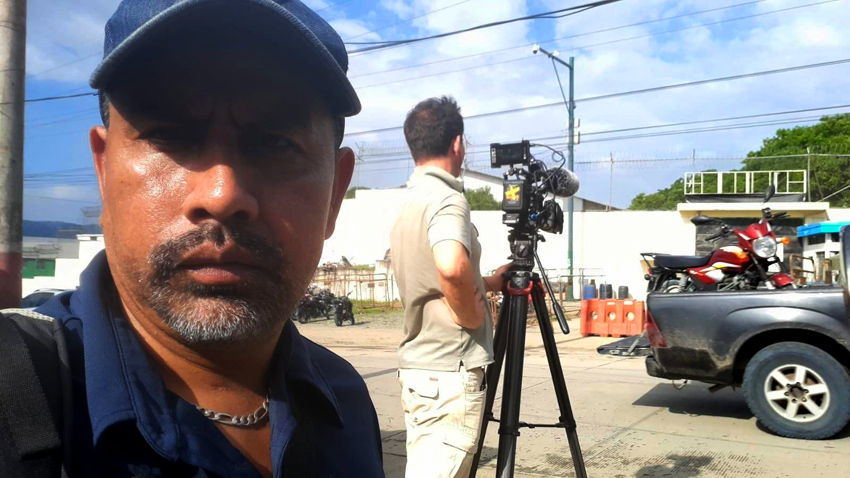
René Manuel Cobos Merchán, an Ecuadorian journalist and fixer who guided foreign film crews through the country’s drug war, believed the death threats he received in the days before he was shot dead in his home on 23rd August were retaliation for his work on a BBC documentary exposing police corruption, his family and colleagues have said.
At half past midnight, six masked gunmen climbed out of two pickup trucks in Tres Postes, in Yaguachi in Guayas province. They wore a mix of military uniforms and police vests.
Cobos, 49, lived in a small single-storey house that shares a tin roof with the home of his partner’s nephew, José Manuel Vélez Vera, 29. The two front doors are almost identical. Family members believe the gunmen went through the wrong one first. ‘Where’s the señor from the yellow taxi?’ they shouted, before shooting the young man dead. Cobos was known for driving a yellow taxi as his own car. The gunmen then forced their way into his home and killed him.
Homicide and forensic officers recovered 30 spent shell casings, 20 from 9mm rounds and ten from 5.56mm rounds. A police officer, speaking on condition of anonymity, alleged these are the standard models used by Ecuadorian police.
The account comes from an investigation by Drop Site News, which interviewed five sources who said Cobos had worked on the BBC film ‘Police Fight Gangs, Guns And Corruption In Ecuador’s War On Drugs’. Cobos coordinated key sources and secured the broadcaster exclusive access to both police operations and the black market. His eldest daughter said both his home and his nephew’s appear in the film.
A longtime colleague, who asked not to be named for fear for his life, said the BBC filmed interviews with gang members in Cobos’s bedroom, the room in which he was later killed.
In one scene a man linked to a drug-trafficking group sits on Cobos’s bed and boasts of having four police officers on his payroll. In another, during a counter-narcotics operation, police captain Jean Carlos Bustamante tells the cameras: ‘We have many, many bad people inside the police unit, inside the state, inside politics. We have many guys that are corrupted. They are in the pay of the gangs.’
In his final days, Cobos told a family friend and three colleagues that he was receiving death threats. Guillermo Galdos, a Channel 4 journalist and friend, said Cobos told him in one of their last conversations that ‘the police are not happy’ with the documentary.
Galdos said Cobos told him police wanted Bustamante’s on-the-record comments about narco infiltration of law enforcement removed.
The National Police confirmed to the press freedom group Fundamedios that Cobos had received death threats.
When Drop Site News asked the National Police Directorate for comment, it referred questions to the Attorney General’s office, which did not respond.
Asked about Cobos’s death and its possible link to the documentary, the BBC said Cobos did not work for the network and was not hired by it. Drop Site News said photographs of his room and the outside of the house match the film.
The BBC did not reply when sent screenshots and follow-up questions.
By mid-September the authorities had yet to publicly establish the circumstances or motive, according to the Human Rights Research Centre, and Cobos’s family say they are afraid to press for answers. ‘I know it shouldn’t just be left like this, but it’s also so scary. To avoid problems, it’s better not to ask or investigate anything ourselves,’ his eldest daughter said.
UNESCO’s Director-General condemned the killing and demanded an investigation. ‘Impunity for such crimes is unacceptable and must not be tolerated,’ the Director-General said.
On 11th September the Inter-American Commission on Human Rights’ Special Rapporteur for Freedom of Expression condemned the murder, and the commission urged the authorities to identify, prosecute and sanction those responsible.

Josh Rushing and Jeremy Young, Emmy-winning journalists with Al Jazeera, said he may have saved their lives in 2023. After a smuggler they had arranged to interview threatened them, Cobos urged them to leave Salinas.
With roads about to close for the elections, he drove to their hotel at 10pm and took them safely to Guayaquil. ‘He put himself in danger to do it,’ Rushing said.
He was a father of six and ‘tío’ to the neighbourhood children. Friends and family said he helped mothers of gun-violence victims move to safety, including a woman who lost four sons and her husband to shootings last year, and helped pay her rent. He would gather his family around the television in their small living room to watch each new documentary, pausing at every scene he had helped set up.
Galdos said Cobos’s face carried a faded scar from an earlier attempt on his life. ‘This is the fifth contact of mine that has been killed,’ he said. ‘The fifth person I’ve worked with who opened a window for me to get to know the underworld and who today is no longer with us because that’s how dangerous the issue is.’
Cobos was killed as attacks on the press in Ecuador mount under the right wing government of President Daniel Noboa, which has issued 23 martial law decrees, including powers to wiretap communications without warrants.
More than 800 attacks on the press have been recorded since 2022. The state was responsible for 46 of the 100 assaults and threats Fundamedios recorded between January and June this year, while organised crime groups accounted for five attacks this year. Ecuador fell 31 places on the World Press Freedom Index between 2025 and 2026.
‘The Noboa government appears to be more effective at attacking civil society organisations and opposition parties than it is at attacking organised crime,’ Juanita Goebertus, Americas director at Human Rights Watch, told Ecuavisa.
On 8th November, investigative journalist Tomás Beltrán was shot dead at his home in Calceta, Manabí province, despite being under state protection. He had received months of death threats after filing a complaint accusing his local mayor, Ledy Muñoz, a member of Noboa’s party, of illicit enrichment.
In June, Monika Silva Koniuszek, a whistleblower who had handed evidence about Noboa’s business dealings to the US embassy in Quito, was found dead in her home with blows to her head. Journalist Gabriela Pachana was sentenced to 30 days in jail for suggesting on X that the killing was meant to silence her.
The independent outlet GK indefinitely suspended all operations on 29th October. ‘The context in Ecuador is not favourable for independent journalism,’ it said. ‘We have sadly witnessed the closure of other media outlets due to political pressure, and the persecution of reporters simply for doing their job and holding those in power accountable.’
Fewer than 10 per cent of homicides in the region are solved. ‘When everyone around there found out that René had died, the whole neighbourhood, everyone there, was devastated, because he had helped a lot of people,’ a loved one said.