
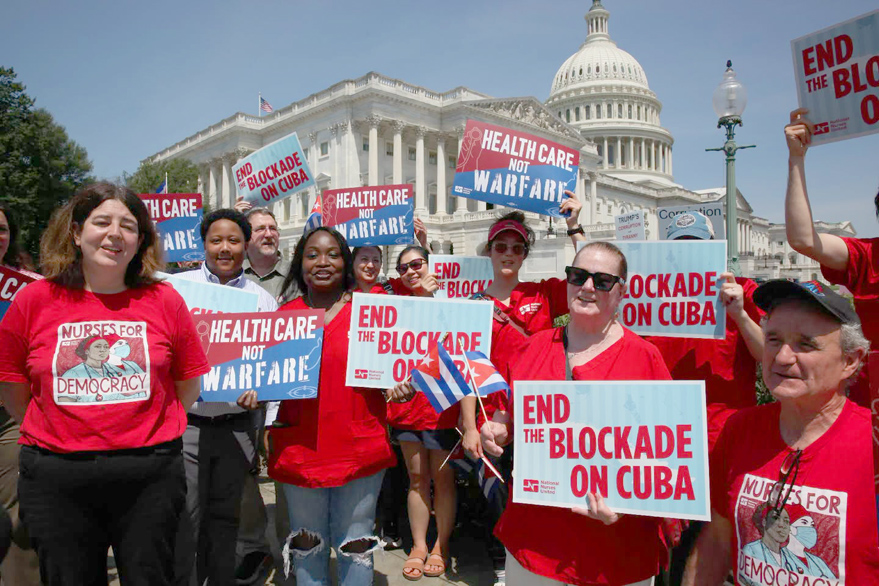
Cuban hospitals are struggling with critical shortages of medicines, medical equipment, and basic supplies alongside persistent power outages as tighter United States restrictions further complicate the country’s access to essential imports.
At William Soler Paediatric Hospital in the capital, Havana, doctors recently treated a severely malnourished and dehydrated two-month-old boy weighing less than five pounds.
The infant, who had been brought to the hospital by protective services after being abandoned, required specialised formula that has become difficult to obtain.
‘We have to make do with formulas made from malanga – a starchy root vegetable – and chicken,’ said Dr Alejandro Chong, head of the hospital’s intensive care unit.
The United States has imposed a total trade embargo on Cuba since the early 1960s and the victory of the Cuban revolution.
The administration of US President Donald Trump has implemented a series of additional economic restrictions against the island nation, including an energy blockade, openly promoting ‘regime change’ there.
Washington, meanwhile, claims its sanctions are not intended to restrict food and medical supplies, but foreign companies fearful of US penalties have become reluctant to sell them to Cuba.
Washington also claims Cuba’s economic deterioration is down to decades of mismanagement and corruption, while Havana denounces the US for subjecting the nation to embargo and sanctions.
Cuba has introduced major economic reforms this year, including ending state monopolies in fuel, banking, and pharmacies. However, US fuel exports to the private sector remain prohibitively expensive.
Cuba’s healthcare crisis has been aggravated by electricity shortages. Cuban officials say only one oil tanker has reached the island since early January, severely straining its power grid.
Doctors report having to finish operations using mobile phone lights when generators fail and manually pump oxygen for patients when ventilators stop working.
‘Those few seconds might seem insignificant to someone outside the medical field, but they’re precious seconds when you’re dealing with a patient under general anaesthesia or a patient on a ventilator in the intensive care unit,’ Dr Chong said.
Cancer drugs, anaesthetics, and laboratory equipment are also critically scarce, the report added.
Doctors said that a toddler had waited 68 days for an artificial lung machine component needed for surgery, compared with the usual two-day waiting period.
The two-month-old boy was readmitted to intensive care following respiratory complications, but died last Thursday, Chong confirmed.
Low salaries and difficult working conditions have driven many doctors out of the profession or abroad.
Chong said he earned more from his food stand than from running the intensive care unit.
‘There are fewer personnel, fewer resources, and it makes all the work we’re doing much more difficult,’ said paediatric surgery resident Dr Lórien Rodríguez, who works as a radio announcer.
Meanwhile, the United Nations General Assembly has for the 34th time voted for a resolution condemning the United States’ economic embargo on Cuba despite Washington’s diplomatic push against the annual document.
The resolution was passed on Wednesday 28th October by 130 votes in favour, 17 against, and 25 abstentions.
Cuban President Miguel Diaz-Canel hailed the resolution’s broad backing as a ‘victory for the heroic Cuban people’, who have not surrendered despite the ‘economic suffocation, threats and abuse by the US government.’
He also commended international opposition to the inhumane embargo ‘even in the face of the crudest pressure and blackmail’ from Washington to alter the outcome of the vote.
Similarly, Cuban Foreign Minister Bruno Rodriguez Parrilla said that the US has ‘once again been isolated in its attempt to continue strangling the Cuban people.
‘Neither its most insane pretexts nor its pressures nor media circus will prevail over the force of facts and truth,’ he added.
Recently, Trump threatened a US military aggression against Cuba on the ‘way back from Iran’.
United Nations experts have repeatedly condemned the unilateral US sanctions against Cuba, which have directly targeted the welfare and future of its people, as a violation of international law.
The UN resolution, titled ‘Necessity of ending the economic, commercial and financial blockade imposed by the United States of America against Cuba,’ was debated last Tuesday and Wednesday before the vote.
Last Tuesday, US Ambassador to the UN Mike Waltz delivered a speech critical of the Cuban government, prompting Parrilla to approach Waltz’s podium and call him a liar.
In anticipation of the vote, Waltz hosted a press conference urging other countries’ ambassadors to vote against the resolution.
Cuban officials censured the US for threatening countries with tariffs, visa restrictions and other penalties if they voted to denounce the illegal embargo.
Last Friday, Cuba’s top diplomat issued a warning to the United States against any attempts at military intervention or domination, sharply condemning a recent escalation of hostile rhetoric from Washington that has included open threats of regime change and covert intelligence recruitment.
‘We reject every threat related to US ambitions toward Cuba,’ its Foreign Minister Bruno Rodriguez said.
‘Our coastline is full of beautiful beaches, but there are also razor-sharp limestone spikes, an inhospitable environment for those who make it to our shores with hostile purposes and lust for domination.’
Rodriguez’s reference describes the razor-sharp, jagged coastal limestone and coral formations that line much of the Cuban coastline, historically making ‘unauthorised amphibious landings’ exceedingly difficult and dangerous.
The Foreign Minister’s remarks were a direct response to comments made earlier last Friday by Trump at a campaign rally in Fort Myers, Florida.
Addressing the crowd, Trump boasted about US naval movements, stating that American ships returning from the war in Iran ‘will pass Cuba’ and that ‘we’ll have one of them stop about 50 yards off the coast.
‘They’ll raise up their hands. And then we’re going to send (Secretary of State] Marco Rubio in to finish up the deal,’ Trump declared, openly hinting at a forced capitulation of the Cuban government.
The diplomatic war of words was further inflamed by an unusual and provocative move by Rubio, who publicly called on Cuban citizens to make ‘discreet’ contact with American intelligence services to help overthrow the island’s government.
‘To those who seek to create positive change in Cuba – now is the time,’ Rubio posted on social media. ‘The disappointment of failed promises, corruption, and the privileged lives of only a few; seize this opportunity to create the change you desire through a discreet partnership with the CIA.’
The public recruitment drive evokes memories of the CIA’s long history of covert operations against Havana, most notably the disastrous Bay of Pigs invasion in 1961.