
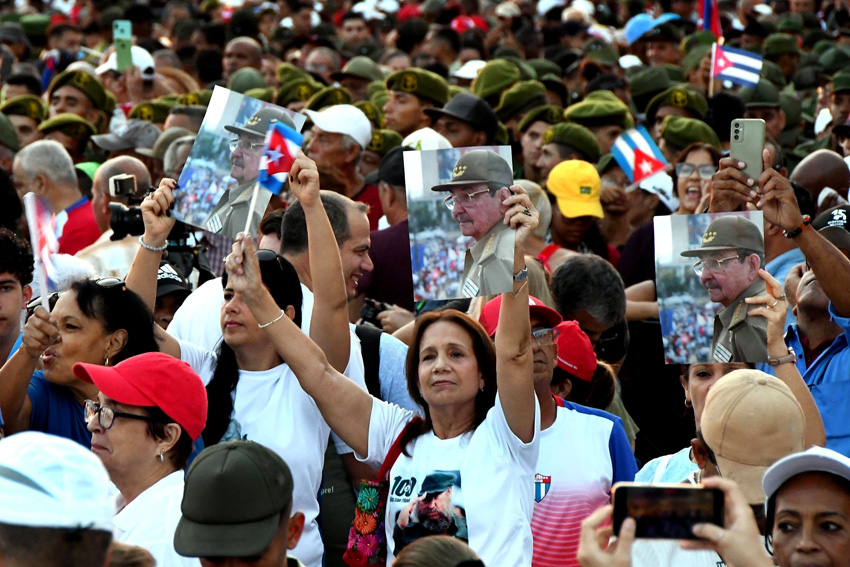
Cuba’s Permanent Representative to the United Nations says Havana is taking the threat of a possible US military aggression against the island seriously and preparing its population to defend the country.
Ernesto Soberon said Cuba holds defence preparations every Friday to safeguard its sovereignty, independence and territorial integrity.
‘We must be prepared for any scenario, including a military one,’ Soberon Guzman said.
He pointed to Washington’s threats of military action against Cuba and its actions on the international stage in recent years as further reasons for Havana to remain vigilant.
The Cuban diplomat made clear, however, that Havana does not seek military confrontation and remains hopeful of normalising relations with Washington.
He said Cuba is ready to engage in dialogue with the United States on the basis of mutual respect and recognition of its sovereignty.
Recently, US President Donald Trump threatened a US military aggression against Cuba on the ‘way back from Iran’.
Also in March, Trump told reporters at the White House that he believed he would have ‘the honour of taking Cuba’.
The Trump administration has presented the pressure campaign as an effort to force political and economic changes on the island, while Cuban officials have rejected Washington’s attempts to dictate the country’s political future.
The pressure has already taken a heavy toll on Cuba’s energy system, with the island suffering repeated nationwide power-grid collapses amid worsening fuel shortages and mounting economic strain.
However, Cuba’s top diplomat has issued a warning to the United States against any attempts at military intervention or domination, sharply condemning the recent escalation of hostile rhetoric from Washington that has included open threats of regime change and covert intelligence recruitment.
‘We reject every threat related to US ambitions toward Cuba,’ Cuban Foreign Minister Bruno Rodriguez wrote in a post on X last Friday.
‘Our coastline is full of beautiful beaches, but there are also razor-sharp limestone spikes, an inhospitable environment for those who make it to our shores with hostile purposes and lust for domination.’
Rodriguez’s reference describes the razor-sharp, jagged coastal limestone and coral formations that line much of the Cuban coastline, historically making unauthorised amphibious landings exceedingly difficult and dangerous.
The Foreign Minister’s remarks were a direct response to comments made earlier on Friday by US President Donald Trump at a campaign rally in Fort Myers, Florida.
Addressing the crowd, Trump boasted about US naval movements, stating that American ships returning from the war in Iran ‘will pass Cuba’ and that ‘we’ll have one of them stop about 50 yards off the coast’.
‘They’ll raise up their hands. And then we’re going to send (Secretary of State) Marco Rubio in to finish up the deal,’ Trump declared – openly hinting at a forced capitulation of the Cuban government.
The diplomatic war of words was further inflamed by an unusual and provocative move by Secretary of State Marco Rubio, who publicly called on Cuban citizens to make ‘discreet’ contact with American intelligence services to help overthrow the island’s government.
‘To those who seek to create positive change in Cuba – now is the time,’ Rubio posted on social media. ‘The disappointment of failed promises, corruption, and the privileged lives of only a few; seize this opportunity to create the change you desire through a discreet partnership with the CIA.’
The public recruitment drive evokes memories of the CIA’s long history of covert operations against Havana, most notably the disastrous Bay of Pigs invasion in 1961.
Cuban hospitals are facing a deepening healthcare crisis as decades of illegal and crippling US sanctions, intensified under Trump, exacerbate shortages of medicines, food, medical equipment and electricity, putting patients’ lives at risk.
Cuban doctors are struggling to save lives as decades of US economic sanctions, tightened by the Trump administration, deepen shortages of medicine, medical equipment, food, and electricity, turning the country’s hospitals into battlegrounds against a growing healthcare crisis.
From improvising infant formula with local ingredients to manually pumping oxygen for patients when ventilators fail, medical staff say they are being forced to fight for their patients’ survival with increasingly limited resources.
The challenges facing Cuba’s healthcare system were recently highlighted in a report by CBS News’ 60 Minutes, which examined the impact of escalating US pressure and restrictions on the country’s medical sector.
At William Soler Paediatric Hospital in Havana, Dr Alejandro Chong, head of the intensive care unit, described how doctors are forced to improvise when specialised infant formulas are unavailable.
In one case, a severely malnourished two-month-old baby had to be given alternative formulas made from malanga, a local root vegetable, and chicken.
Chong also warned that frequent power outages pose serious risks to critically ill patients, particularly those dependent on ventilators or undergoing surgery.
Doctors have sometimes been forced to finish operations using cellphone flashlights, while manually providing oxygen when ventilators stop working.
The crisis extends beyond electricity and infant nutrition. According to doctors quoted by CBS, cancer drugs, anaesthetics, and laboratory equipment are also in critically short supply.
Medical staff say they are increasingly unable to provide patients with the treatment they need.
Dr Lórien Rodríguez, a second-year paediatric surgery resident, said shortages of personnel and medical resources have made their work increasingly difficult.
She added that doctors are constantly forced to tell patients they cannot help them because of the lack of supplies.
The crisis has also driven many Cuban doctors to abandon the profession or leave the country, while those who remain struggle with low wages and are forced to take second jobs.
Dr Chong earns more from his food stand than from running the hospital’s ICU, while Rodríguez works as a radio announcer to support herself.
The crisis unfolding inside Cuba’s hospitals is part of a much longer history of US-imposed hardship on the island, dating back more than six decades.
The roots of illegal US sanctions against Cuba go back to the revolution that overthrew the dictatorship of Fulgencio Batista on January 1st, 1959.
Batista had ruled Cuba through an authoritarian regime and enjoyed the support of Washington because of his anti-communist stance.
Fidel Castro’s movement came to power promising profound social and economic change, including land reform and an end to the dominance of foreign corporations over the island’s economy.
The United States initially recognised the new Cuban government, but the relationship rapidly deteriorated as the new Cuban leadership began restructuring an economy in which American companies had held enormous influence.
One of the revolution’s most consequential early measures was its agrarian reform programme, introduced in May 1959.
The law targeted large landholdings and restricted foreign ownership of land, challenging an economic order in which US companies and wealthy landowners had controlled substantial parts of Cuba’s agricultural wealth.
The Cuban government subsequently began taking over foreign-owned farms, businesses, and other assets.
While these measures were presented by Havana as an effort to reclaim national resources and redistribute economic power, Washington viewed them as a direct threat to American corporate profits and its longstanding economic control over the island.
The confrontation escalated in 1960.
After Cuban authorities took control of US-owned oil refineries in June, the Eisenhower administration cut most of Cuba’s remaining sugar export quota to the United States in July.
Sugar was the backbone of the Cuban economy, and the US market had been its principal destination.
Havana responded by nationalising additional US-owned property.
On October 19th, 1960, Washington imposed an export embargo on Cuba, initially allowing exceptions for certain food, medicines, and medical supplies.
Washington used its dominant position in trade and finance to punish the new government for challenging American interests in Cuba.
The loss of the US sugar market and the growing restrictions on trade pushed Havana to seek alternative economic partners, particularly the Soviet Union.
Washington then treated Cuba’s closer relationship with Moscow as another reason to intensify its coercive measures.
In January 1961, the United States severed diplomatic relations with Havana.
Economic pressure was accompanied by direct US efforts for so-called ‘regime change’ in Cuba.
In April 1961, a force of Cuban exiles trained, financed, and supported by the CIA invaded Cuba at the Bay of Pigs in an attempt to overthrow Castro.
The disastrous Bay of Pigs invasion failed, but it exposed the extent to which Washington is prepared to go to reverse the outcome of the Cuban Revolution.