
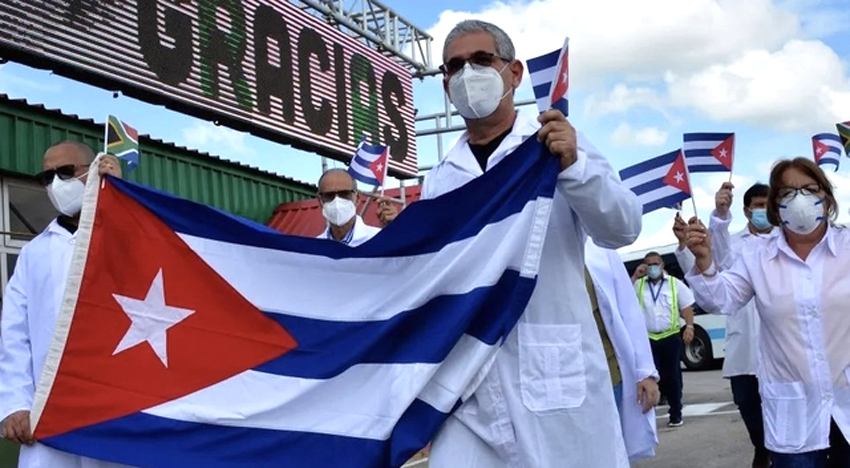
Bruno Rodríguez, Cuba’s Foreign Minister, on Thursday denounced the US administration of President Donald Trump for trying to pressurise countries into refusing the help of the Cuban Medical Brigades.
The Cuban Medical Brigades is a group of doctors, nurses and other medical staff who go to countries around the world to help them with providing medical services and are used extensively, particularly where there is a crisis.
Cuban Foreign Minister Bruno Rodríguez said that the United States government is actively engaged in pressuring and extorting other nations to remove the presence of Cuban Medical Brigades.
This action, according to Rodríguez, is part of a broader strategy by Washington to ‘economically asphyxiate the Caribbean nation, utilising ‘mendacious pretexts’ in its campaign, a tactic Washington has consistently employed for over six decades against Cuba’s commerce, investments, bank transfers, and other legitimate sources of income.
Rodríguez further highlighted that these brigades significantly aid in the development of healthcare systems by providing experienced human resources. He stressed that their personnel are contracted voluntarily and legally, adhering strictly to international norms and standards.
The text of his statement reads: ‘The US government persecutes, presses and extorts other governments to end the presence of Cuban Medical Brigades in various countries, under mendacious pretexts as usual.
‘It has done so for more than six decades with our trade, investments, bank transfers and any other type of income to our economy, with examples more than obvious and well-known.
‘Cuban medical missions perform solidarity work in hard-to-reach places; they help develop health systems with experienced human resources; and their personnel are hired voluntarily, legally in compliance with international standards.
‘The objectives of the US government and the media campaign that it is developing are to continue curtailing the Cuban economy and cutting off legitimate sources of income in order to choke the people of Cuba.’
The Cuban international assistance mission began in 1963 with its inaugural deployment to Algeria, an initiative driven by the visionary leadership of revolutionary Commander Fidel Castro.
Following the departure of French doctors after Algeria’s independence, Castro called for volunteers to assist a nation facing severe healthcare deficiencies.
He stated at the time ‘Today we can send only 50 doctors, but within eight or ten years, who knows how many, and we will be helping our brothers.’
Since that pioneering mission in Algeria over 600,000 Cuban professionals have provided services in 165 nations across the planet, establishing a profound legacy of humanitarian aid and international medical cooperation.
Initiatives such as the Comprehensive Health Programme in 1998, established in the aftermath of Hurricanes Mitch and Georges in Central America, the formation of the Henry Reeve Contingent, and Operation Miracle, collectively underpin a distinguished history of service.
These programmes have consistently delivered healthcare in rural areas, low-income communities, and regions severely affected by natural disasters and epidemics.
Despite this extensive history of humanitarian aid, Washington-promoted smear campaigns have unfortunately led to the cessation of cooperation agreements in Central America and the Caribbean.
In Honduras, following the decision by the government of Nasry Asfura to terminate collaboration, Cuba’s Ministry of Public Health reported the interruption of work that, until its cessation, had accumulated over 30 million consultations and nearly 900,000 surgical interventions in those territories. This abrupt end to vital medical services has left numerous communities vulnerable and without access to essential healthcare.
Similar situations have unfolded in Guatemala, where a gradual withdrawal of Cuban specialists, present since 1998, was recently announced.
Furthermore, Jamaica’s government also rescinded its cooperation agreement on 4th March.
These terminations, driven by external political pressure, underscore the direct impact of US policies on the health and well-being of populations in the region.
Nevertheless, Cuba maintains that these actions are not only hostile towards its sovereignty but also detrimental to the healthcare access of vulnerable populations.
This pattern of interference highlights a broader geopolitical struggle where humanitarian aid is weaponised in pursuit of political objectives.
On Thursday, several Panamanian political figures sent an open letter to the United States government demanding an end to the blockade imposed on Cuba, which has been in place for more than six decades.
The letter, titled ‘Cuba Is Not Alone: A Call for Solidarity from Panama,’ was signed by former leaders of the Democratic Revolutionary Party (PRD), founded in 1979 by General Omar Torrijos.
Among the signatories are Mitchel Doens, Pedro Miguel Gonzalez, Hector Aleman, and Elias Rios, who denounced the measures taken by the US President Donald Trump’s administration, aimed at economically and politically suffocating the Cuban people.
The politicians stated that false arguments, such as portraying Cuba as a threat, are being used to justify renewed pressure and create a scenario of destabilisation against a country that defends its independence.
The letter recalled that the United Nations General Assembly has repeatedly condemned the economic blockade, demonstrating a global consensus in favour of respect for international law and the self-determination of peoples.
The signatories emphasised that Cuba, far from being isolated, enjoys the solidarity of nations and citizens worldwide, which reinforces its position as a symbol of resistance.
The document urged Panamanians to adopt a firm stance, consistent with national history, to defend sovereignty and support those facing external pressures.
On Thursday, Mexican President Claudia Sheinbaum stated that she was proud to support Cuba, noting that this action represents Mexico’s finest diplomatic tradition and its historical fraternity with other countries.
She recalled that Mexico has supported various countries, including El Salvador and Honduras, with the ‘Sowing Life’ programme, and Chile and Haiti in the face of natural disasters.
She emphasised that Mexico maintains a tradition of international solidarity, stressing that all Mexicans should be proud of this fraternity, as it reflects a commitment to the self-determination of peoples.
Regarding the oil shipment to Cuba, Sheinbaum clarified that it is humanitarian aid and that a scheme is being sought that does not negatively impact Mexico, while Cuba receives fuel from Russia.
Recently, Sheinbaum defended Mexico’s healthcare cooperation with Cuba, confirming the continuation of the agreement to hire Cuban doctors.
She recalled that Cuban doctors were crucial during the Covid-19 pandemic, providing care under difficult conditions, and are currently supporting remote areas of Mexico.
- On Thursday, Cuban President Miguel Diaz-Canel took part in a forum organised by the United Nations on unilateral sanctions around the world.
During his intervention, he denounced that the US energy blockade is causing a severe impact on Cuba’s health sector.
Diaz-Canel said: ‘More than 96,000 Cubans, including 11,000 children, are waiting for surgeries due to the lack of electricity.’
He is also warning that 16,000 patients who need radiotherapy and nearly 3,000 who depend on dialysis are affected by the shutdown of services amid energy problems.
The Cuban leader also said that public and private transportation are practically paralysed due to fuel shortages.
Companies and food production have also been heavily affected by the US oil blockade implemented since January.
Diaz-Canel added: ‘Beyond these figures, it is impossible to quantify the physical and psychological exhaustion.
‘Cuba is experiencing a flagrant, deliberate and unjustified violation of the human rights of an entire people and of the freedom of trade of third countries.
‘The determination of Cubans to defend our absolute sovereignty is total.
‘We will not forget those who, in the face of abuse and blackmail, stood on the side of justice and raised their hands and voices without fear.’