
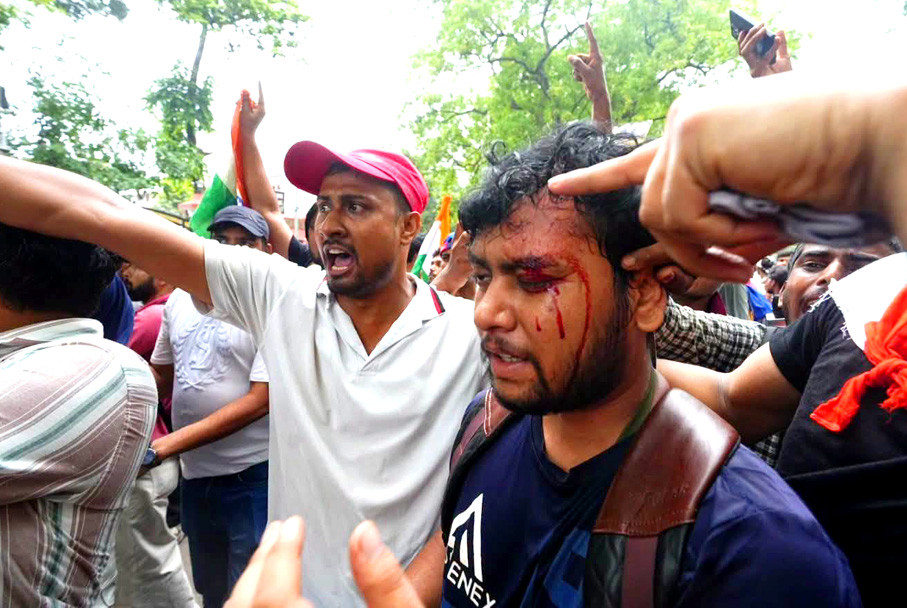
INDIA’S Education Minister Dharmendra Pradhan was forced to resign last Saturday after weeks of protests demanding he be sacked over exam paper leaks and testing irregularities.
After years of frustration, high unemployment and feeling ignored by mainstream politics, young Indians founded a group to unite them, the Cockroach Janta Party (CJP).
CJP founder Abhijeet Dipke announced news of the education minister’s resignation at Delhi’s Jantar Mantar.
The crowd erupted into a loud cheer as he yelled: ‘We have done it!’
From the start of the protests seven weeks ago, the CJP said their core demand was Pradhan’s resignation.
But the movement has also been demanding a complete overhaul of India’s education system, with greater accountability for alleged exam paper leaks.
The protesters were angry over the cancellation of India’s top medical entrance exam – the National Eligibility cum Entrance Test, Undergraduate (NEET-UG), after a paper leak in May.
The CJP said the minister should take moral responsibility for the leak and quit.
The CJP has also demanded 10m rupees (£77,737) in compensation for the families of NEET aspirants who allegedly died by suicide after the paper was cancelled, and the withdrawal of all cases against all protesters.
Since news of Pradhan’s resignation broke, politicians from all parties have made their way to Jantar Mantar.
But as speeches were being made from the stage on Saturday, one slogan cut through all the celebrations – ‘Just because you’re in the opposition, don’t smile too much!’ protesters yelled.
They continued: ‘Accountability is a system now. We’ll ask you the same questions.’
Thousands more made their way to Jantar Mantar as news of Pradhan’s resignation spread.
A nearby road was closed and police erected barricades, forcing young people to get out of their tuk-tuks and continue on foot.
India’s opposition leaders welcomed Pradhan’s resignation, with many calling it a victory for the youth-led protest movement.
Congress president Mallikarjun Kharge called it a ‘victory for the millions of our youth who took to the streets to demand an overhaul of the education system across the country’.
Veteran politician Sharad Pawar called it a ‘major victory for the united power of the nation’s youth.
‘This struggle – in which the youth stood firm against injustice without fear of suppression and compelled the government to accept moral responsibility – stands as a testament to the strength of democracy,’ he wrote on X.
Samajwadi Party leader Akhilesh Yadav called it a ‘big victory for the youth’, but said it should serve as a lesson to all political parties to strengthen examination systems and prevent paper leaks in the future.
Aam Aadmi Party leader Arvind Kejriwal also called it a ‘big win for democracy.’
Meanwhile, since July 20, a team of advocates from the Bombay High Court has been providing free legal assistance to students detained during protests held across Mumbai.
On July 20, Supreme Court advocate Garima K acted swiftly after being contacted by a 24-year-old youth who was gravely injured during the police crackdown at Jantar Mantar amid the protest led by the Cockroach Janata Party (CJP) against the NEET paper leak.
As soon as she learnt about his detention by the Delhi Police, she sent her team of junior counsels to the North District police station at around 10.00pm.
She is one of many lawyers who have stepped forward to help detained protesters. She said: ‘This collapse of law and order was entirely avoidable through democratic dialogue, yet authority chose coercion.
‘Invoking fundamental guarantees under Article 22(1) for legal counsel, Article 21 for physical integrity, and procedural mandates under BNSS for grounds of arrest and mandatory medical examination, my team of lawyers asserted the rule of law and ensured the immediate release of the detained protester.
‘Independent advocates remain available 24/7 to extend legal aid. If you require legal assistance, my doors are always open to defend your constitutional liberties,’ she added.
The advocate is among a growing list of lawyers offering pro bono legal assistance to protesters. The list, carrying the names and contact details of lawyers, surfaced on social media soon after reports of detentions during the protest emerged.
Supreme Court advocate Gaurav Pachauri, a partner at Kartavya Law Firm, told reporters: ‘On the morning of July 21, 2026, I received a call from Mr Wasim informing me that his friend, Shahnawaz, had been detained by the police for more than 24 hours and was likely to be produced before the SEM Court in Jahangirpuri, Delhi.
‘I immediately deputed my associate, Mr Ashish Mundare, to appear before the court and ascertain the facts.
‘Upon reaching the court, he discovered that the detainee had indeed been kept in police custody for more than 24 hours and had been shifted between multiple police establishments before being produced before the learned Special Executive Magistrate.’
He added: ‘My associate appeared before the court, and the detainee was ultimately released on bail after furnishing a bond to maintain peace.
‘This incident is a stark reminder that personal liberty is a cherished fundamental right protected under the Constitution of India.’
He explained that Section 58 of the BNSS requires that a person arrested without a warrant cannot be detained for more than 24 hours, excluding the time necessary for the journey to the magistrate, unless further detention is authorised by a magistrate in accordance with law.
‘The legal aid initiative has been coordinated by me and fellow lawyers,’ Advocate Piyush Todkar said.
He recalled: ‘A protest was scheduled at Chaityabhoomi, Dadar, at 4.00pm on July 20. However, several organisers were reportedly placed under preventive detention the previous night.
‘Despite this, a large number of protesters gathered in Dadar and were detained before reaching the protest venue. Several students were picked up from Dadar railway station and shifted to Mahim, Sion, Worli, Kalachowki, Satan Chowki, Dadar and Shivaji Park police stations.’
He said the detained students’ mobile phones were allegedly seized but were returned after the police were questioned about the absence of any seizure procedure.
‘Detentions have continued at several locations across Mumbai… Advocates are visiting different police stations to provide legal assistance to the detained students. Senior Advocate Mihir Desai has extended significant guidance and support throughout these legal efforts,’ Advocate Todkar said.
The list of lawyers willing to volunteer continues to grow, as seen in an Instagram post by Advocate Manu Abhishek Bhardwaj. The post is separate from the directory prepared earlier.
Around 70 protesters were detained by the Delhi Police during last Monday, 20 July’s protest. While the police accused the protesters of displaying ‘unruly, aggressive and violent behaviour’.
They accuse the police and the RAF of using brute force, including nailed batons, electric shocks and tear gas.
Amid the unrest, independent lawyers have been working actively to assist detained protesters. What began as a voluntary effort by a handful of lawyers soon evolved into an organised network to reach and provide legal aid to detainees.
- India’s latest crackdown on the press has seen the arrests of a number of regional media workers.
The International Federation of Journalists (IFJ) and its affiliate, the Indian Journalists Union (IJU), condemn the use of harassment and intimidation to silence journalists in India and urge the state and national authorities to respect press freedom.
Those arrested include Kashmiri journalist Irfan Mehraj in connection with a terrorism case and journalists Sanjay Rana and Jaspal Singh for their comments on local Bharatiya Janata Party (BJP) politicians.
On March 20, 2023, Kashmiri journalist Irfan Mehraj was arrested by the Indian National Investigation Agency (NIA) for his alleged involvement in the financing of terrorist operations
The freelance journalist was arrested as a part of the NIA’s ongoing probe into Kashmir non-profit organisations, with the agency alleging that several organisations had sponsored terrorist or ‘anti-national’ activities.
In a separate incident, Fatehabad journalist Jaspal Singh was arrested on March 18, after the son of a BJP politician, Sumit Kumar, filed a police complaint for alleged defamation.
Kumar claimed that the journalist posted on several WhatsApp groups that his politician father had been involved in a gambling case lodged on March 16.
Police detained Singh on various charges, including defamation, the Information Technology act, and anti-caste discrimination legislation. The arrest has been criticised by local media.
The same week, journalist Sanjay Rana was also arrested in Uttar Pradesh after questioning Gulab Devi, the BJP state minister for secondary education, on unfulfilled campaign promises.
The IFJ said: ‘The IFJ calls on the Indian authorities to immediately release the three detained journalists and drop all charges against them.
‘The state and national governments must uphold their obligations to protect and promote press freedom and ensure that journalists can work without fear of reprisal.’
On 22 July, journalist Irfan Mehraj was released on bail in New Delhi. He was initially granted bail by a lower court, but the NIA opposed this and demanded the suspension of his release.
The Delhi High Court permitted his release on the condition that he remain in New Delhi and arrange his own accommodation. He still faces charges and the trial is ongoing.