
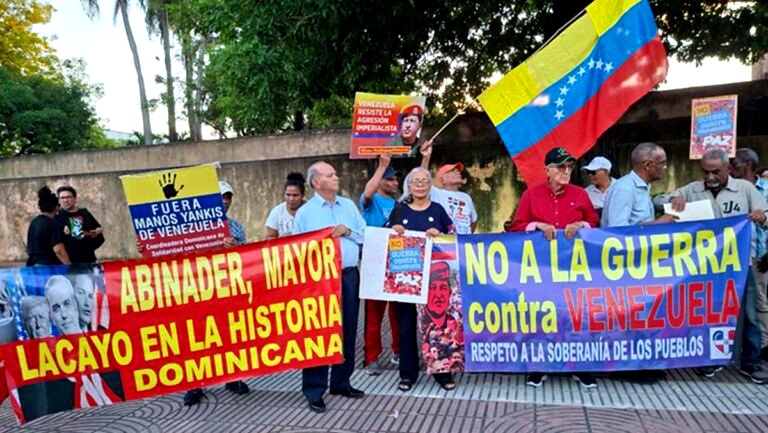
There were large protests in the Dominican Republic on Sunday after the Caribbean Island’s government agreed to the United States setting up ‘temporary military bases’ there.
‘Yankees out of the Caribbean’ was chanted by protesters at the demonstration which numbered several thousand in the capital Santo Domingo.
The Dominican government recently decided to temporarily grant the US access to an air force base and the country’s main international airport under the pretext of ‘combating drug trafficking’, several US military aircraft have arrived in the Dominican Republic, drawing widespread condemnation.
The latest US military deployment in the Caribbean is vast in scale. Dominican society, shaped by the historical memory of the 1965 US military intervention, has reacted with anger to the presence of foreign troops.
In the last week, large military aircraft have landed at Dominican airports. Fuel tanker trucks, buses, vans, light vehicles, communications equipment and other military supplies were seen in surrounding areas under tight security measures.
The left-wing National Popular Coordination group said: ‘The US military presence at airports and strategic infrastructure constitutes an “unacceptable intrusion” that could embroil the country in regional tensions and jeopardise peace in Latin America.’
Manolo Pichardo, former president of the Central American Parliament said: ‘The painful events of 1968 remain present in the collective memory of Dominicans. The controversy over the US military presence extends beyond drug control, human rights or democracy, and reflects Washington’s broader regional and global geopolitical strategy.
Nicaragua’s Co-President Daniel Ortega last Sunday condemned the United States expanding military footprint in Latin America and the Caribbean and branded US sanctions against Venezuela and his own country as ‘bites designed to paralyse nations with fear’.
Ortega said: ‘The empire’s strategy hasn’t changed.
‘They bark, they bite, they impose sanctions to terrorise the peoples – but we refuse to be intimidated.
‘Our main objective remains peace — peace with justice, peace with identity.’
The Sandinista leader traced today’s resistance to the liberating campaigns of Simón Bolívar who lead South Americas resistance against US imperialism and led to revolutions though out the continent, noting that while 19th-century traitors pushed for Central America’s annexation to the United States, popular revolutions blocked those plans and secured independence.
He warned that US President Donald Trump’s administration’s anti-drug narrative is merely cover for a regional militarisation aimed at encircling Venezuela and ‘stealing its oil’, and urged the ALBA group of Latin American nations who are fighting against the US, to stay united and creative in the face of seemingly ‘invincible’ enemies.
‘Powerful foes can be defeated — firmness and courage without ever stopping the march,’ he concluded, calling for renewed productive brigades, joint energy projects and the health missions first launched by leader of the Cuban revolution, Fidel Castro, and Venezuela revolution leader, Hugo Chávez, to shield the region from both sanctions and fear.
The Venezuela oil tanker seizure by US military forces in Caribbean waters triggered massive nationwide protests, with President Nicolás Maduro celebrating the mobilisations as the ‘Sovereign Force’ of Venezuela.
Speaking at a rally in Caracas Maduro said: ‘This is Yankee piracy.
‘The oil belongs to Venezuelans — whoever wants it must pay!’ ‘I would like to thank all the Venezuelans who are standing up to US imperialism, they are genuine, this shows grassroots participation. ‘These are real people in the streets — noble, dignified, brave, combative!’
Elsewhere, tens of thousands of Brazilians have taken to the streets to protest against a bill advancing in Congress that would significantly shorten the prison term of former President Jair Bolsonaro, who was sentenced to more than 27 years in jail for attempting to overturn Brazil’s 2022 presidential election.
Demonstrations, organised by trade unions, artists, and political parties, were held across major Brazilian cities including in the country’s two largest cities São Paulo and Rio De Janerio and the capital Brasilia on Monday.
Protesters voiced opposition to lawmakers’ efforts to soften penalties for Bolsonaro and his allies, including supporters convicted over the attack on government buildings in Brasília after his electoral defeat.
The rallies were the first major nationwide protests since Bolsonaro began serving his sentence last month.
The former president, whose far-right movement attacked the working class and indigenous people, reshaped Brazil’s political landscape, is being held in a specially prepared cell at a federal police facility in the capital.
The demonstrations followed a vote last week in the lower house of Congress, where a conservative majority advanced a bill that, according to its sponsor, could cut Bolsonaro’s sentence to just over two years.
The proposal now awaits debate in the Senate.
If approved, the measure would also reduce sentences for Bolsonaro’s supporters involved in the 2023 storming of government institutions in Brasília.
Even under the new rules, Bolsonaro, would remain barred from holding public office for another three decades.
The bill would further revise parole rules, allowing prisoners to move from full confinement to parole after serving one-sixth of their sentence, compared with one-fourth under current law.
President Luiz Inacio Lula da Silva, who defeated Bolsonaro in the 2022 election and plans to seek re-election next year, is expected to veto the bill if it clears the Senate.
Congress could override such a veto, a step likely to trigger challenges before Brazil’s Supreme Court.
Bolsonaro’s legal troubles have also drawn attention abroad.
In July, US President Donald Trump imposed a 50 per cent tariff on Brazilian goods, citing several reasons, including Bolsonaro’s trial, which he described as a ‘witch hunt’.
Brazilians, including President da Silva and the Supreme Court, condemned Trump’s actions as attempts to interfere in the country’s internal affairs.
- A group of protesters rejected the election of Jose Antonio Kast and were repressed by police officers, marking the first direct confrontation against the elected President of Chile.
In an atmosphere of growing political tension, detractors of the far-right President Elect Jose Antonio Kast expressed their rejection of the results announced by Electoral Council of Chile, in which Kast emerged victorious with 58.18 per cent of the votes against the progressive candidate Jeannette Jara, who obtained 41.82 per cent of the votes.
A large contingent of police officers (Carabineros, in Spanish), including Public Order Control officers, water cannon trucks, and riot police, moved into the square to disperse crowds. Videos from the scene and social media posts documented the repression against civilians.
The police action led to the closure of the nearby Baquedano and the Catholic University Metro stations as authorities worked to clear the area.
According to a report from local media, the clashes between supporters and detractors of the far-right President elected resulted in at least one arrest.
The protest unfolded hours after the announcement of Kast’s victory.
The Colombian President Gustavo Petro spoke in support of the demonstration on Sunday he stated: ‘From the south and from the north come the winds of death. Beware, Gran Colombians, they are coming for us, and we must resist with Bolívar’s sword held high and the stride of victors.
‘The pendulum does not return to its place because the Chilean people have always been progressive. From the southern ocean’s depths, the arrows of Arauco stopped the Spaniards. Fascism is advancing. I will never shake the hand of a Nazi or the son of a Nazi,’
Jose Antonio Kast is the youngest of 10 children of Nazi military officer Michael Kast Schindele and Olga Rist Hagspiel, who arrived in Chile after World War II. He will assume the presidency on 11th March, 2026, when the term of current President Gabriel Boric ends.