
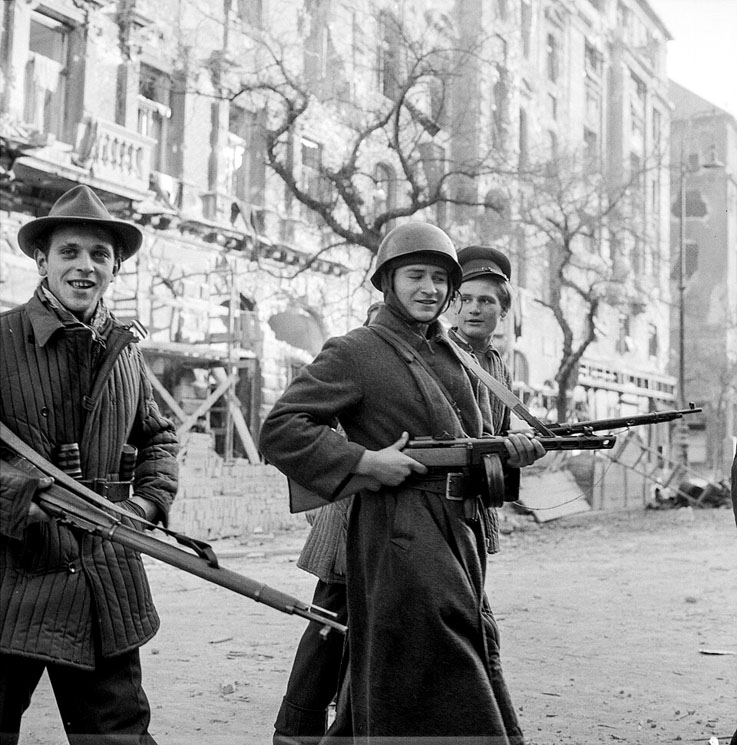
The Hungarian revolution was ignited on October 23rd 1956 when a demonstration called by students in the Hungarian capital Budapest to demand reforms and new elections for the leadership of the ruling Stalinist Communist Party was met with bullets from the secret police.
The background to the revolution that erupted on that day is bound up with the degeneration of the Soviet Union under the brutal dictatorship of Stalin.
Hungary had experienced a short-lived socialist revolution in 1919 that was swiftly crushed by an invasion by imperialist troops.
The infant socialist republic was replaced by a right-wing dictatorship headed by Miklos Horthy which allied itself with Hitler and played a role in the Nazi invasion of Russia.
In 1945 the victorious Russian Red Army marched into Hungary and Stalin wasted no time in establishing his authoritarian rule over the country.
Hungary for Stalin and the Stalinist leaders who followed him after his death in 1953 was treated as an appendage of the Soviet Union to be run by bureaucrats obeying all diktats from Moscow with their absolute rule enforced by a brutal secret police force – the AVH (State Protection Authority).
In 1955 the Hungarian economy was in crisis as the post war recovery was held up by high inflation and economic stagnation – a crisis accelerated by the economic demands on Hungarian production made by the Stalinist leadership in Russia.
The same crisis was reverberating across the countries of the Eastern Bloc and led to a wave of discontent from workers and youth.
This was accelerated following the speech by Russian president Khrushchev on February 25th 1956 in which he ‘denounced’ the crimes of Stalin.
Faced with a tide of workers and youth rising up in the Eastern Bloc and joining with workers in Russia posing a revolutionary threat to the Stalinist bureaucracy Khrushchev gambled on placing all the blame squarely on the shoulders of the dead Stalin.
In his speech Khrushchev damned Stalin and the ‘cult of the individual’ who had been transformed into a paranoid man ‘easily influenced by the rabid enemy of our party’.
He contrasted Stalin with Lenin who he exalted for leading the Russian revolution to victory.
If Khrushchev believed that exalting Lenin and the Bolshevik Party would in some way dampen down the anger of workers and youth in Hungary, he was badly mistaken.
Indeed invoking the spirit of Lenin, who led the first successful socialist revolution in history and who fought his entire life for the liberation of workers and the masses from capitalism across the world, had the effect of encouraging the youth and workers to demand their basic rights under a system that called itself socialist.
Encouraged by this speech into believing that the Stalinist bureaucracy was changing and meaningful concessions could be achieved by peaceful means students called the peaceful demonstration on October 23rd 1956.
Among the demands of the demonstrators was for Imre Nagy, a former prime minster who had been sacked and expelled from the Communist Party for not being hard enough, to be reinstated, fresh elections for a new leadership of the party, the withdrawal of Soviet troops from Hungary and free elections.
Tens of thousands of students and workers attended this peaceful protest which quickly turned ugly when members of the AVH opened fire on the demonstrators.
This ignited a revolutionary confrontation as workers, many of them armed, poured onto the streets of Budapest.
In panic, the Stalinist bureaucracy in Moscow ordered a military invasion of Hungary on 24th October to put down the revolution.
This invading force was met with ferocious resistance by workers and youth who fought on the streets with the Soviet soldiers.
These soldiers, some of whom had been lied to and told they had been sent to put down a fascist uprising, started to fraternise with the revolutionary Hungarian workers, to the extent that the Stalinist leadership feared losing complete control of the situation and ordered the withdrawal of Soviet troops.
On 25th October the bureaucracy attempted to buy time by removing the hardline leaders who had provoked the workers and bring back Nagy as prime minister.
Nagy’s first action was to declare martial law.
On the streets outside parliament 300 workers were killed by the AVH.
With any illusion that Nagy offered hope for changing the Stalinist bureaucracy dashed, revolution tore through the entire country at breakneck speed.
In every city and town throughout Hungary, workers set up workers councils that took control of municipal government and called general strikes to bring the country to a halt.
Workers councils were established at industrial plants and mines and many unpopular regulations like production norms were eliminated.
They demanded control over production, increased wages and a programme to rapidly increase house-building.
These revolutionary workers councils intended to manage industry while protecting the interests of workers and bringing in a socialist economy free from the rigid control of the Stalinist bureaucracy.
The revolution that seized power in the cities and towns was reflected in the countryside where peasants organised to send food to workers in the capitals free of charge.
In addition the peasants tore down the hated collectivised farms, run by bureaucrat functionaries, and passed a resolution declaring that farmers would not accept the return of capitalism and landlordism.
While the working class held the power, along with their allies in the peasantry, across the entire country in Budapest the official government of Nagy was completely sidelined and irrelevant.
In Moscow, Khruschev was gripped by the fear that the revolution that had swept Hungary would ignite a similar uprising by Russian workers in a political revolution to overthrow the Stalinist bureaucracy.
To crush the revolution Khruschev ordered a second invasion on Sunday 4th November.
This time, Khruschev ensured that the tanks came from the furthest region of the USSR from Hungary, but still felt it necessary to tell at least some troops that they were in fact in Germany fighting a fascist uprising.
Budapest was surrounded by Russian tanks and a combined attack involving air strikes, artillery and co-ordinated tank-infantry action from 17 Russian divisions launched a massive attack on the capital.
Fighting raged between the 15,000 revolutionary fighters and the Soviet army with the working class districts in the industrial centre offering the most determined resistance.
On the spot reporters at the time record Soviet tanks creeping along main roads firing indiscriminately into buildings while workers and youth took to the streets fighting to the end to defend their revolution.
Despite the overwhelming Soviet force and the brutal bombardment Hungarian workers, youth and the rural people fought on until the 11th November.
The last areas to succumb to the Soviet assault were located in the working class areas in Csepel and Dunaujvaros.
In total, 2,500 were killed and 20,000 wounded with Budapest bearing the brunt of the bloodshed, with 1,569 civilians killed.
Approximately 53% of the dead were workers while half of all Hungarian casualties were below the age of 30 years.
For approximately two weeks, the working class held the power in Hungary and despite the defeat of the revolution at the hands of the counter-revolutionary Stalinists, their fight resonates today amongst young people and workers across Europe and the world.
In the aftermath of the defeat, reformist and revisionist elements within the working class movement rushed to denounce the brutality of the Soviet and Hungarian Stalinists and denigrated the revolution by showering it with praise for its heroism while insisting that its defeat was inevitable.
The International Committee of the Fourth International (ICFI) alone stood for the unconditional defence of the Hungarian revolution and hailed its struggle in the fight for the programme first advanced by Leon Trotsky for the political revolution to overthrow the Stalinist bureaucracy and re-establish the rule of workers soviets and the gains of the October revolution.
Today on the 70th anniversary of the Hungarian revolution the working class with youth in the forefront are rising up across the world against a capitalist system that offers no future except wars and destitution.
Karl Marx called for workers of the world to unite, a call made in the very last radio broadcast by students occupying the Hungarian state broadcaster in 1956, they have nothing to lose but their chains while they have the world to win.
Now is the time to build sections of the International Committee of the Fourth International to provide the leadership required to lead the worldwide socialist revolution to its victory.
This is the way to celebrate the heroism of the workers and youth who fought for the Hungarian revolution.