
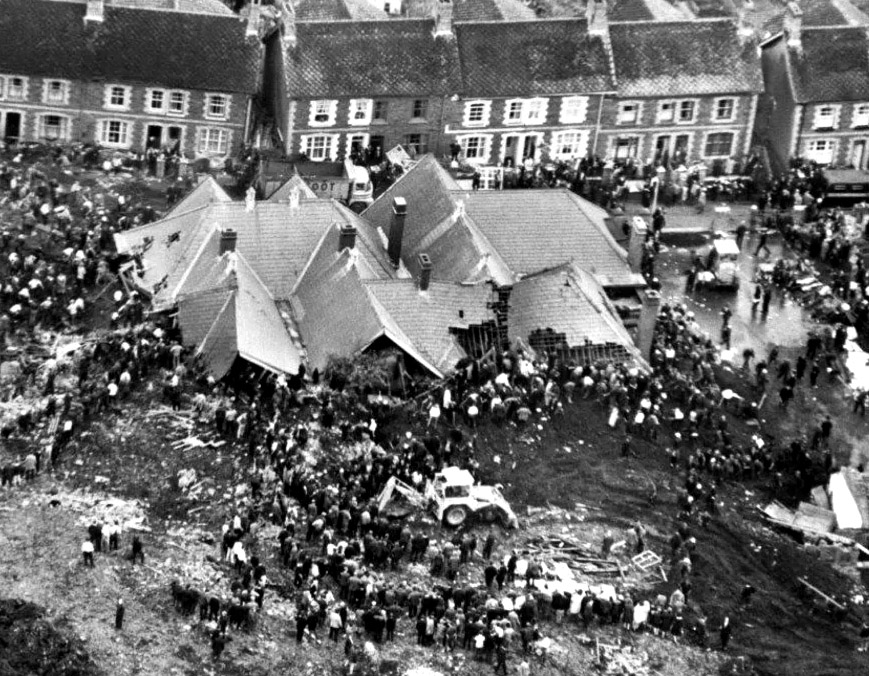
THE 21st October marks the 60th anniversary of the Aberfan disaster in the valley of the Taff south Wales. On 21st October 1966, with the Labour government of Prime Minister Harold Wilson in power, there was a catastrophic collapse of a colliery spoil tip, slag heap.
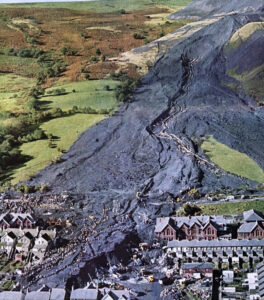
The tip had been created on a mountain slope above the Welsh village of Aberfan, near Merthyr Tydfil, and overlaid a natural spring.
Heavy rain led to a build-up of water within the tip which caused it to suddenly slide downhill as a slurry, killing 116 children and 28 adults as it engulfed Pantglas Junior School and a row of houses.
Coal was a nationalised industry and the tip was the responsibility of the National Coal Board (NCB), and the subsequent inquiry placed the blame for the disaster on the organisation and nine named employees.
Before the tragedy, local National Union of Mineworkers (NUM) branch officials in the Merthyr Vale Lodge were aware of the instability of tip number seven and the dangers of water logging, and warned that measures needed to be taken to make the area safe.
There were seven spoil tips on the hills above Aberfan; Tip 7 – the one that slipped onto the village – was started in 1958 and, at the time of the disaster, was 111 feet (34 metres) high.
In contravention of the NCB’s procedures, the tip was partly based on ground from which springs emerged.
After three weeks of heavy rain, the tip was saturated and approximately 140,000 cubic yards (110,000 metres) of spoil slipped down the side of the hill and onto the Pantglas area of the village.

The main building that was hit was the local junior school, where lessons had just begun; 5 teachers and 109 children were killed.
Residents whose homes were directly destroyed or rendered uninhabitable along Moy Road in Aberfan were not systematically provided with government-funded new homes as part of a mass housing relocation programme.
Despite the damning report, no employee or board member was prosecuted for manslaughter or any regulatory offence, and the NCB faced no corporate fines or criminal charges.
None of the staff members blamed by the tribunal were sacked, demoted, or disciplined, and the NCB chairman, Lord Robens, retained his position after his resignation offer was rejected.
Rather than a coordinated housing scheme, survivors and families mostly navigated private rebuilding, local council housing options, or psychological and social recovery, supported heavily by community efforts and the Aberfan and Merthyr Vale Community Centre (opened in 1973).
The Aberfan Disaster Memorial Fund (ADMF) was established on the day of the disaster.
It received nearly 88,000 contributions, totalling £1.75 million.
The remaining tips were removed only after a lengthy fight by Aberfan residents against resistance from the NCB and the government on the grounds of cost.
The site’s clearance was paid for by a government grant and a forced contribution of £150,000 taken from the memorial fund.
In 1997, the British government paid back the £150,000 to the ADMF, and in 2007 the Welsh government donated £1.5 million to the fund and £500,000 to the Aberfan Education Charity as recompense for the money wrongly taken.
Many of the village’s residents developed medical problems as a result of the disaster, and half the survivors have experienced post-traumatic stress disorder at some time in their lives.

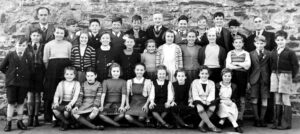
Gaynor Madgwick who was eight at the time of the Aberfan disaster said: ‘You couldn’t really describe what it was. That instinct of flight took over me.
‘I remember just putting a foot out to try and run for the door.’
Then the classroom window went black and in an instant she was swept away.
Madgwick’s brother Carl, seven, and sister Marilyn, 10, were among them.
Madgwick continued: ‘A generation was completely wiped out.
‘You don’t get a lot of sunlight in the valleys. When it rains, it just keeps on.
‘Another survivor was underneath me, another was next to me.
‘We couldn’t move – we were just pinned by all this debris.’
Last year, on the 59th anniversary of the disaster South Wales Fire and Rescue Service said: ‘59 years have passed since the Aberfan disaster.
‘Today, we come together to remember all those who lost their lives so tragically, and those left behind to grieve their loss.
‘The thoughts of us all, today and every day, are with the community of Aberfan.
‘We will never forget.’
The Aberfan Memorial Garden stands on the site of the former Pantglas Junior School.
The garden is of huge importance to the bereaved parents, siblings, next of kin, survivors and the whole community, as well as the thousands of visitors who come to pay their respects every year from around the world.
‘The world has not forgotten Aberfan,’ the chair of Aberfan Memorial Charity said.
Chairman David Davies continued: ‘Over the years thousands of people from across the world have visited the memorial garden …
‘The memorial garden will continue to be a place to visit, a tranquil place to pause and reflect. I know a lot of people can’t go to the cemetery here in Aberfan and that includes the surviving teachers because it’s too painful.
‘But many come here to the garden instead to remember and lay wreaths on the anniversary.’
The Memorial garden was refurbished in 2019.