
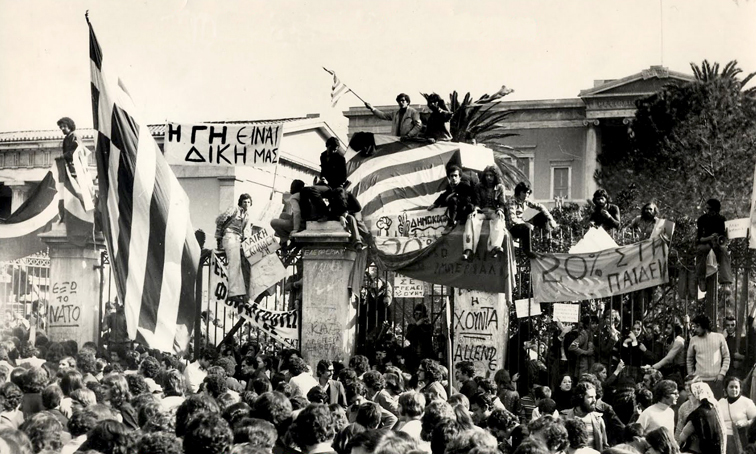
MANY thousands of students, young people and dozens of trade union delegations visited Athens Polytechnic over the weekend and on Monday to pay their respects to the student uprising of 17th November 1973 which led to the overthrow of the military junta’s dictatorship.
On that day, over 50 people were killed and hundreds injured by the dictators’ army as a tank stormed the Athens Polytechnic students’ occupation which was demanding the overthrow of the military dictatorship and the United States-NATO forces which backed it.
As trade union and school delegations laid wreaths on the Polytechnic Uprising Monument on Sunday, students shouted: ‘Bread, education, freedom!’ and ‘US imperialism out!’
Students’ Associations had set up hundreds of tables displaying their publications and large posters calling for ‘Our Generation’s Uprising’, ‘From France, Italy, Spain, Albania to Greece, Rise Up for Freedom’, ‘Victory to Palestine’.
The annual mass march to the USA Embassy in commemoration of the 1973 Athens Polytechnic Uprising took place yesterday (Tuesday) afternoon.
The Athens Polytechnic Uprising occurred in November 1973 as a massive student demonstration that turned the struggle against the Greek Military Junta of 1967-1974 (Regime of the Colonels).
It began on 14 November 1973 and escalated to an open anti-junta revolt.
It ended in bloodshed in the early morning of 17 November, starting with a tank crashing through the gates of the Athens Polytechnic.
It was the first public action against the Greek junta.
As early as 21 February 1973, the law students went on strike and barricaded themselves inside the buildings of the Law School in the centre of Athens, demanding the repeal of the law that imposed forcible conscription.
The police used brutal methods and torture against the students to try and put them down.
Then on 14 November 1973 students at the Athens Polytechnic (Polytechneion) went on strike and started protesting against the military junta.
The students were calling themselves the ‘Free Besieged’, a reference to the poem by Greek poet Dionysios Solomos.
Their main rallying cry was: Bread-Education-Liberty!
An assembly formed spontaneously and decided to occupy the Polytechnic.
Police had gathered outside but did not manage to break into the premises.
During the second day of the occupation (often called ‘Celebration Day’), thousands of people from Athens poured in to support the students.
A radio transmitter was set up, using laboratory equipment, enabling the occupation to run a pirate radio station, over which they ran broadcasts with requests for solidarity and aid.
The demands of the occupation were anti-imperialistic and anti-NATO.
Construction workers and some farmers joined in with the student protests.
During the afternoon, demonstrations and attacks against neighbouring ministries took place.
Central roads were closed, fires erupted and Molotov cocktails were thrown for the first time in Athens.
Students barricaded themselves in and repeatedly broadcast across Athens:
Polytechneion here! Polytechneion here! People of Greece, the Polytechneion is the flag bearer of our struggle and your struggle, our common struggle against the dictatorship and for democracy!
Under the fear that the uprising would become a trigger that would overthrow their regime, the Junta’s reaction was to escalate repression and violence.
On November 16, the police attacked the people gathered outside the Polytechnic with water cannons and batons. Many of the demonstrators were hospitalised with injuries. Barricades were immediately set up to prevent the police forces from approaching the building.
This failed police intervention led the Junta’s leader, colonel Georgios Papadopoulos, to order the army to intervene to crush the revolt.
At the early hours of November 17, three tanks were placed outside the Polytechnic. One of them pointed its cannon towards the main gate. The Coordinating Committee asked for negotiations, but their request was not granted.
At 3 am, one of the tanks received the order to invade the Polytechnic; while doing so, it crushed those climbed on and standing behind the gate. Immediately afterwards, terror and chaos prevailed; thousands of people were trying to escape the police and the ESA (Greek Military Police) brutality, as well as the snipers’ gunfire coming from rooftops of buildings around the Polytechnic.
The total confirmed number of injured between 15 and 17 November was up to 1,103.
The Papadopoulos government then reimposed martial law.
Each year the annual march starts near the grounds of the Polytechnic, and the Greek working class remembers the Athens Polytechnic Uprising with pride.
The best way to remember it today is to fight for an all-out indefinite general strike to bring down the Israel-supporting Greek bourgeois government and go forward to a workers’ government and a socialist society.