
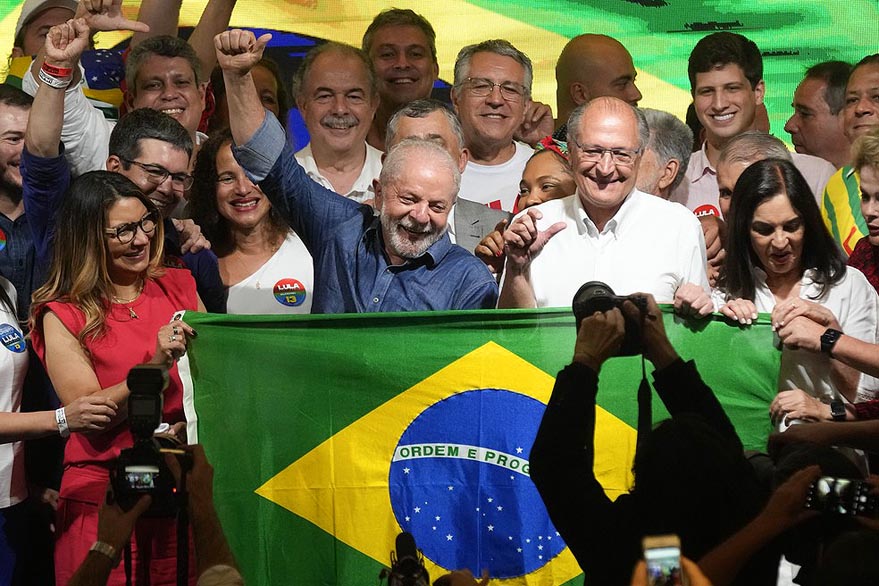
BRAZIL’S left-wing president Luiz Inácio Lula da Silva won a spectacular victory to defeat his right-wing rival Flávio Bolsonaro in the presidential election on Sunday, leading to wild cheering and dancing in the streets of cities in Brazil and all across Latin America.
Lula defeated Bolsonaro in the presidential runoff, with 51.79% of valid votes, or more than 60 million ballots, compared with Bolsonaro’s 48.21%.
The margin exceeded four million votes.
This marks the first time since Brazil’s return to direct presidential elections in 1989 that a candidate who finished second in the first round reversed the result in the runoff.
Lula, a former metalworker, who has already served three terms as president, lost the first round of voting and many had not thought it possible for him to turn the result around in just three weeks.
But his campaign sprang back, driven by huge street demonstrations as large as one million-strong and a massive social media push – his new term as president begins on 5th January 2027.
‘I just had to tell you that I love you. Tomorrow, the fight continues,’ Lula told cheering supporters at a victory parade in Sao Paulo. ‘No one is required to like the president-elect, but he must govern for everyone.’
Born into a poor family in 1945, Lula sold peanuts as a child, only learning to read aged 10. He became a metal worker in his teens, losing a finger in an industrial accident in the 1960s.
As a trade union member and activist, he was elected head of the Metalworkers’ Union in 1975. Five years later, he founded the Workers’ Party (Partido dos Trabalhadores or PT) – Brazil’s first major socialist party.
Winning the Brazilian presidency in 2003, Lula made social equality a central plank of his early premiership, funnelling billions into grant programmes like the Bolsa Familia.
In this election, Lula won in more than 200 municipalities where he had lost just 21 days earlier.
He carried Minas Gerais, Brazil’s second most populous state and also managed to reverse the result in the city of Rio de Janeiro, long considered one of the Bolsonaro family’s political strongholds.
Celebrating Lula’s victory, Maira de Mello Cabral e Matos, 42, was ‘overjoyed’ with the result, adding that the Bolsonaro family posed ‘a very serious threat’. ‘I already thought we were going to win because of the strength of the popular mobilisation and I think that made history. Let’s keep going.’
In his victory speech, Lula signalled that Brazil would pursue an independent course in foreign affairs, insising that Brazil ‘does not accept being anyone’s backyard’.