
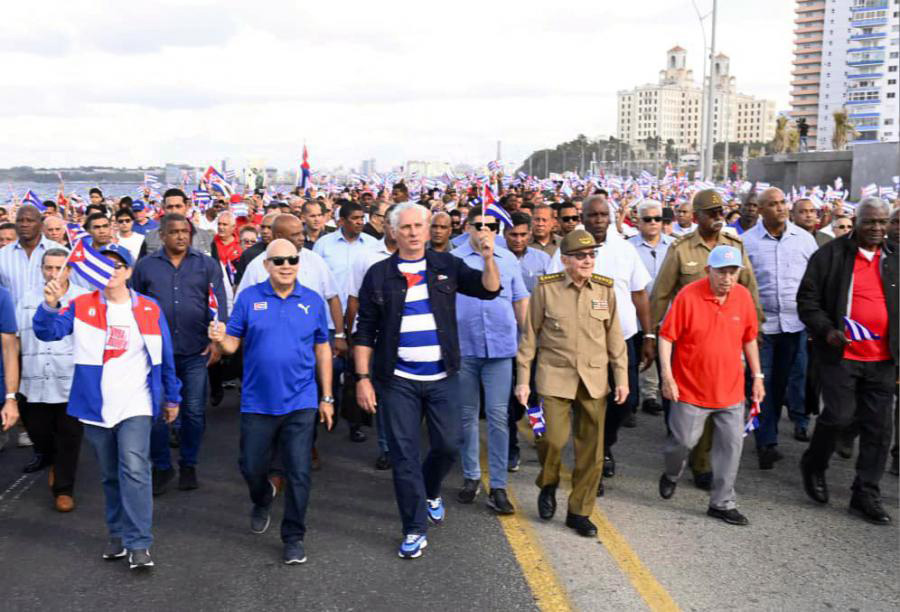
On Friday, thousands of Cubans joined the ‘March of the Fighting People’ to honour 32 Cuban soldiers who were killed during a US military operation carried out in Venezuela on 3rd January when President Nicolas Maduro and first lady Cilia Flores were kidnapped.
As they marched through the streets of Havana, demonstrators sent a clear message to US President Donald Trump: Cuba does not fear imperialism and will defend its independence and sovereignty.
‘Down with imperialism! Yes to Cuba,! No to Yankees! Bring President Maduro back!’ and ‘Justice for the fallen!’ were among the chants voiced by thousands of Cubans as they waved national flags.
Young people, students, workers, scientists, and artists took part in the march, which was led by Cuban President Miguel Diaz-Canel Bermudez and other revolutionary government officials.
Diaz-Canel said: ‘We knew they would behave like titans even in their final battle.
‘They not only defended the sovereignty of Venezuela – President Maduro and his wife.
‘They defended human dignity, peace, the honour of Cuba and of our America.
‘They will always be the reminder that there is no small people when it is a steadfast people.
‘When an energetic and virile people cries out, injustice trembles.
‘Cuba does not threaten or challenge; Cuba is a land of peace.’
In his speech, he emphasised that the history of the Cuban people is linked to unity and courage, concluding his emotional message with a warning to US imperialism.
Mayara Rodriguez, a Cuban citizen said: ‘Cuba does not forget its children.
‘They are heroes. This people march for them, showing their love and respect. Eternal glory!’
Before the march set off from The World Anti-Imperialist Platform headquarters in Havana, President Diaz-Canel delivered a speech honouring the 32 fallen fighters, warning the United States that coercion will not bend his nation.
He said: ‘There is no possible surrender or capitulation, nor any kind of understanding based on coercion or intimidation.
‘Cuba does not have to make any political concessions, nor will that ever be on the negotiating table for an understanding between Cuba and the United States.
‘Cuba does not threaten or defy. If we were to be attacked, we would fight with the same ferocity shown by several generations of brave Cuban fighters in the 19th century independence wars, in the Sierra Maestra guerilla, in the underground struggle, in Africa, and in Caracas in the 21st century.
‘They will not intimidate us. Their current threats remind us of the threats made by nearly all previous US administrations,’ the Cuban president concluded.
In an address to Venezuela’s National Assembly last Thursday, the country’s acting President, Delcy Rodriguez, delivered a pivotal annual message that reverberated with the core tenets of the Bolivarian Revolution: An ardent commitment to nationalism and the steadfast defence of the nation’s sovereignty.
Rodriguez’s discourse underscored Venezuela’s resolute posture, particularly when confronting the recently intensified geopolitical friction with the United States.
She accused US forces of orchestrating the kidnapping of President Nicolas Maduro and First Lady Cilia Flores on January 3rd, a grave accusation that set the stage for her comprehensive articulation of Venezuela’s approach to international relations and national dignity.
Her speech was not merely an update but a strategic declaration, designed to reinforce internal unity and project an image of unyielding resolve on the global stage.
Acting President Rodriguez’s address served as a potent reaffirmation of Venezuela’s inherent right to self-determination, a principle deeply embedded in the ethos of the Bolivarian Revolution.
She meticulously detailed how the current administration, under the leadership often associated with President Maduro, consistently prioritises the protection of its territorial integrity, political independence, and the autonomous decision-making processes that define a sovereign state.
Rodriguez emphasised that this potent nationalistic spirit transcends mere political rhetoric; it is, she asserted, the fundamental guiding force behind all governmental actions, domestic policies, and international engagements, specifically aimed at fortifying the nation against perceived external pressures and various forms of foreign intervention.
The Bolivarian government, since its inception, has consistently positioned itself as a vigilant bulwark against what it frequently describes as imperialistic ambitions, particularly from Western powers.
The kidnapping of President Nicolás Maduro and First Lady Cilia Flores by US forces, which she stated occurred on January 3rd.
This serious accusation marks a dramatic escalation in an already tense bilateral relationship, moving beyond economic sanctions and political pressures to direct action against the head of state.
Rodriguez articulated a dual strategy for addressing this perceived aggression: While Venezuela is committed to confronting such challenges through robust diplomatic channels, she asserted unequivocally that the nation’s sovereignty remains an absolute, non-negotiable principle.
Her message was thus a nuanced blend of seeking peaceful resolution through dialogue, while simultaneously conveying an ironclad resolve against any form of subjugation or external imposition.
The mention of the January 3rd incident, presented as a clear act of hostility, underscores Venezuela’s perception of targeted and extreme measures from Washington, further complicating the already precarious diplomatic landscape between the two nations.
Despite the severity of the accusations levelled against the United States and the stated intent for diplomatic engagement, acting President Rodriguez left no ambiguity regarding the conditions under which Venezuela would participate in any potential dialogue with the US government, specifically mentioning the administration of President Donald Trump.
She declared with profound conviction that any such interaction, even if it necessitated a journey to Washington DC for ‘conversations or contacts’, would transpire strictly on Venezuela’s terms and with an unyielding sense of national pride and dignity.
Her hypothetical description of such a visit was imbued with potent imagery and an unmistakable spirit of defiance.
Rodriguez’s resolve found its voice in a direct and powerful statement: ‘And I tell you, if one day I have to go to Washington as acting President, I will do it standing, walking, not crawling; I will do it with the tricolour flag, I will do it with the glory of the brave people marking the rhythm of my heart.’
Nicaraguan Co-President Daniel Ortega has said that his government still stands in full solidarity with the Venezuelan people.
Ortega stated: ‘Once again, I say that the kidnap of Venezuelan President Nicolas Maduro, the rightful president is a crime.
‘The bombing of the country by US military forces is also a crime and the stealing of oil is also unacceptable. It is not just Venezuela, they are coming for our oil.
‘The oil of South American and Central American countries whether that be Colombia or Nicaragua or Mexico – they want to take our resources our raw materials to enrich themselves, the richest people at the top, Trump’s people.’
He also went on to condemn their continued blockade of Cuba: ‘Sixty years of this blockade, terrible; it harms the entire Cuban people.
‘We will stand firm. We have shown in Nicaragua, over the course of decades, that we will not bend the knee to US imperialism.
‘They wanted to destroy our revolution, infiltrate with forces backed by the CIA.
‘They have done this in other places. In Chile, the US supported Pinochet. He did not have the support of the majority of the population.
‘The US and even Britain were behind the killing of Salvador Allende.
‘They opposed the Cuban revolution and developments in Colombia and Ecuador and Bolivia.’