
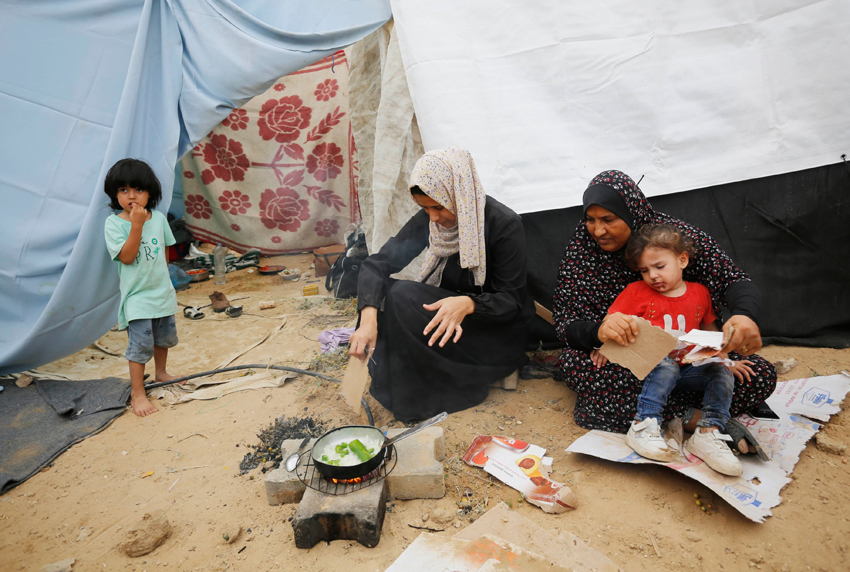
WHILE the world marked International Women’s Day on 8th March, women in the Gaza Strip are fighting a daily battle for survival amid the devastating war that has continued since the autumn of 2023.
In the displacement tents spread across the south of the Strip, many women have become the sole providers for their families after losing their husbands in the bombing, or after their families were scattered due to repeated displacement.
The role of women is no longer limited to caring for the family, it now includes providing food and water and securing the minimum necessities of life in an environment dominated by destruction and a shortage of resources.
In a worn-out tent in the south of the Strip, Umm Yusri, 42, tries to light a fire to prepare bread for her four children after losing her husband in a bombardment that targeted their home in Gaza City.
She says her life changed completely from that moment, as she became the mother, the father, and the provider at the same time.
Her day begins with searching for water, then collecting firewood from among the rubble to use as a substitute for gas, before becoming busy securing food for her children amid a severe shortage of basic supplies.
Gaza has been suffering for months from a severe crisis in cooking gas due to restrictions imposed on bringing it into the Strip, forcing many families to rely on firewood or primitive cooking methods, which increases the burdens placed on women who carry out most household work under difficult conditions.
Miram Madi, 35, stands next to her tent in the Al-Mawasi area of Khan Younis after moving with her family many times between the north of the Strip, its centre, and its south due to evacuation orders and airstrikes.
She says the most difficult thing she faced during those repeated journeys was searching for a safe place to shelter her children, noting that many displacement locations lack the most basic necessities of life such as clean water and sanitation facilities.
Miram’s experience reflects the reality of thousands of women who suddenly find themselves facing a life of displacement with all the constant anxiety and lack of stability it brings.
Statistics issued by the Palestinian Central Bureau of Statistics reveal the scale of human losses caused by the war, as the number of martyrs exceeded 72,000, in addition to more than 171,000 injured.
Among the victims are thousands of women and children, while local estimates indicate that more than 21,000 women lost their husbands during the war, making them the sole providers for tens of thousands of orphaned children.
A noticeable proportion of families in the Strip now depend entirely on women to manage daily life affairs and secure the family’s needs.
Suffering is not limited to living conditions, reports issued by the Palestinian Ministry of Women’s Affairs indicate that a large percentage of women in Gaza suffer from psychological disorders as a result of the war and continuous pressures.
These reports explain that rates of depression, anxiety, and insomnia have risen significantly amid the conditions of displacement, the loss of loved ones, and the absence of a sense of safety.
Despite this, many women try to hide their fears from their children in order to maintain the minimum level of psychological stability within the family.
Salwa Taha, 35, who lost her husband at the beginning of the war, says she tries to show strength in front of her four children despite the constant fear of bombardment.
She explains that she is forced to suppress her grief for family members lost in the war because her collapse could directly affect her children who depend on her for everything.
Samira Zamlut, 40, combines caring for her three children with caring for her blind father-in-law, helping him move, accompanying him to the health clinic, and working to provide his medicines alongside her other daily responsibilities.
Under these harsh conditions, women in Gaza have become the main pillar for the continuation of life within families torn apart by war. Between tents, rubble, and water lines, women continue to manage the details of daily life despite the loss of safety and stability.
Despite the dangers and psychological and social pressures surrounding them, the women of Gaza present an exceptional image of resilience, where the struggle for life becomes a daily task that requires a great deal of patience and strength.
On a day when the world celebrates the achievements of women, the message of the women of Gaza appears different, survival, protecting children, and preserving what remains of hope amid a reality that grows harsher day after day.
Meanwhile in Lebanon, the evacuation warning issued by the Israeli occupation army to residents of the southern suburb of Beirut was not merely a military warning for Palestinian refugees in Burj al-Barajneh camp, but rather a moment that brought back to the forefront the memory of displacement that has accompanied their lives for decades.
Within a few hours, the narrow alleys of the camp turned into a scene of confusion and anxiety, as Palestinian families hurried to gather whatever belongings they could and leave their homes, searching for a safe place amid the absence of any clear destination for displacement.
As the warning spread, calling on residents of wide areas of the southern suburb to immediately evacuate their homes, dozens of Palestinian families in the camp began leaving their houses or preparing to do so, amid growing fears of the expansion of Israeli air raids in the area.
Burj al-Barajneh camp for Palestinian refugees is located in the southern suburb of Beirut, and it was established in 1948 to shelter Palestinian refugees who were displaced from their cities and villages during the Nakba.
Today, the camp is considered one of the most densely populated Palestinian camps in Lebanon, where thousands of refugees live in a narrow area inside closely packed buildings and tight alleys, which increases the fragility of the humanitarian situation there during any escalation.
After the evacuation warning spread, several Palestinian families began leaving the camp or searching for somewhere to stay outside the southern suburb.
The entrances of the camp witnessed unusual movement as families left rapidly, while the surrounding roads became crowded with vehicles.
Residents reported that a number of families began leaving their homes carrying some basic belongings, amid fears that the bombardment could extend to the surroundings of the camp.
Abu Ahmad al-Haddad, one of the camp’s residents, says that the moment the warning was issued was difficult for Palestinian families.
They quickly gathered some clothes and important papers, ‘but the problem is that we do not know where we will go. The roads are crowded and everyone is trying to leave at the same time,’ he said.
Umm Mohammad Abdel Hadi says that her greatest fear is for her children, ‘We left the house without knowing where we will spend the night. The children are afraid, and we have already been refugees for many years, and now we feel that we are living displacement again.’
Abu Khaled al-Samouni points out that many families left without being able to carry more than a few of their belongings, adding, ‘People left quickly because everyone fears the bombardment. Some families left their homes as they were and could not take anything.’
In this context, Issa al-Ghadban, the official of the popular committee in Burj al-Barajneh camp, said that a state of severe concern prevails among Palestinian refugees in the camp following the evacuation warning that affected wide areas of the southern suburb.
Al-Ghadban explained that a number of Palestinian families have already begun leaving the camp or preparing to move to other, safer areas, amid fears that the bombardment could expand around the area.
He added that the state of confusion that accompanied the warning worsened the suffering of residents, especially in light of the absence of clear shelter locations that could accommodate families forced to leave their homes, as many refugees already live under difficult living conditions inside the camp.
Al-Ghadban confirmed that the fragile urban structure in the camp and the high population density there increase the level of concern among residents, noting that any targeting in the vicinity of the southern suburb could cause damage inside the camp due to the strength of explosions and shockwaves.
With tensions continuing, fears are increasing inside the camp of the possibility of a new humanitarian crisis if the Israeli raids expand in the southern suburb, especially in light of the absence of clear shelter locations capable of accommodating displaced families.
Residents of the camp also express concern about the possibility of the camp sustaining indirect damage even if it is not directly targeted, due to the intensity of explosions and shockwaves that could affect the closely packed and fragile buildings inside it.