
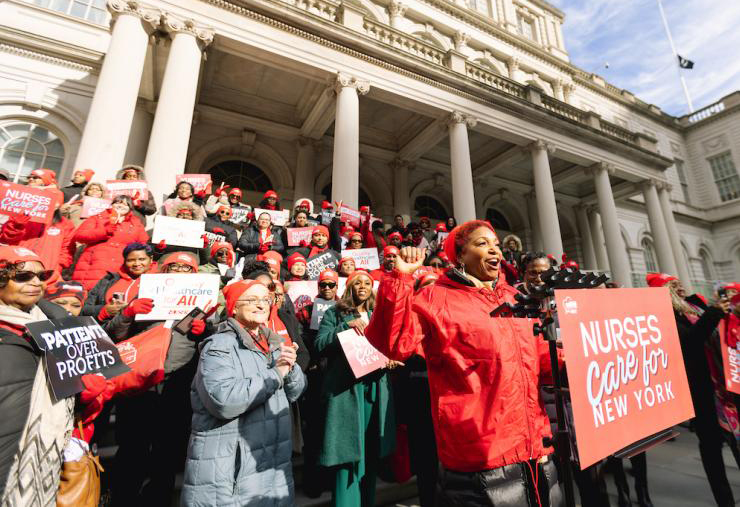
The largest nurses strike in New York City history ended at the weekend when the last holdouts in the 41-day labour action overwhelmingly voted to ratify a contract and agreed to return to work.
On Saturday, around 4,200 members of the New York State Nurses Association (NYSNA) employed by the private New York-Presbyterian system approved a contract that includes more than a 12 per cent increase in salaries over the life of the three-year deal.
The nurses and management of the New York-Presbyterian system also agreed to improve enforceable safe staffing standards, boost protection for nurses from workplace violence and, for the first time ever, provide safeguards for employees against artificial intelligence.
The union previously said the hospitals had threatened to cut health care benefits for frontline nurses and roll back safe staffing standards that were won by nurses after a three-day strike in January 2023.
The labour agreement was approved after about 10,500 NYSNA nurses employed by the private Montefiore, Mount Sinai Hospital and Mount Sinai Morningside and West hospitals approved a similar contract last week.
Some nurses in the system began returning to work on Saturday, officials said.
About 93 per cent of the NYSNA nurses in the New York-Presbyterian system voted to ratify the contract, and about seven per cent rejected the deal, which was announced on Thursday, according to the union.
Nearly 15,000 nurses in total walked off their jobs on January. 12 after declaring a stalemate in negotiations with management for the private hospital systems, making it the largest nurses’ strike in New York City history.
NYSNA President Nancy Hagans said in a statement: ‘This is a proud moment for our union … We are so happy with the wins we achieved, and now the fight to enforce these contracts and hold our employers accountable begins.’
Meanwhile, postal workers held a number of marches and rallies across the United States on Sunday to bring attention to their job concerns.
Members of the National Association of Letter Carriers, Branch 388, walked in front of the St. Cloud, Minnesota Post Office for about an hour to raise awareness about their upcoming contract talks.
The rally was part of a National Day of Action for letter carriers that took place in over 120 cities across the country.
Branch 388 President Jim Heim says they are fighting for a stronger contract, and they need the public’s support.
‘We’re looking for better wages, especially starting wages that have dramatically been cut starting in 2012 and haven’t bounced back.
‘We’re looking for better staffing, especially here in the St. Cloud area, staffing’s been hit really hard ever since the COVID Pandemic; we haven’t recovered yet, so we can provide better service to the American public.’
Heim added that they are also asking for better working conditions, and it affects postal workers across the area, like in Waite Park, Paynesville and Princeton, Minnesota.
‘It’s all over; it’s become a chronic problem that we need to get this fixed.
‘We need help, and then the post office, I think, has to get the union stronger contracts, that’s gonna help get the post office staffed and help serve the American public to get better service and make the post office stronger.’
Heim says most people don’t realise how much has changed with being a postal carrier over the last twenty years, and it is hard for them to retain workers.
The NALC says 55 per cent of non-career letter carriers leave the job within the first year, and their work is vital to the economy.
Dozens of postal workers and supporters braved the cold along West Market Street in Akron, calling for a fair contract. Contract negotiations between the NALC and the US Postal Service are scheduled to begin later this week.
‘Working for the government should be, you know, as solid as anything else,’ said Ben Harris, the president of the Akron branch of the NALC.
Union leaders say the job has become increasingly demanding with carriers working in extreme weather, and handling heavier package loads.
Harris added: ‘I’ve heard people say, “Why would I want to be out in weather like this when I can work at a retail store for a dollar less an hour”?’
Letter Carrier Austin Seibert said: ‘We want a fair contract. The Letter Carriers have recently been proposed with a tentative agreement with a whole total of a 3.9 per cent raise over the course of three years, which is only a 1.3 per cent raise every year, which, if you even do the math, that’s less than $50 cents an hour.’
- From sanitation workers in Philadelphia to Boeing machinists in Missouri to nurses in California, thousands of workers across the country went on strike last year to demand higher pay, better benefits, and safer working conditions.
New data from the Bureau of Labour Statistics (BLS) show that 306,800 workers were involved in 30 major work stoppages in 2025, a 13% increase from 2024.
This is likely an undercount of strike activity given data limitations. However, the number of workers involved in major strikes remains elevated compared with the strike activity that occurred in the early 2000s.
Most major work stoppages in 2025 (17) took place in the public sector.
Six involved workers at public colleges and universities, including a five-day strike involving 1,400 custodial, maintenance, and services workers at the University of Minnesota where the Teamsters secured higher wage increases and other concessions.
Public administration had five major work stoppages and the health care sector had four major work stoppages.
Thirteen major work stoppages took place in the private sector.
Seven involved health care workers, including a historic 46-day strike involving 5,000 nurses at Providence Hospitals where the Oregon Nurses Association secured substantial wage increases, better staffing plans for patient care, and guaranteed pay for missed breaks or meals. Manufacturing and retail trade had two major work stoppages each.
Major work stoppages took place in 15 states across the US in 2025. The five states with the most stoppages were California (18), Washington (3), Colorado (2), Illinois (2), and Oregon (2).
Some strikes took place across state lines: For example, the five-month strike involving 3,200 Boeing machinists occurred in both Missouri and Illinois where the International Association of Machinists and Aerospace Workers secured a 24% general wage increase during the length of the contract.
There are big limitations to the BLS data, which only include information on work stoppages (both strikes and lockouts) involving 1,000 or more workers and lasting one full work shift between Monday-Friday, excluding federal holidays.
For example, the 2025 data did not capture a four-day strike involving 580 hockey players and the East Coast Hockey League because it didn’t meet the size limitations.
Given that a majority (58%) of private-sector workers are employed by firms with fewer than 1,000 employees, these size and duration limits mean that BLS is not capturing many workers who walked off the job in 2025.
While BLS shows 30 major work stoppages in 2025, Cornell’s Labour Action Tracker reports 303 work stoppages – 298 strikes and five lockouts.
- 100 drivers at Temco Logistics, a wholly-owned subsidiary of Home Depot, in Lithonia, Georgia, have voted to join Teamsters union Local 528.
This ground-breaking vote represents the first union organising victory at Temco Logistics and Home Depot in history.
Teamsters General President Sean M. O’Brien said: ‘We are incredibly proud to welcome our newest brothers and sisters at Temco Logistics into our Teamsters family.
‘These workers are taking a history-defining step in being the first at a Home Depot company to join a union.
‘They will prove that the Teamsters’ militancy and power have no bounds when they win their first contract.’
Thomas Gesualdi, Director of the Teamsters Building Trades and Construction Materials Division said: ‘Home Depot and its subsidiaries are one of the most notorious anti-union employers in the country, but the drivers at Temco displayed enormous dedication and courage in joining the Teamsters.
‘Home Depot attempted every desperate trick to try to slow down this campaign, but there’s no stopping the powerful Teamsters Union.’
Temco Logistics transports building and construction materials throughout the state of Georgia.
The new members of Local 528 drive flatbed trucks outfitted with Moffett forklifts that require specialised training and certifications.
The drivers overcame an intense anti-union campaign from the company that they expect will continue as they prepare for their first bargaining agreement.