
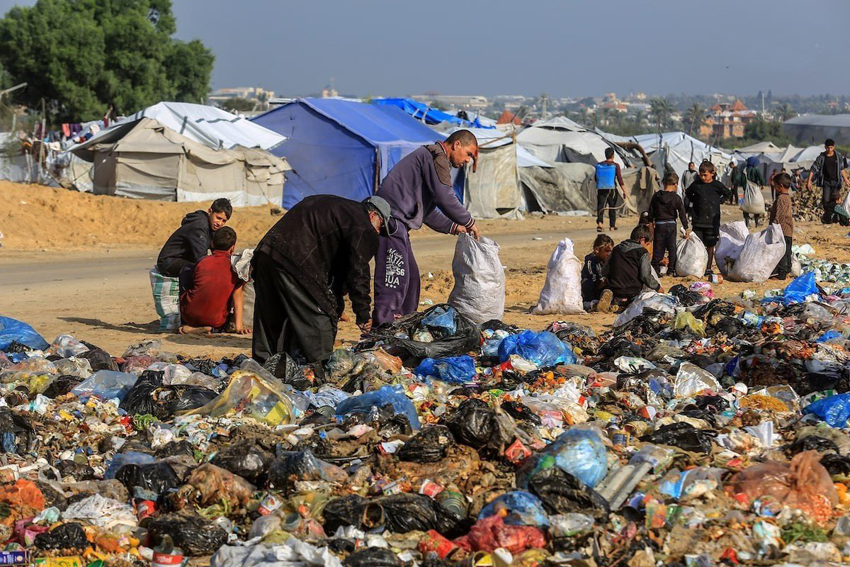
Israel’s genocide in Gaza, has dismantled long-standing civilian waste systems, forced displaced Palestinians into burning plastic to survive amid siege conditions, and created a widening environmental catastrophe whose health consequences are expected to persist long after reconstruction begins.
Before the war, daily life in Gaza included an informal yet structured plastic collection system that functioned as both livelihood support and environmental protection.
Waste collectors moved through neighbourhoods using donkey-drawn carts, calling out to residents who sold plastic and scrap materials collected inside their homes.
Families routinely separated waste at the source, sorting larger items such as cups, toys, appliances and household plastics before storing them for collection.
The practice reduced visible waste accumulation while generating modest income in an economy constrained by blockade.
Plastic travelled street by street through these collection networks and entered limited recycling pathways depending on available facilities and technical capacity.
Under siege conditions, the system provided a fragile but effective form of local environmental management and supported basic public health.
The genocide shattered that structure.
Bombardment destroyed roads, markets and workshops, while mass displacement fractured neighbourhood networks that sustained informal recycling.
Plastic waste now accumulates across devastated urban areas, agricultural land and displacement zones without organised collection, steadily releasing pollutants into air, water and soil.
The destruction extends beyond physical infrastructure.
Established material management practices have collapsed alongside civilian governance systems, reshaping the relationship between society and waste.
Gaza increasingly faces an environment saturated with debris and synthetic materials for which there are few safe alternatives or mitigation strategies, creating risks that extend beyond the territory into the wider region.
Israel’s decision to cut off fuel and electricity supplies on 9 October 2023 deepened the crisis.
Fuel rapidly became inaccessible for civilians already facing siege conditions, leaving families without reliable cooking or heating sources.
As bombardment continued for months, available firewood steadily disappeared.
Displaced families burned salvaged doors, furniture and fragments of damaged homes until even these resources were exhausted.
In growing numbers, households turned to emergency alternatives, the most hazardous of which was burning plastic.
Under duress created by blockade and genocide, some Palestinians attempt to convert plastic into diesel-like fuel through improvised pyrolysis.
The process begins with collecting plastic from scattered locations and sorting it by type, a task made extremely difficult amid displacement and scarcity.
Plastic is cut into small pieces and placed inside iron furnaces heated to temperatures ranging from 400 to 600 degrees Celsius.
During heating, the material melts and vapourises, travelling through pipes as gas into a water-based cooling system where it condenses into liquid fuel.
Heavy residues remain and are repeatedly reheated through additional thermal cycles until reaching roughly 80 per cent purity.
The procedure can take between eight and 10 hours depending on the volume and composition of plastic used.
Conducting such work amid bombardment, limited tools and scarce materials presents serious dangers even before exposure to toxic emissions is considered.
Far more commonly, plastic burning occurs through improvised clay ovens or direct open fires inside displacement camps.
Families burn plastic, paper and other waste in confined tents or crowded outdoor spaces simply to cook food or produce warmth.
The health consequences are severe.
Women are typically responsible for cooking and remain closest to ovens or fires, while children often stay nearby in cramped living spaces.
Burning plastic releases dense smoke and toxic chemicals that accumulate rapidly inside poorly ventilated shelters.
Medical workers report rising respiratory illnesses, including asthma and pulmonary infections, particularly among children, elderly people and women.
Exposure rarely produces a single acute incident. Instead, civilians experience cumulative and long-term respiratory damage through repeated inhalation.
Displacement tents increasingly function as concentrated sources of air pollution.
Civilians already facing hunger, disease and ongoing military violence are simultaneously exposed to toxic emissions generated by survival practices forced upon them.
Open burning fundamentally alters surrounding air quality.
Environmental studies have consistently shown that residential plastic burning releases hazardous pollutants and fine particulate matter capable of penetrating deep into the respiratory system.
Inside enclosed tents, smoke accumulates quickly.
Limited ventilation traps emissions close to breathing height, exposing vulnerable populations for extended periods.
Rather than isolated exposure events, families endure continuous inhalation over weeks and months.
The danger extends beyond visible smoke.
Burning plastic accelerates its breakdown into microplastic and nanoplastic particles.
Melted material settles onto nearby surfaces before cooling and fragmenting into microscopic debris invisible to the naked eye.
Microscopic and spectroscopic analysis shows these particles retain the chemical signatures of their original polymers.
Once released, microplastics remain suspended in the air or settle onto bedding, clothing and food.
Displacement shelters therefore become long-term accumulation sites for airborne microplastics.
Residents inhale and ingest particles repeatedly through daily activities, introducing an additional layer of invisible contamination with lasting implications for respiratory and systemic health.
Military bombardment plays a central role in expanding the scale of the problem.
The destruction of homes, shops, factories and warehouses produces enormous quantities of damaged plastic materials alongside concrete rubble.
Pipes, insulation, electrical wiring, furniture and appliances are shattered or partially burned during attacks.
Exposure to heat, sunlight and mechanical abrasion accelerates degradation.
Repeated burning further breaks these materials down into microplastics and toxic combustion by-products that infiltrate soil, groundwater and agricultural systems.
With formal waste management systems dismantled, plastic debris accumulates across streets, farmland and around displacement shelters.
Safe disposal sites are largely absent. At the same time, fuel shortages leave residents with few alternatives for cooking or heating.
Informal dumping and burning areas have emerged close to densely populated camps.
Smoke drifts through living areas while ash and residue contaminate surrounding ground.
Humanitarian aid, essential for survival, inadvertently feeds the cycle.
Plastic packaging used for food and bottled water rapidly becomes unmanaged waste in an environment without collection systems.
Families frequently reuse containers beyond safe limits or burn packaging for fuel.
Children face the greatest risk within this exposure pathway.
Many now grow up surrounded by burned plastic residues and scattered debris, playing near waste piles while consuming food and water stored repeatedly in reused containers under unsafe conditions.
Developing bodies are exposed to pollutants during critical stages of growth at a time when laboratory testing facilities, environmental monitoring systems and much of Gaza’s medical infrastructure have been severely damaged or rendered inaccessible.
Pollution therefore becomes biologically embedded through prolonged exposure.
Plastic contamination enters lungs, food systems and water supplies simultaneously, compounding already severe health vulnerabilities created by siege and displacement.
Even after hostilities cease, environmental specialists expect plastic-derived pollutants to persist in soil, groundwater and the food chain for years.
Reconstruction alone cannot remove chemical contamination already integrated into ecosystems.
Addressing Gaza’s future without confronting plastic pollution risks rebuilding homes, schools and hospitals on contaminated land.