
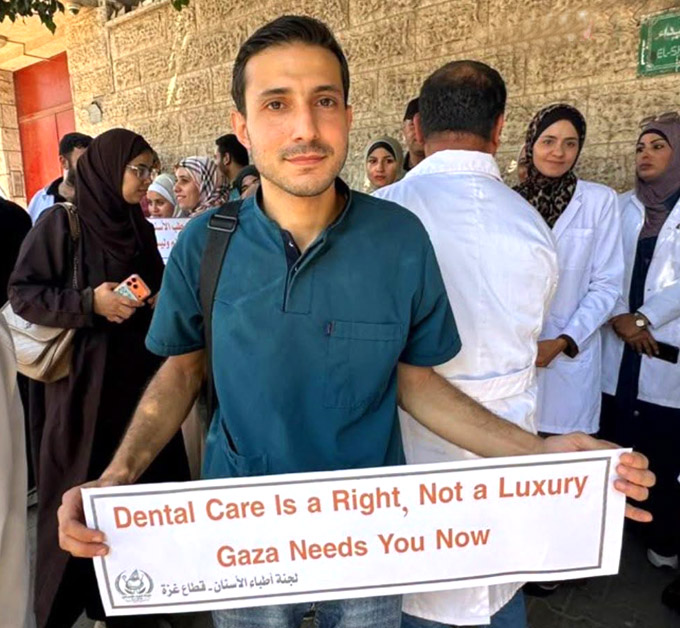
PALESTINIANS in Gaza are having teeth pulled that could be saved, because Israel’s siege has driven the cost of treatment far beyond what displaced families can pay.
Israeli air strikes have destroyed or damaged 80 per cent of Gaza’s dental clinics, and more than 100 dentists have been killed since the genocide began, according to Irfan Eshtaiwi, head of the dentists’ syndicate in Gaza’s southern governorates.
The syndicate receives daily notices from dentists who are closing down or scaling back to emergency care only.
The clinics that remain open work without reliable electricity, running water or sterilisation materials.
Nour Abo Shamala, 22, has lived with pain in her front tooth since February.
At night she lies awake in a tent in Deir al-Balah, rinsing her mouth with salt water.
Her family lives on aid, and was displaced from their home in Jabaliya more than five times before reaching Deir al-Balah in May 2024.
In May she went to one of the few dentists still working nearby. The decay had reached the nerve, he told her, and without root canal treatment she would lose the tooth.
It would cost 300 shekels, about $100.
When she said she could not pay, he offered to pull the tooth for 50 shekels, about $16.
‘I can’t pay 300 shekels, and if I have them, it would go to things that matter more,’ Abo Shamala told US based Drop Site News.
‘I’m a girl. Imagine me without a front tooth. How would I laugh or talk to people?’
Months of painkillers have left her with an inflamed stomach, diagnosed at a UNRWA clinic.
She can no longer bite into bread or fruit, and cuts her food into small pieces to chew with her back teeth.
‘If the treatment was 80 shekels the way it used to be, I wouldn’t have waited a single day,’ she said. Seven months on, the tooth can still be saved.
Ahmed Abo Dan, 34, who sells chocolate from a street stand in Deir al-Balah, made the other choice. He was forced from his home in northern Gaza in October 2023, when Israel ordered 1.1 million Palestinians north of Wadi Gaza to move south.
His tooth began hurting in March. In June a dentist offered him a root canal on his molar for 450 shekels, around $145, or extraction for 30 shekels, around $10.
‘I’m displaced and can barely scrape together the price of a bag of bread for my children,’ he said.
He borrowed the 30 shekels from a friend, and the tooth was pulled in July.
‘War has made us pull out our teeth just to live,’ he said. Another tooth has now started to hurt. ‘I’m afraid to go and be told I need treatment I can’t pay for all over again and maybe lose another tooth.’
Hardly any dental supplies have entered Gaza since October 2023, according to Eshtaiwi and Dr Osama Jaber al-Shanti, former dean of the Faculty of Dentistry at the University of Palestine.
Last month al-Shanti joined dozens of dentists who gathered in their white coats outside the headquarters of the International Committee of the Red Cross in western Gaza City to demand that dental supplies be let in.
‘They claim these are dual-use materials,’ al-Shanti said. ‘It’s a label used to evade and restrict, to keep useful materials out of Gaza.’
Small quantities get in, he said, through a few private traders who pay very high fees, and those black market costs are passed on in the price of treatment.
A syringe of resin for fillings that cost 70 to 80 shekels before the genocide now costs 1,200 shekels, a rise of 1,500 per cent.
Root canal treatment, once 70 to 150 shekels, now costs 500 to 700 at most clinics.
Al-Shanti charges 300, below his costs, because he is still using stock he bought earlier in bulk.
His clinic in Gaza City’s Rimal neighbourhood is the third he has set up from scratch since October 2023. Israeli strikes destroyed two of his earlier clinics, and displacement forced him to abandon another.
He can still provide fillings, extractions and root canals, but has had to stop implants, whitening, bridges and dentures.
Most of his colleagues have stopped working altogether, he said.
Ayman al-Shabrawi, who owns a dental laboratory in the al-Saha area of Gaza City, has closed part of it and laid off two thirds of his staff, and expects to shut the rest if supplies remain blocked.
The Gaza Centre for Human Rights said in August that Israel bars a wide range of purely therapeutic dental materials under the dual-use label, and that the resulting prices have pushed dentists towards extraction as the only remaining option.
In Khan Younis governorate, only one government dental clinic and two UNRWA clinics are still operating, it said, alongside a small number of private practices.
Screening children in displacement camps in Deir al-Balah and Khan Younis for a Save the Children Netherlands programme in March 2025, al-Shanti found large numbers with untreated decay that no one was following up.
Malnutrition has made it worse, he said, and most children in Gaza are not examined at all.
Warda Shaath, a dentist in Khan Younis, said most treatment now has to be rationed because supplies are simply not available.
Light-cured fillings have disappeared from the market, and some procedures that cost around 50 shekels before the genocide now cost close to 250.
About 90 per cent of her patients ask to have the tooth pulled rather than treated, because they cannot pay for a filling or a root canal. If the shortage continues, she is considering closing her clinic next month.
Shaath still fits implants, with black market materials bought at very high prices. One patient, a 32-year-old mother of four, lost several teeth when her house collapsed on her and needs four implants.
The full treatment would cost around 10,000 shekels, about $3,300, and the first stage alone close to 5,000. The clinic could not find a way to cover the cost, Shaath said, and the woman left in tears.
‘The moment supplies enter, the first thing I will do is message all my patients and drop my prices immediately,’ al-Shanti said.
In her tent, Abo Shamala’s front tooth is growing weaker and darker.
A small piece broke off recently when she bit into dry bread. She is still waiting for Israel to let supplies in, so that prices come down.