
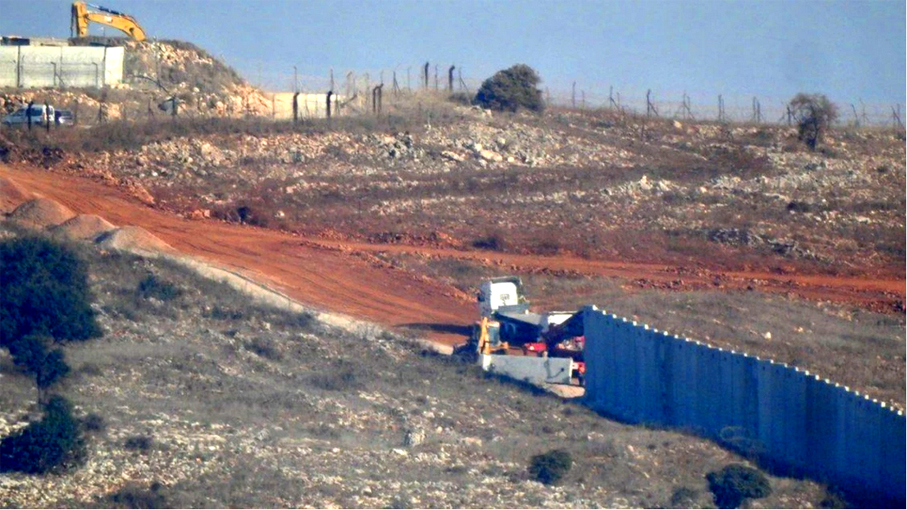
ISRAEL is building a network of roads and military outposts spanning nearly 90 kilometres of southern Lebanon, satellite imagery shows, while its forces keep shelling, demolishing and searching villages all across the south despite the June framework agreement which promised a gradual Israeli withdrawal.
Lebanon’s National News Agency reported that, on Saturday, Israeli forces carried out a demolition in Bani Hayyan, searched Khiam, shelled the outskirts of Wadi al-Hujair and struck a house in Aita al-Jabal.
Then in reports relayed on Sunday, there was also artillery fire on Zawtar al-Sharqiya, the area between Mayfadoun and Kfar Tebnit, Mansouri, and Wadi Zibqin, with four projectiles hitting Beit Yahoun.
And the previous Friday there was a demolition in Tiri.
L’Orient-Le Jour, analysing dozens of satellite images and other sources, has found that since fighting resumed in March, Israel has built eight fortified bases, 32 kilometres of roads and new checkpoints in the south of Lebanon, and still occupies more than 600 square kilometres.
On 31 October, the National News Agency reported Israeli forces cutting roads through mountains and valleys to link their posts in the central and western sectors, alongside demolitions, and targeting a mosque in al-Amiriyah, near a Lebanese army checkpoint.
Israeli Defence Minister Israel Katz said during a visit to the south on 12 August: ‘I have instructed the army to take all necessary steps to prepare for a long-term presence in the region.’
The framework agreement signed in Washington on 26 June, which followed an April ‘ceasefire’, provides for a gradual Israeli withdrawal with no timetable in return for the Lebanese army deploying, and Hezbollah being disarmed, beginning with two pilot zones.
It also records Israel’s declaration that it has no territorial ambitions in Lebanon.
Lebanese Prime Minister Nawaf Salam claims the agreement aims to achieve Israel’s withdrawal from all Lebanese territory, however, Hezbollah has rejected it, its leader Naim Qassem saying: ‘Israel must leave unconditionally.’
Katz claimed on 24 June that Washington had not demanded a withdrawal and that Israel would not leave ‘even if there is an American demand’.
Israel handed back three villages to the Lebanese army in July, and the pilot zones have not been expanded since.
Military talks in Tampa, Florida, on 20 and 21 October ended without an announced breakthrough or a joint statement; and a ‘political source’ said at the time there would be no real political track until it was clear who would be governing Israel following the recent elections.
Israel’s president tasked Israeli opposition leader Gadi Eisenkot on Sunday with forming a government.
Meanwhile, the United States and its allies are pressing Beirut to disarm Hezbollah.
Just days after Hezbollah began firing retaliatory rockets at Israel in early March, the Lebanese government obliged by declaring its military and security activities illegal.
Last Thursday, a Lebanese military judge issued formal charges against two Hezbollah members over a truck carrying nearly 800 kilos of explosives, seized on 5th October on the Beirut to Damascus road; and the embassies of the US, UK, Australia, Canada and Japan issued a joint statement backing ‘the (Lebanese) state monopoly of arms’.
Last Wednesday, an Israeli drone struck a motorcycle in Qabrikha – which is in Lebanese territory, outside the zone Israel has declared for its troops – killing one man and wounding another, Lebanon’s Health Ministry said.
Lebanese media identified the dead man as a paramedic with the Risala Scouts, a rescue group linked to the Amal movement.
The Israeli military claimed it ‘struck two suspects who were observing IDF(Israel Defence Force) soldiers’, and its chief of staff, Eyal Zamir, said the army ‘will not allow Hezbollah to establish terror infrastructure’ in southern Lebanon; but local residents are adamant both men were members of rescue teams.
It was the first strike on suspects approaching Israeli troops in several weeks.
Israeli attacks have killed 4,390 people and wounded 12,429 in Lebanon since 2nd March, according to the Lebanese Health Ministry’s figures as of 5th November.
The ministry says more than a million people have been displaced.
UNIFIL (the United Nations peace keeping mission to Lebanon) has confirmed that its mandate ends on 31 December 2026 under Security Council Resolution 2790 – which was adopted unanimously in August 2025 – after which it will begin its drawdown and withdrawal.
The force was created in 1978 to confirm the withdrawal of Israeli forces from southern Lebanon, and the United States and Israel view it as having failed in its mandate.
Peacekeepers from 45 countries will carry on their daily tasks until the end of the mandate, it said, and the Council is considering options for the period afterwards, including monitoring and reporting along the Blue Line.
The House of Commons Library says most uniformed personnel are expected to leave by mid-2027, with a smaller UN observer mission, UNTSO, remaining.
France and Italy are working on an alternative force.
Lebanese Parliament Speaker Nabih Berri said on Friday that Resolution 1701 is the legal guarantee of Lebanon’s right to reclaim its full territorial sovereignty and that UNIFIL remains the sole operational mechanism to ensure its full implementation.
Lebanese President Joseph Aoun has warned that the withdrawal ‘will create a vacuum that will have negative repercussions on the security situation in the region’.
The Israeli press reported last Friday that the army is preparing for a possible resumption of its offensive in Lebanon if fighting with Iran resumes, readying positions along the border and updating its plans ahead of winter while the security establishment awaits a US decision.
Israeli forces hold positions with significantly fewer troops than during the ground offensive, but are clearing territory and preparing for renewed fighting.
Aoun told French lawmakers on 28 October that Israeli forces continue to bomb, destroy and bulldoze villages and towns in the south in violation of the framework, and called on the United States and the international community to press Israel to stop and withdraw.
He claimed his government was committed to keeping UNIFIL in the south or replacing it with European forces that could form the nucleus of a broader force.
He has also told US congressmen Darin LaHood and Josh Gottheimer that Lebanon is sticking to the agreement while Israel disregards its provisions.
Israel kept five positions after the November 2024 ceasefire – which required a full withdrawal within 60 days – but satellite imagery in November 2025 showed them ringed by earthen fortifications and linked by widened access roads, with buildings in nearby villages almost entirely destroyed.
Israel claims it keeps them to ensure Hezbollah does not carry out military activities in the area.
Sheikh Ali Damoush says ‘no difference’ in Democrats policy
HEAD of the Executive Council of Hezbollah, Sheikh Ali Damoush, says the Democrats’ sweep to victory in the 2026 US midterm elections and flipping long-held Republican seats in both chambers of Congress will not change Washington’s hostile policy toward West Asian nations.
The senior Hezbollah official emphasised on Friday that successive US administrations have pursued similar strategies regardless of their political affiliation.
He pointed out that Washington’s policies remain unchanged, and US politicians all seek to dominate West Asia and its natural resources at the same time as offering unqualified support for the Israeli regime.
Only the methods differ from one administration to another, he noted.
Sheikh Damoush identified the war of aggression on Iran, the shift in US public opinion about Israel and the Palestinian cause, and the ongoing US-backed Israeli genocide as the factors behind the Republican Party’s defeat in the midterm elections.
He, however, warned that the Democrats’ electoral gains do not translate into any shift in Washington’s policies toward West Asia.
‘We see no difference between the Democratic and Republican camps regarding regional issues,’ Sheikh Damoush said, adding that the US project of regional hegemony and its support for the Tel Aviv regime remain unchanged.
Turning to Lebanon, the senior Hezbollah official called for an end to US interference in the country’s internal affairs, and denounced Washington for exerting unparalleled influence over its political, security, judicial, and financial affairs while exacerbating divisions among different walks of society.
‘The American agenda aims to create discord among the Lebanese. We will not permit this scheme to prevail, and we will oppose it as we have in the past.’