
HEAVY US-Israeli airstrikes continued across Iran on Thursday, hitting Tehran, Isfahan, and Mashhad as the death toll from the war climbed to at least 1,937, including 240 women and 212 children, according to Iran’s deputy health minister Ali Jafarian.
More than 24,800 people have been injured since the conflict began on 28 February.
CENTCOM commander Admiral Brad Cooper said Wednesday that American forces have struck more than 10,000 targets across Iran, claiming that 92 per cent of Iran’s largest naval vessels have been destroyed and that the US has ‘significantly’ degraded Iran’s naval drone and missile capabilities.
Israeli defence minister Israel Katz announced that a strike had killed the IRGC’s naval commander, Alireza Tangsiri, along with other ‘senior officers of the naval command’.
Katz said: ‘The IDF eliminated the commander of the IRGC Navy, the person directly responsible for the terror operation of mining and blocking the Strait of Hormuz to maritime traffic.’
Iran has not confirmed his death.
Iran has struck back with force.
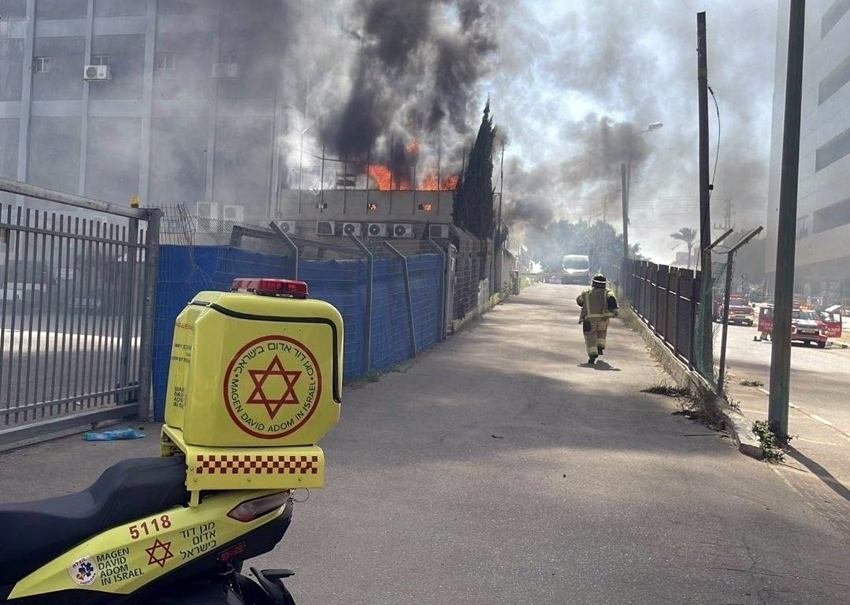
A ballistic missile hit the state-owned ICL Rotem chemical complex in Israel’s Negev on Wednesday, causing a large blast and fire at the facility linked to phosphate extraction used in white phosphorus production – a weapon Israel has deployed illegally in both Gaza and southern Lebanon.
Iran also launched a missile at Israel’s largest power plant in the coastal city of Hadera, which struck a short distance from its target.
In the Gulf, Kuwait, Bahrain, and the United Arab Emirates activated air defences early Thursday to intercept incoming Iranian projectiles, with Bahraini authorities working to extinguish a fire in Muharraq, home to the country’s international airport.
Two people were killed in Abu Dhabi by falling shrapnel from a missile interception.
Iran’s retaliatory bombing of US bases across the Middle East has forced many of the roughly 40,000 American troops stationed in the region to relocate to hotels and office buildings, according to the New York Times.
Bases in Kuwait, nearest to Iran, have suffered the worst damage, and Central Command has dispersed thousands of personnel, some as far as Europe. Iranian officials accused Washington of using civilians as human shields.
‘We are forced to identify and target the Americans,’ the IRGC said. ‘Therefore, it is better not to shelter them in hotels and to stay away from their locations.’
Iran’s Revolutionary Guard also claimed Tuesday to have downed a US Navy F/A-18 fighter jet over the southeastern port city of Chabahar, calling it ‘the fourth successful hunt’ of American or Israeli jets since the war began. CENTCOM denied the claim.
The Strait of Hormuz has become a central theatre. Iran is reinforcing defences on Kharg Island, which handles roughly 90 per cent of its crude exports, laying mines and deploying additional air defences, CNN reported, while the Trump administration weighs a ground operation to seize the island.
A senior Gulf official warned that such a move could trigger Iranian retaliation against regional infrastructure.
Iran’s parliament is pursuing legislation to formalise tolls on vessels transiting the strait, with Lloyd’s List Intelligence reporting that a de facto toll regime is already operating.
Bahrain has put forward a draft UN Security Council resolution invoking Chapter Seven to authorise military force to reopen the strait, but China and Russia are opposed.
France introduced a competing resolution making no mention of Iran and urging de-escalation. Neither is expected to be voted on this week.
UAE ambassador Yousef Al Otaiba wrote in the Wall Street Journal that a simple ceasefire is insufficient and that any resolution must address Tehran’s ‘full range of threats’, claiming Iran has launched more than 2,180 missiles and drones at the UAE since the war began. The op-ed signals deepening Emirati alignment with Washington’s war aims at a moment when both the UAE and Saudi Arabia are reportedly considering formally joining US military operations.
Jordan, meanwhile, suspended the residency of one Iranian diplomat and denied accreditation to another, following similar moves by Saudi Arabia and Lebanon.
Pakistani foreign minister Ishaq Dar confirmed Thursday that Pakistan has been relaying messages between Washington and Tehran. ‘The United States has shared 15 points, being deliberated upon by Iran,’ Dar wrote on X, adding that Turkey and Egypt are also supporting the initiative. Trump, posting on Truth Social, insisted Iran is ‘begging us to make a deal’ and warned: ‘They better get serious soon, before it is too late.’
Iran’s foreign minister Abbas Araghchi flatly contradicted him. ‘No negotiations have happened with the enemy until now, and we do not plan on any negotiations,’ he said on state television, adding that Iran has allowed passage through the Strait of Hormuz only to countries it considers friends – China, Russia, India, Iraq, and Pakistan.
Each day since the war began, US military officials have compiled a two-minute video montage of strikes for the president, described by one official as ‘stuff blowing up’.
Three current and one former official told NBC News the format is fuelling concern that Trump is not absorbing the full picture of the conflict. Former National Counter-terrorism Centre director Joe Kent said: ‘Key decision-makers were not allowed to express their opinion to the president’, and that ‘there wasn’t a robust debate’.
Congressional frustration is sharpening. House Armed Services Committee chair Mike Rogers denounced Pentagon officials after a classified briefing failed to answer basic questions about troop deployments: ‘We just wanted them to tell us what’s the plan, and we didn’t get any answers.’
He warned: ‘This has consequences if you don’t remedy it.’ Rep. Nancy Mace posted on X: ‘I will not support troops on the ground in Iran, even more so after this briefing.’
House Democratic leaders Hakeem Jeffries and Greg Meeks are meanwhile facing backlash for postponing a War Powers Resolution vote until mid-April, despite indications that the measure has enough support to pass. Some Democrats are reportedly reluctant to end a war they view as a political liability for Trump.
Separately, the TSA reported ‘the highest wait times in TSA history’, with some passengers waiting more than four and a half hours, after a 40-day DHS funding shutdown cost the agency more than 480 officers.
The Justice Department agreed to pay Michael Flynn roughly $1.2 million to settle his malicious prosecution lawsuit, framing it as redress for the ‘Russia Collusion Hoax’. ICE admitted it had misrepresented its legal authority to arrest immigrants at courthouses for over a year.
And Idris Robinson, the only Black philosophy professor at Texas State University, sued after his contract was terminated following a talk on Palestine at a North Carolina book fair, alleging violations of his First and Fourteenth Amendment rights.
In the Caribbean, the US conducted its 47th strike on an alleged drug-trafficking vessel, killing four people and bringing the death toll from Operation Southern Spear to over 160.