
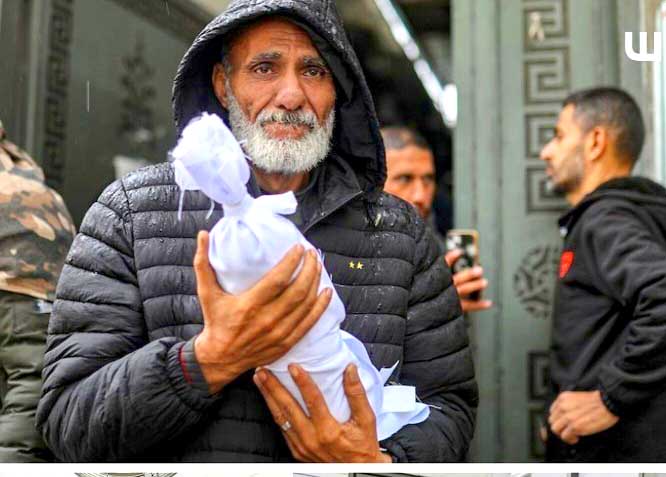
TWO-WEEK-OLD Mohamed Abul-Khair died from hypothermia in the Gaza Strip on Tuesday as a result of prolonged exposure to low temperatures.
Earlier, the director general of the ministry of health, Munir al-Bursh, warned that many children, elderly people and patients are at risk of dying due to the drop in temperatures inside rain-soaked tents sheltering displaced families.
Bursh said the humidity and rainwater inside tents create an environment conducive to the spread of respiratory diseases among the displaced, while patients are unable to obtain any medical care.
Meanwhile, a Palestinian was killed and several others sustained injuries after part of a residential building collapsed in Gaza City amid heavy rainfall.
Civil defence teams said they recovered a body from the rubble of a house that partially collapsed in the Shati refugee camp.
Several wounded people were also rescued from the scene.
Eyewitnesses said that thousands of tents sheltering displaced people were flooded or blown away by strong winds that have battered Gaza since Monday evening, worsening conditions for families already living in precarious circumstances.
Gaza’s infrastructure has been severely weakened after 26 months of Israeli attacks, leaving many buildings vulnerable to collapse during extreme weather.
Meanwhile, life for Palestinians in the Occupied West Bank is no easier.
In the early morning hours, as daily life begins in the villages south of Bethlehem, Israeli occupation forces (IOF) imposed a new closure on the entrances of the villages of Al-Manshiya and Marah Rabah, leading to a near-total siege of the area.
This comes at a time when the region is already suffering from severe restrictions on movement, especially with the continued closure of the main entrance of the town of Beit Fajjar since October 7th, 2023.
This measure is part of a recurring policy that has been implemented almost weekly, leaving cumulative impacts on all aspects of life and exacerbating the suffering of thousands of residents who rely on these roads to reach their workplaces, educational institutions, and healthcare services.
According to data released by the Wall and Settlement Resistance Commission, the number of permanent and temporary military checkpoints and gates across Palestinian territories has reached 916, including 243 gates installed after October 7th, 2023, reflecting a clear escalation in restrictions on freedom of movement.
With the entrances closed, employees, students, and drivers have found themselves stranded in front of iron gates that open for short periods but then close for hours without prior notice.
This has caused near-total paralysis and created severe traffic congestion, particularly on narrow alternative roads that are unfit to accommodate such large numbers of vehicles.
The villages of Beit Fajjar, Al-Manshiya, and Marah Rabah rely on a single road network that is geographically and socially interconnected.
With the closure of the main entrance, secondary roads have turned into mandatory routes, increasing pressure on infrastructure and raising the risk of traffic accidents.
Residents confirm that these closures have directly affected their daily lives, forcing many to leave their homes hours earlier without any guarantee of arriving on time.
These measures have also impacted students, especially university students, who are increasingly missing lectures, as well as mothers who face difficulties getting their children to school.
For his part, anti-settlement activist Hassan Breijieh said that what is happening south of Bethlehem cannot be separated from the IOF’s broader policy aimed at tightening the noose around Palestinian communities.
In a statement to the Palestinian Information Centre’s correspondent, he explained that these closures constitute a form of collective punishment and contribute to isolating Palestinian villages from their natural surroundings, negatively affecting residents’ economic and social conditions while serving settlement expansion in the area.
Breijieh added that the continuation of these practices in the absence of international accountability encourages further escalation, stressing the importance of documenting these violations and highlighting their humanitarian impact on civilians’ lives.
Meanwhile, Khader Abu Diya, head of the Al-Manshiya Village Council, said that local councils are facing major difficulties in dealing with this reality because of the IOF control over main entrances.
He noted that alternative roads are not equipped to withstand such daily pressure, leading to rapid deterioration and increased suffering for residents.
As these ongoing closures persist, the villages south of Bethlehem remain trapped in a harsh humanitarian reality, where freedom of movement becomes a daily ordeal and the most basic rights to work, education, and medical care are curtail
Tensions are rapidly escalating inside Israeli prisons, with senior prison officials warning that conditions among Palestinian detainees are approaching a breaking point that could trigger a wide-scale confrontation.
Kobi Yaakobi, commissioner of the Israeli Prison Service, said the situation in the so-called security sections reflects a fundamental shift from previous years.
‘The reality in the security wings today is different from what it was before,’ he said.
Yaacobi claimed that Palestinian prisoners are living in a state of despair after losing hope of release, adding: ‘We are at the beginning of an event inside the prisons. For us, the war is about to begin,’ a statement widely seen as laying the groundwork for intensified repression and violence against detainees.
According to Israeli officials, preparations have been underway for nearly two years for what they describe as ‘the day the prison sections ignite,’ indicating expectations of a large-scale confrontation inside detention facilities.
Avihai Ben Hamo, head of operations at the Israeli Prison Service, alleged a ‘direct link’ between the Al-Aqsa Flood operation of October 7th, 2023, and changes in prisoners’ behaviour.
He claimed detainees had learned to identify different types of locks and metal window bars, and that many believed they would soon be freed before realising ‘the doors had been shut,’ accusing them of attempting to challenge prison security policies.
Ben Hamo further alleged that prison authorities had discovered hand-drawn maps of cells and sections in some rooms, including markings identifying lock locations and the number of guards assigned to each wing.
He said that while improvised weapons were displayed last year, the past year has seen the seizure of detailed maps indicating areas guarded by only one or two wardens, which he described as attempts to ‘break the security system’.
These developments come amid the deadliest period in the history of the Palestinian prisoners’ movement. Since 1967, at least 322 prisoners whose identities are known have died in Israeli custody.
Dozens more detainees from Gaza remain forcibly disappeared, with their fate still unknown.
On December 14, administrative detainee Sakhr Zaoul from the town of Husan near Bethlehem died in Ofer prison, bringing the number of prisoners whose martyrdom has been announced since the start of Israel’s genocide in Gaza to 86.
Just days earlier, on December 10, detainee Abdul Rahman Al-Sabatin, also from Husan, died after being transferred from an Israeli prison to Shaare Zedek hospital. He had been detained since June 24, 2025.
Earlier this month, the Commission of Detainees Affairs and the Palestinian Prisoner Society announced the martyrdom of three detainees from Gaza, based on official responses from the Israeli occupation forces.
The victims were identified as Taysir Saeed Al-Sababa, 60, Khamis Shukri Ashour, 44, and Khalil Ahmad Haneyya, 35, all arrested during the genocide on Gaza and later reported martyrs in detention.
The two organisations said the three martyrs are part of a much larger toll resulting from systematic torture, starvation, medical neglect, sexual abuse, and widespread violations of basic human rights inside Israeli prisons.
In the same context, a new report issued earlier this month by Israel’s Public Defender’s Office documented an unprecedented deterioration in detention conditions of Palestinian prisoners since October 7th, 2023.
The report included testimonies describing acute hunger, severe weight loss, and living conditions deemed ‘unfit for human habitation’.