
The Union of Gaza Strip Municipalities warned on Friday that essential services are on the verge of complete collapse as Israel continues to block the entry of critical supplies.
Gaza Municipality spokesman Husni Muhanna said the crisis has moved beyond fuel shortages and reached an extremely dangerous stage due to the near depletion of industrial oils needed to operate municipal machinery and equipment.
He warned that the shutdown of vital services would sharply worsen humanitarian suffering and pose a direct threat to public health.
Drinking water wells are among the facilities at risk of stopping, potentially depriving large numbers of Palestinians of safe water.
Sewage pumping stations could also cease operating, raising the danger of wastewater flooding streets and residential neighbourhoods.
Waste collection and transportation vehicles are similarly threatened with a shutdown, which could lead to further accumulation of solid waste and the spread of epidemics and infectious diseases.
Muhanna said around 700,000 cubic metres of solid waste have already accumulated in Gaza City, while municipalities lack the capacity to handle it after Israeli attacks destroyed much of their equipment and vehicles.
Municipal authorities called for urgent international intervention to allow the entry of industrial oils and other essential supplies needed to maintain basic services and prevent an imminent humanitarian disaster.
One Palestinian was killed and several others were injured last Thursday evening in separate Israeli attacks across the Gaza Strip, amid ongoing violations of the ceasefire agreement.
According to local reports, Abdullah Yassin was killed after being shot by Israeli forces near Wadi Gaza in central Gaza.
Several other civilians were wounded when Israeli military vehicles opened heavy fire on residents along Salah al-Din Road near the Wadi Gaza area east of central Gaza.
In Gaza City, a number of Palestinians were injured when an Israeli drone struck a house near Al-Sunna Mosque in the Al-Nafaq area north of the city.
These incidents come as ceasefire violations continue across various parts of the Gaza Strip despite the truce remaining formally in effect.
In a related development, Gaza’s health ministry announced that 1,005 Palestinians have been killed since the ceasefire took effect in October of last year as a result of ongoing Israeli attacks and military operations.
As summer sets in with soaring temperatures, the suffering of Gaza’s people is reaching unprecedented levels.
A new and harsh chapter of daily hardship is unfolding, driven by the widespread and systematic destruction of water infrastructure during the Israeli genocide.
At the heart of this crisis, a drop of water has shifted from being a basic human right to an unattainable hope. It now comes at a high cost to people’s health and energy.
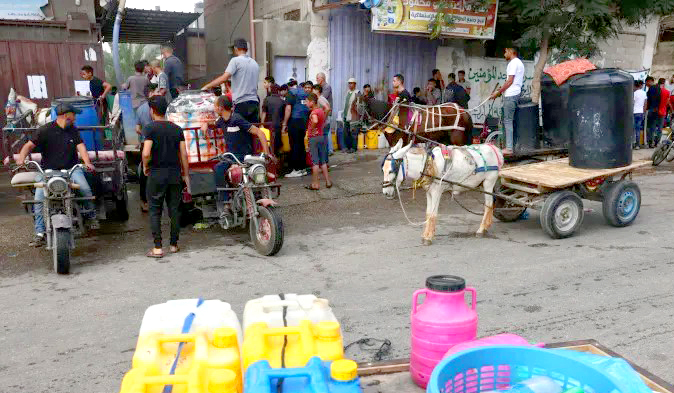
Across the strip, long lines stretch for hours in front of water trucks and limited filling stations, while warnings grow of an impending public health disaster threatening hundreds of thousands of displaced people, particularly children, the elderly, and the sick in overcrowded camps.
UN agencies indicate that the crisis is becoming increasingly severe. Tens of thousands of families now rely entirely on water tankers or fragile local stations.
UNICEF reports that 82 per cent of households in Gaza are already experiencing water insecurity, while 70 per cent are unable to access even the minimum humanitarian standard of six litres per person per day.
During a field visit documenting this daily struggle, Um Uday Mhanna, a displaced mother of three living in a camp west of Gaza City, described her ordeal.
She said she waits for more than two hours under the scorching sun for water trucks. When they arrive, chaos erupts as people rush to secure their share before supplies run out.
She stressed that the crisis is no longer just about thirst. It now affects personal hygiene, laundry and basic sanitation.
In Al-Shati Camp, securing water has become a compulsory daily routine that is stealing children’s childhoods.
There has been a reduction in funding allocated for drinking water support by international donors without clear justification.
This decline will have catastrophic consequences for civilians in the coming weeks.
Meanwhile, Mazen al-Banna, Director General of Planning at the Water Authority and Environmental Quality Authority, issued a stark warning.
Al-Banna stated that water shortages now pose a direct threat to public health and significantly increase the risk of deadly disease outbreaks.
In a press statement, al-Banna outlined the scale of destruction. Approximately 85 per cent of Gaza’s water and sanitation infrastructure, including wells, pumping stations, desalination, and treatment facilities, has been damaged or destroyed.
The estimated losses in this vital sector amount to around 800 million dollars.
As a result, water production has dropped to about 130,000 cubic metres per day.
This represents only 30 to 40 per cent of pre-war levels, which once reached 300,000 cubic metres daily from three main sources.
These sources include groundwater, seawater desalination plants, and supplies from Israel’s Mekorot company.
He added that damage to distribution networks has increased water loss from 30 per cent before the war to between 50 and 60 per cent today. This further complicates efforts by municipalities to deliver water to residents.
Currently, individuals in displacement camps relying on tankers receive no more than 10 litres per day.
This is far below the World Health Organisation recommended minimum of 50-100 litres per person daily.
‘Transported water is highly vulnerable to contamination during delivery or through unsafe storage practices in camps which increases the risk of waterborne diseases under deteriorating environmental conditions,’ al-Banna warned.
Notably, even before the war, 97 per cent of Gaza’s groundwater wells already failed to meet safe drinking standards.
He concluded with a grave warning that the arrival of summer will dramatically increase water demand at a time when municipalities face critical shortages of fuel, spare parts, and chlorine needed to operate and disinfect water facilities.
The ongoing blockade continues to obstruct any meaningful efforts to boost production or improve life-saving services.
In this bleak reality, Gaza’s water crisis is no longer merely a service shortage. It has become a silent threat to life.
The risk of widespread outbreaks of intestinal and skin diseases is rising rapidly due to the mixing of sewage with accumulated waste.
This places the international community and humanitarian organisations before an urgent moral test.
Immediate action is needed to push for the opening of crossings and the entry of fuel, chlorine, and essential equipment to repair what remains of the water infrastructure before thirst and disease claim even more lives in the devastated strip.
With the onset of summer, the suffering of thousands of Palestinian families in the Gaza Strip is renewed, not only due to the difficult economic and humanitarian conditions, but also as a result of the significant boredom experienced by children amid an almost complete absence of recreational places and safe spaces that enable them to play and spend useful time away from the pressures of daily life.
Families now find themselves facing a real dilemma with the end of the school year, as there are no qualified public parks or suitable recreational facilities available, while the difficult economic conditions and the high cost of living stand as an obstacle to any alternative options that could alleviate the suffering of the children.
Although the Gaza beach represents the only natural recreational spot for many families before and after the war, reaching it is no longer an available option for everyone.
Social specialists warn that the continuation of unexploited free time among children for long periods, especially in an environment suffering from continuous crises, may lead to worsening psychological and behavioural pressures for them, and increase feelings of anxiety, isolation, and loss of motivation to learn and socially integrate.
They emphasise that children need organised programmes, activities and safe spaces to play and interact, considering them an essential part of their right to proper development and psychological support.
Recent UN data indicates that childhood in the Gaza Strip is becoming more difficult.
The ‘Gaza Child-Centred Assessment’ published by the United Nations Children’s Fund, UNICEF, in May 2026 showed that young children lack the safe and stimulating environments necessary for their growth, while older children face prolonged interruption from education and a decline in opportunities for social and psychological growth and development.
UNICEF confirmed that the majority of Gaza children continue to live with the effects of repeated displacement and deprivation of basic services, while the need persists to provide educational and safe spaces that help children recover and restore part of their normal lives.
In another report, UNICEF explained that about 800,000 children in the Gaza Strip continue to live in harsh displacement conditions, and that ‘Return to Learning’ programmes and safe spaces remain among the most prominent humanitarian needs for children.
For its part, the United Nations Relief and Works Agency for Palestine Refugees, UNRWA, reported that it provided hundreds of thousands of psycho-social support sessions for children and displaced persons during the past period, in an indication of the scale of the increasing psychological needs among children who live in exceptional and ongoing circumstances.
Between the difficulty of the living conditions and the absence of recreational alternatives, the children of Gaza stand before a new summer that lacks the simplest elements of normal childhood, while appeals from parents and community institutions continue to provide programmes and safe spaces that grant children the opportunity to play, learn, and restore part of their lost childhood.