
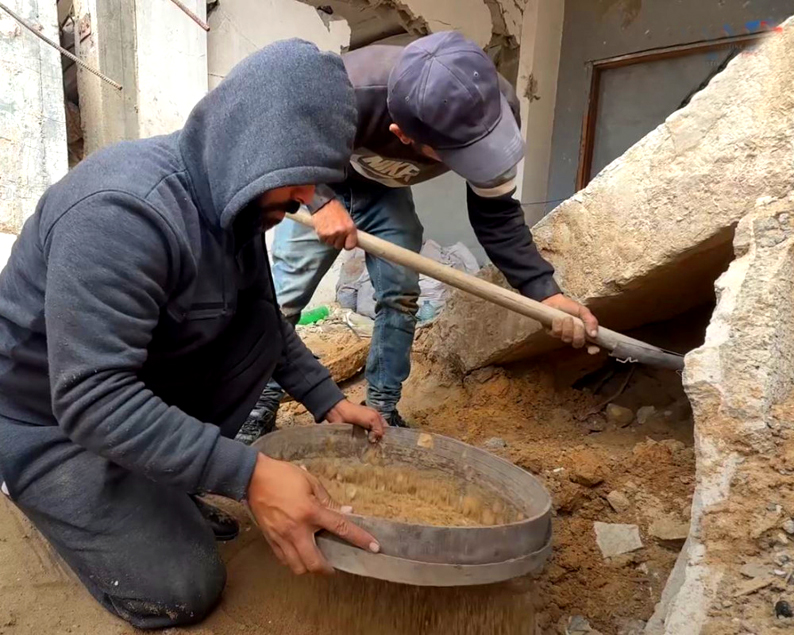
FOR 200 days, Abu Ismail Hammad has been digging beneath his destroyed home in Gaza City, sifting through the sand to collect the remains of his wife and unborn child after an Israeli airstrike wiped out his family during the genocide in Gaza.
The original reporting was carried out by US-based Drop Site News.
The strike hit the family’s apartment in the Sabra neighbourhood on 6th December 2023, just under two months into Israel’s assault.
Hammad’s five children, Ismail, Mohammed, Ghaith, Jana and Joudi, aged between eight and sixteen, were killed alongside his wife, Naama Alaa Al-Din Hammad, who was nine months pregnant with their sixth child, a girl they had planned to name Haifa.
His brother, sister-in-law and all of their children also died in the attack.
Hammad had left the apartment to go upstairs only fifteen minutes before the strike.
He was badly injured and became the sole survivor.
Displaced and wounded, he was unable to return for a year.
At the end of 2024 he came back and began searching for the bodies. After a few weeks he was forced to stop again as the assault intensified.
In November, soon after the so-called ceasefire took effect, he returned once more to the ruins.
He showed photographs of his family smiling together before the war, their faces cracked across the screen of his damaged phone.
After clearing tonnes of rubble, he began to dig.
‘I was able to recover my brother, his wife, and their children. When I reached the living room in my home, it became clear that it was completely burned.
‘I realised that the fate of my children was unknown – that they were burned and their bones had melted away. I then went to the room where my wife had been and I found her bones,’ Hammad said.
‘How did I know it was my wife? First, the location of the room.
‘Second, the bones of the unborn child were found in the same place, because the pregnancy was complete.’
He spoke while crouched in a deep hole, surrounded by the wreckage of his home.
Neighbours helped him dig with shovels, hoes and bare hands, placing small mounds of earth into a flour sifter for him to search through.
‘I am now collecting her piece by piece. With what? With this sifter.
‘This sifter is normally used to sift flour … Today, I am using it to collect the bones of my wife and children,’ he said.
‘Collecting bones with a shovel is difficult, so I thought of using a sifter – to sift, bone by bone, one by one. And praise be to God, I was able to reach this,’ he said, pointing to a small pile of fragments on a tarp.
Across Gaza, the living remain surrounded by the dead.
More than 72,000 Palestinians have been confirmed killed, while over 10,000 are believed to remain buried beneath tens of millions of tonnes of rubble.
Israel has heavily restricted the entry of bulldozers, excavation equipment and fuel, preventing large-scale recovery efforts. Only 717 bodies have been retrieved over the past four months.
Equipment was allowed in to recover the remains of Israeli captives.
‘The last of them, a policeman, was located on 26th January and returned to Israel. Israeli troops excavated and destroyed the Palestinian Al-Batsh cemetery in northern Gaza during the search.
‘For a Zionist soldier, a killer – the one who killed us and killed our children, along with his occupying, colonial state that has colonised us since 1948 – the entire world mobilised and did not rest until his body was recovered from Gaza,’ Hammad said.
‘If I was able to reach my wife and children in this primitive way, there are many others in Gaza who are searching for the same thing. Just provide the means.’
The search for bodies has become a defining reality of the genocide. Alongside those buried beneath the ruins, an unknown number of Palestinian bodies are being held by Israel.
Under a ceasefire arrangement, Israel agreed to hand over the bodies of fifteen Palestinians for every Israeli body returned.
The most recent official exchange took place on 29 January, when Israel returned fifteen Palestinian bodies after the last Israeli captive’s remains were found.
That brought the number of Palestinian bodies handed over since November to 360. All were returned without identification, and many bore signs of abuse, torture and summary execution.
With no forensic equipment or DNA testing kits, authorities in Gaza have been forced to photograph the remains and post the images online or hold screenings for families in the hope of recognising clothing or marks.
Only sixty bodies have been identified, according to the Health Ministry. Dozens have been buried in mass graves as unknown martyrs.
‘The population continues to face severe challenges. It continues to face immense suffering, destruction, and death.
‘Thousands of families are awaiting any news about their missing children, and their pain continues amid the extreme difficulties they face in identifying their loved ones, given the limited forensic capacities in the Gaza Strip,’ said Amani Al-Naouq, spokesperson for the International Committee of the Red Cross, speaking outside Al-Shifa hospital on 29 January.
On 4 February, Israel handed over the bodies of fifty-four Palestinians along with sixty-six boxes of body parts through the Red Cross.
The boxes contained only skulls and bones. Some of the bodies showed signs of severe mutilation, including severed hands and abdomens that had been surgically opened and stitched back together, according to Dr Mohammed Abu Salmiya, director of Al-Shifa hospital.
‘We do not know where these bodies were recovered from – whether from Al-Batsh cemetery for example, or whether they were bodies that had been buried in other cemeteries inside the Gaza Strip, or bodies that were in the occupied Palestinian areas,’ said Moein Al-Wahidi, head of the special committee for receiving bodies.
‘We are facing a real dilemma: the lack of tools and the absence of identification systems, such as DNA testing.
‘This makes the documentation process difficult, primitive, and traditional, relying on photography and on families of the martyrs and missing persons recognising certain details of their loved ones, such as clothing or shoes.’
Allam Abu Wadi came to Al-Shifa on 4 February hoping to identify his seventeen-year-old brother, Mohammed, who disappeared on 26 February 2024 near a checkpoint in southern Gaza.
‘I lost my brother two years ago. There is no information at all. Some people say he’s there, others say he’s not. And today we came just to identify his body,’ he said.
‘There is no way – no simple, clear evidence – that allows you to say whether he is here or not. We can’t find any way. Anything – clothes, for example, teeth, anything. Everything has decomposed.’
He continued, ‘Over the past two years, we went to Nasser Hospital, we went to Al-Aqsa, and today we came here to Al-Shifa. We are trying as much as we can just to identify the bodies of our children.
‘But there is no evidence – any evidence, anything – to prove that these are our children. These are decomposed remains, decomposed organs. There is nothing.’
Each body or box was taken into a room where doctors and specialists photographed and examined the remains.
‘The bodies arrive to us without any information, without any details, without even identification tags.
‘They arrive labelled with only a number – the body is a number. But we are not numbers. These are Palestinian bodies, Palestinian martyrs. They are not numbers,’ Al-Wahidi said.
‘Our message to the entire world is this: Preserve the dignity of the Palestinian body, preserve the dignity of the Palestinian martyr.
‘All international capabilities must be mobilised, as stipulated in international laws and conventions, to preserve human dignity and the dignity of the dead.
‘The Palestinian is no less worthy than any other person in the world.’