
THE US has ignited outrage after seizing a Venezuelan oil tanker in what Caracas compared to Israel’s pattern of unlawful military aggression and resource appropriation, denouncing the move as a blatant ‘act of international piracy’.
President Donald Trump boasted on Wednesday that US forces had taken control of the massive tanker Skipper – carrying roughly 2 million barrels of heavy crude – off Venezuela’s coast, declaring, ‘I assume we’re going to keep the oil.’
The aggression, executed using helicopters launched from the USS Gerald Ford, marks one of the most dramatic escalations in Washington’s four-month pressure campaign against President Nicolás Maduro.
Caracas blasted the seizure as ‘a grave international crime’ that ‘constitutes a blatant theft and an act of international piracy’.
‘The true motives have always been our oil, our energy, the resources that belong exclusively to the Venezuelan people,’ the government said.
It said the US is mirroring Israel’s long-criticised tactics of seizing resources, violating sovereignty, and using military force to achieve political goals, all under the guise of security operations.
US officials claimed the vessel – sanctioned since 2022 – was part of an illicit oil network supporting foreign militant groups.
But analysts say Washington is exploiting its expanded militarisation of the Caribbean, much like Israel’s justification of force in occupied territories, to pursue Venezuela’s vast oil reserves.
The tanker’s capture comes amid an intense US military campaign in the region, including 22 lethal strikes on alleged drug-smuggling boats since September that have killed more than 80 people.
Critics describe the attacks as extrajudicial and reminiscent of the impunity often attributed to Israel in Gaza and the West Bank.
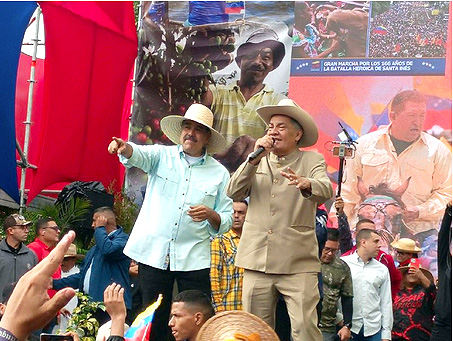
Maduro, addressing supporters in Caracas, urged Venezuelans to be prepared to confront ‘the North American empire’, stating that Washington is weaponising sanctions, naval power, and covert operations to undermine Venezuelan sovereignty.
On Wednesday, the two helicopters used to seize the Skipper were launched from the USS Gerald Ford, the world’s largest aircraft carrier, which was sent to the Caribbean last month.
Ten Coast Guard members, 10 Marines, as well as special forces, were used to seize the oil tanker.
US Secretary of War Pete Hegseth, who is under pressure over what many legal experts see as war crimes during the campaign against the Latin American region, oversaw the seizure of the oil tanker.
Earlier, in a direct message to the American people, Venezuelan President Nicolás Maduro warned on Monday: ‘Do you want a new Gaza in South America?’
His statement came in response to US military movements in the Caribbean and reflects a deepening fear in Caracas that Washington’s actions could pave the way for a broader conflict.
The pretext of combating drugs has not convinced many, even within the United States.
American military officials stated that no ‘fentanyl’ was found on the boats that were targeted, despite the fact that Donald Trump accuses Venezuela of trafficking this substance into his country.
Maduro argued that the United States is not targeting Venezuela alone but ‘all of Latin America, and therefore humanity as a whole’, warning that any direct military intervention could expose his country to the kind of devastation ‘the Gaza Strip endured at the hands of the Israeli army, including genocide’.
Analysts argue that the primary drivers behind this escalation are structural and rooted in decades of US doctrine in the region, yet President Maduro’s vocal support for Gaza and Palestine has added a new political irritant that amplifies tensions.
Meanwhile, Venezuela’s armed forces have added 5,600 new troops as Washington intensifies its military pressure on the Latin American country.
Last Saturday’s swearing-in ceremony at Fuerte Tiuna, the capital’s largest military base, came after President Maduro urged heightened enlistment.
Washington has alleged, without offering evidence, that Maduro heads the drug Cartel de los Soles (Cartel of the Sun), which it labelled a terrorist organisation last month.
Maduro says the US administration of President Donald Trump seeks to depose him and seize the nation’s oil resources.
Addressing the event, Colonel Gabriel Alejandro Rendon Vilchez, one of the officials who conducted the ceremony, declared: ‘Under no circumstances will we allow an invasion by an imperialist force.’
Official data indicates that Venezuela’s armed forces comprise 200,000 troops and another 200,000 police personnel.
Also on Saturday, Maduro spoke by phone with Turkish President Recep Tayyip Erdogan about global geopolitics and the US military build-up in the Caribbean.
The Turkish leader ‘expressed deep concern over the threats recently facing Venezuela, particularly the military deployment and various actions intended to disrupt peace and security in the Caribbean’, Venezuelan Foreign Minister Yvan Gil said in a statement.
Maduro described the manoeuvres in the Caribbean as an ‘illegal, disproportionate, unnecessary and even extravagant’ act of aggression, adding that Venezuela remains committed to peace.
‘It is important to keep channels of dialogue open between the US and Venezuela,’ Erdogan told him, according to a statement from his office released on X, adding that he hoped ‘the tension will ease as soon as possible’.
Since August, the US Southern Command has dispatched warships, submarines, aircraft carriers, F-35 squadrons, and 15,000 personnel to the Caribbean and off Venezuela’s coast under the guise of combating drug trafficking.
The US Southern Command has further deployed Carrier Strike Group Twelve (CSG-12), including the USS Gerald R Ford to the region.
US forces stationed there have conducted lethal strikes on more than 20 purported narco-trafficking vessels, killing at least 87.
Officials in Caracas have condemned the attacks as a deliberate display of US hostility designed to intimidate the region and undermine Venezuela’s sovereignty amid heightened geopolitical tensions.
Meanwhile, across the United States, protests have been held against a major air and missile attack on Venezuela, which appears closer and closer.
Washington has already carried out dozens of airstrikes, killing nearly 100 people, and assembled the largest US Armada in Latin American waters since the Cuban Missile Crisis of 1962.
United States President Donald Trump blames Venezuela, without evidence, for being the primary source of America’s drug problems, but many believe it’s their socialist inspired government, which capitalist, imperialist Washington cannot allow.
The latest polls show that 70% of the people in the United States do not support a military invasion of Venezuela, and in fact support is falling for a war, despite the Trump administration’s insistence that an attack is imminent.
Many say that Venezuela is too strong for a ground invasion even after decades of brutal Western sanctions that have sought to strangle the population and foment civil war.
And if they were to enter into war with Venezuela, it would be an endless war because, right now, first of all, Venezuela has 8 million people in their citizen militias.
While Washington may say, oh, it’s not really 8 million people, but whatever number it is, it’s certainly hundreds of thousands of people who are really quite ready and willing to take up arms to defend their lands.
Because, first of all, they’ve seen what the United States does to their enemies, going back to Korea, Vietnam, Laos, but also, more recently, to Palestine, and they know that what the Gazans suffered, what the people of Palestine have suffered, is on the agenda for the people in Venezuela.
Trump’s aggression towards Venezuelans is a direct contradiction of his anti-war campaign promises and a continuation of US imperialism, not forgetting that Venezuela sits on the world’s largest oil reserves.