
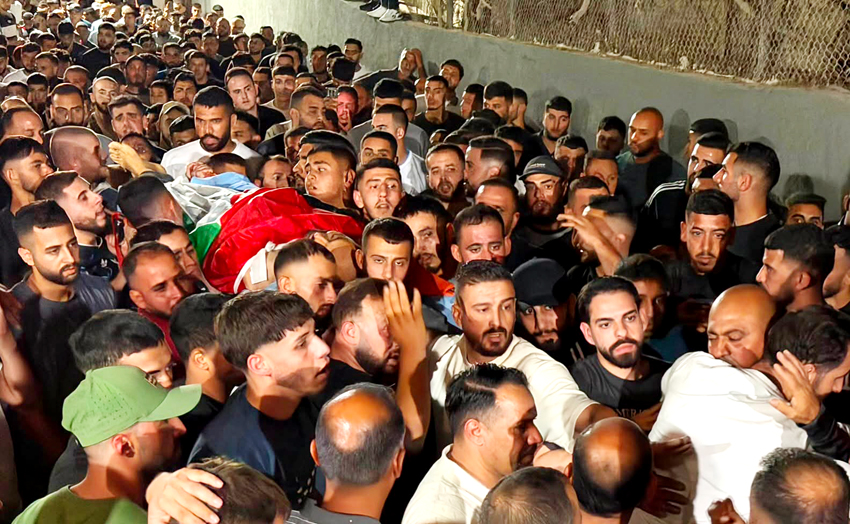
Deir Jarir town, near Ramallah, was brutally attacked again at dawn on Monday by settlers under the protection of the Israeli occupation force (IOF) killing two Palestinian citizens and injuring many others.
The village is already reeling under a suffocating siege making its people’s lives a daily hell due to ceaseless incursions and property theft.
The head of Deir Jarir village council, Eid Hammad, said that settlers, protected by the IOF, stormed a house in the old town and stole the sheep in its yard.
Confrontations then broke out between the young men of the village and the settlers amid heavy firing of bullets by the IOF and the settlers, which killed the two citizens and injured many others.
According to the Ministry of Health, the two dead are Auda Farakhna, 53 years old, a member of the village council, and Ahmed Abu Mukho, 26 years old.
Deir Jarir town is located 13 kilometres northeast of Ramallah city.
Hammad said that the IOF and the settlers blocked the ambulances, and the narrow roads also complicated rescue operations.
He stressed that Deir Jarir lives under a complex siege imposed by the settlements, settlement outposts, and surrounding military checkpoints, which prevent the movement of the people and are used as a cover for repeated settler attacks on agricultural lands and livestock with the aim of emptying the area of its residents.
He pointed out that the village doesn’t have a medical centre, which forces people to transport the injured to Silwad emergency centre, and serious cases all the way to Palestine Medical Complex in Ramallah, all the while having to endure deliberate procrastination at IOF checkpoints which increases the suffering of the wounded.
The population of the village in 1922 was about 739 people, and in 1945 about 1,080, and after the June 1967 aggression, its population reached 1,275. According to the Israeli census, this number rose to about 2,005 people in 1987, and in 2006 it reached about 4,500.
During the past weeks, Deir Jarir has been subjected to a series of attacks, including attempts at sheep stealing, night incursions, and gunfire, all part of a deliberate settler plan to expand their outposts near the village and control the surrounding pastures.
Meanwhile, on Monday, the Hamas Movement said the Israeli airstrikes throughout the day against civilians in the Gaza Strip constitute a systematic act of aggression and a flagrant violation of international law and humanitarian norms.
In a press statement, the Movement said the ongoing crimes and massacres committed by the Israeli occupation would only strengthen the Palestinian people’s determination to remain on their land, defend their rights, and uphold their right to life, freedom, and dignity.
Hamas stressed that the Palestinian people will continue to stand firm and confront Israeli Judaization, settlement expansion, and territorial annexation plans aimed at uprooting them from their homeland.
The Movement called on mediators, the countries guaranteeing the ceasefire agreement, and the United Nations to take immediate and urgent action to halt the Israeli aggression.
It also urged the international community to compel the Israeli occupation to end its crimes and stop its policy of killing, starvation, and siege imposed on the Palestinian people in the Gaza Strip.
Earlier, the Gaza Ministry of Health announced that the death toll from the Israeli genocide in the Gaza Strip since October 7th, 2023, had risen to 73,283 Palestinians, along with 173,864 others wounded.
Israeli occupation forces have continued, for the 284th consecutive day, to violate the ceasefire agreement that called for an end to the war on the Gaza Strip, through gunfire, airstrikes, and artillery shelling, while continuing to expand the so-called ‘Yellow Line’.
Fourteen Palestinian civilians were injured, three critically, following an Israeli airstrike on a vehicle in the central area of Gaza City on Monday afternoon near the crowded al-Ghafri junction area, sparking widespread panic among passers by.
The Red Crescent ambulance crews rushed to the scene and took the wounded to Al-Saraya Field Hospital, where those in critical condition are receiving intensive care.
Another civilian was reportedly injured by Israeli gunfire in Halawa displacement camp in eastern Jabalia, north of Gaza.
Meanwhile, widespread military activity, including demolitions, shooting incidents, artillery shelling, and airstrikes, was reported across Gaza yesterday.
Obtaining a lighter in the Gaza Strip is no longer as simple as it once was. With the siege continuing and the effects of the war deepening, the small tool has joined the list of missing goods, becoming a daily crisis for thousands of families who rely on fire to prepare food or boil water.
In Gaza’s markets, residents search for lighters but often cannot find them. When they are available, they only appear in limited quantities or at prices more than 100 times higher than before.
‘I swear, for two months not a single carton of lighters has come in,’ said Abu Mohammed, who runs a stall in the Al-Mawasi market in Khan Younis. ‘Anyone who has two or three is hiding them for emergencies and selling them at double the price. People fight over them.’
Umm Khaled, from Jabalia refugee camp, said she now has to visit several stalls just to find one lighter.
‘The last time I found one, it cost 15 shekels. Before the war, it was two shekels,’ she said. ‘We are forced to buy them because we need them for cooking.’
Residents say the shortage has forced them to keep old lighters and repair them repeatedly, or borrow fire from neighbours whenever they need to light a cooking stove.
With lighters unavailable, some families have turned to primitive methods to start fires, such as keeping embers burning for hours or using paper and cardboard and trying to ignite them in different ways.
These methods take time and effort and can pose serious risks inside tents and displacement shelters.
‘I keep an ember burning from morning until night in a tin container,’ said Umm Ahmed, a displaced woman living in a tent in Al-Mawasi, Khan Younis.
‘I’m afraid to sleep and leave it, but I have no choice. Once, the tent next to us caught fire because of paper. Obtaining a flame has become more dangerous than hunger.’
Mahmoud, 24, said that at times he walks half an hour to a neighbour’s home to bring back a bit of fire in a container.
‘Getting fire has become harder than getting firewood itself,’ he said, especially as families now rely almost entirely on wood-burning stoves after cooking gas ran out.
Traders say the disappearance of lighters reflects the depth of Gaza’s humanitarian crisis. The suffering is no longer limited to shortages of food, medicine and fuel, but has reached the simplest household tools.
‘The siege has strangled us in the smallest things before the biggest,’ said Abu Rami Isleem, a trader from Deir Al-Balah. ‘The lighter, the needle, the charger, everything is cut off. Customers think we are hiding goods, but in reality, nothing is entering.’
Traders say the continued halt in supplies has depleted many small items at a time when residents need them more than ever and have few alternatives.
A lighter may seem like a simple item under normal circumstances, but in Gaza it has become an essential tool for preparing food and securing the minimum requirements of daily life.
‘Before, we used to complain about electricity and gas,’ said Umm Wasim. ‘Now, we complain about a spark. Imagine reaching a point where we are searching for a spark just to boil water for our children.’
The disappearance of lighters shows how even the smallest needs have become a new challenge for Gaza’s residents, reflecting the pressure that war and siege have imposed on every detail of daily life.