
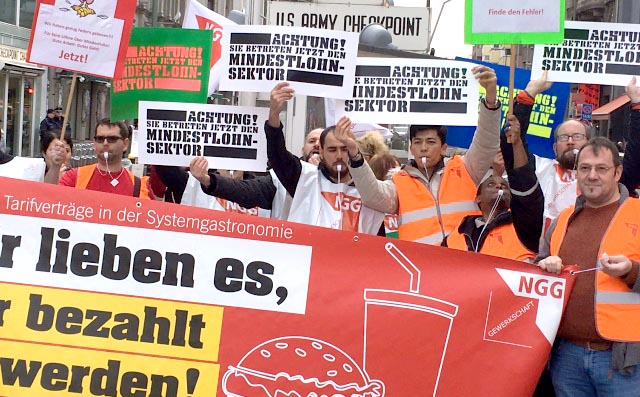
Germany’s Ernährung, Gastronomie, Genuss (NGG) union has announced it will step up strike action after negotiations with the Bundesverband der Systemgastronomie (BdS) over a sectorwide wage agreement failed to reach an agreement.
The dispute covers the system gastronomy sector, a category that includes major fast-food chains such as McDonald’s, Burger King and KFC, and could touch restaurants, distribution and supply operations across the country.
The BdS had offered a minimum hourly rate of 13 euros under a contract spanning 42 months, with the first raise to be backdated to 1st January.
NGG rejected the offer and pressed for higher terms, including a 15 euros minimum hourly wage, a monthly pay rise of 500 euros, a one-time 500 euros payment for union members and increased pay for interns.
Union leaders framed their demands as necessary to secure living wages and improved working conditions for many fast-food workers who often juggle multiple jobs or rely on public assistance.
NGG said the escalation will involve as many as 120,000 workers in the sector, signalling a large-scale campaign that could include coordinated strikes and mass protests. If realised, such action would affect crews working front counter and drive-through, back-of-house kitchen staff, and workers in logistics and supply chains that feed system gastronomy outlets.
The NGG stated: ‘For employees, the dispute highlights persistent cost-of-living pressures and the thin margins many fast-food workers face.
Higher hourly minimums and lump-sum payments would raise take-home pay and reduce reliance on secondary shifts or public benefits for affected workers.
For managers and workers, strikes could mean short staffing, lost sales and operational headaches during peak shifts, while wider disruptions in supplier networks could complicate restocking and prep work.
Also in Germany, the Ver.di trade union called strikes yesterday, after two major rounds of collective bargaining with employers failed to deliver their demands
Ahead of the strike, Ver.di stated: ‘The approximately 14,000 employees of the Federal Autobahn and the several thousand employees of the state road construction authorities are called upon to participate in industrial action, protests, and rallies as part of the nationwide road sector strike day.
‘The strikes will take place at a total of 18 locations across Germany.
‘The reason for the strikes is the protracted and unacceptable progress of the collective bargaining negotiations for the Autobahn and the collective agreement for the public service of the federal states.’
Christine Behle, deputy chair of Ver.di, responsible for both sectors, stated: ‘Roads are the number one mode of transport in Germany – every day, tens of thousands of employees ensure the smoothest possible traffic flow on highways, federal and state roads, bridges, and in tunnels.
‘And with this joint day of strike action, they want to demonstrate that their work deserves better pay.
‘We need attractive working conditions to retain and recruit people for these extremely important jobs.’
‘On Tuesday, there will be actions and work stoppages at various locations, including branches and offices of Autobahn such as Nuremberg, Rostock, Stuttgart, Hanover, Montabaur, Hamm, Gelsenkirchen, Cologne, Kiel, Hamburg, and Berlin.
‘Industrial action is also planned at state road construction authorities, including road maintenance depots and traffic and tunnel control centres, for example in North Rhine-Westphalia, Lower Saxony, and Schleswig-Holstein. In North Rhine-Westphalia, all 28 state tunnels will be affected by the strike.’
- Meanwhile in France, the Louvre Museum was shut down on Monday – the third time in a month – due to a strike by staff.
Trade unions, including the CGT and CFDT and the SUD, are pressing for more recruitment, pay and better maintenance of the vast former royal palace, and have launched several days of strikes in recent months.
Nearly 140 new hires have been announced since the start of the strike movement in mid-December, and another meeting was scheduled at the culture ministry on Thursday to discuss salary increases.
Valerie Baud of the CFDT union said in a statement: ‘If we get the pay but continue with this governance model, we won’t be out of the woods’.
Elise Muller from the SUD union stated: ‘There may be announcements, but we are still dealing with a management that digs its heels in and doesn’t recognise that it can sometimes be wrong.’
The two days of museum closures in December and earlier in January have resulted in a loss of ‘at least one million euros’ in revenue, management said.
The security failures highlighted by a spectacular break-in at the museum on 19th October have cast a harsh spotlight on management of the institution.
Footage of the heist was broadcast for the first time on French television last Sunday evening, showing the jewel thieves breaking into display cases.
The images, filmed by surveillance cameras, were shown by the TF1 and public France Televisions channels, three months after the hugely embarrassing break-in in October.
They show the two burglars, one wearing a black balaclava and a yellow high-visibility jacket, the other dressed in black with a motorcycle helmet, as they force their way into the Apollo Gallery.
After breaking in through a reinforced window with high-powered disk cutters, they begin slicing into display cases under the eyes of several staff members who do not intervene because, rightly, they do not want to be injured while they are working.
Managers at the Louvre agree that staff are not trained to confront thieves and are asked to prioritise the evacuation of visitors.
As union repression reaches unprecedented levels, the CGT trade union federation is launching its campaign for union freedoms with a major meeting at its headquarters in Montreuil on February 4th.
In a statement the CGT said: ‘Using a popular expression can now lead to prosecution.
‘The CGT general secretary, Sophie Binet, learned this the hard way at the end of last year.
‘Yet, with the phrase “The rats are leaving the ship”, she was simply describing a reality: the threats of offshoring by big bosses, ready to do anything to increase their profits.
‘This is obviously just a pretext, and this gag order procedure is yet another piece in the vast strategy of intimidation against those who defend the interests of workers in companies:
- five union leaders are or have been targeted by legal proceedings since 2023;
- hundreds of activists are harassed – or even repressed – every day in connection with their union activities;
- The extreme rightward shift of society, and in particular of big business, greatly amplifies the phenomenon.
‘This cannot continue.
‘Trade union freedoms remain an essential pillar of democracy and social progress – they must be protected and strengthened.
‘The CGT is launching its campaign to defend trade union freedoms with a major rally on February 4, 2026 , hosted by Guillaume Meurice in partnership with Radio Nova, at the CGT headquarters.
‘Objective: to highlight the extent of union repression and discrimination, but also and above all to highlight the proposals, actions and alliances needed to protect union freedoms.’