
BY ANY conventional measure, the no-holds-barred military and economic aggression unleashed by the United States, the Israeli regime, and some of their regional allies should have brought the Islamic Republic of Iran to its knees by now.
Massive aerial campaigns, a naval siege, relentless cyberattacks, and a sophisticated propaganda apparatus were all deployed with a single objective – force Iran into submission.
Yet more than two months into this imposed war, the opposite has happened, and the situation has become far more complicated for the aggressor than for the defender, and time is slipping away.
The Islamic Republic, has emerged not as a defeated party but as a new regional power holding significant strategic leverage.
This war is becoming increasingly costly for the US, the Israeli regime, and their Persian Gulf partners, as Iran’s firm and legitimate control over the Strait of Hormuz – combined with a resilient population and a united leadership – has placed Tehran in a position of advantage.
For the Israeli regime, the war against the Islamic Republic was supposed to be a decisive blow against its most formidable adversary. Instead, it has turned into a crisis on every front for the genocidal regime and its backers.
Tehran has already forced the US to accept several of its terms, and for the Israeli regime, which was built on the presumption of Iranian containment, the emergence of a diplomatically triumphant, militarily dominant Iran is an existential horror.
Meanwhile in southern Lebanon, Hezbollah has been quietly dismantling Israeli military superiority using drones so simple and inexpensive that they defy conventional counter-measures.
Daily targeted strikes on Israeli regime equipment, tanks, and troop concentrations have rendered southern Lebanon a no-go zone for Israeli occupying forces.
More terrifying for Tel Aviv is the prospect of this asymmetric warfare model spreading to Gaza and the occupied West Bank, which many military pundits see as a nightmare scenario that would transform the entire Palestinian theatre.
Israel also faces internal political collapse. The failure to achieve its declared war objectives has triggered unprecedented internal pressures on Benjamin Netanyahu’s embattled regime.
Rivals within Israel’s fractious political system are circling, capitalising on the disconnect between wartime promises and battlefield realities, with Netanyahu’s political opponents forming a coalition to bring down his regime.
Far from weakening Iran, the imposed war has strengthened both it and the resistance front, leaving Israeli regime leaders with no credible exit strategy.
Iran also has a huge, as yet unrevealed, arsenal.
The recent 40-day war showcased only a fraction of Iran’s military capabilities. What remains undisclosed – new missile systems, advanced drones, cyberwarfare tools, and asymmetric naval tactics – promises blows far heavier than those inflicted during the Ramadan War.
Also, the ‘normalisation’ policy has collapsed. The Abraham Accords, once hailed by Western pundits as a transformative realignment of Arab-Israeli relations, have been quietly forgotten.
Persian Gulf Arab states, have dramatically cooled their embrace of Tel Aviv. Iran’s enhanced regional role has made normalisation a political liability rather than a diplomatic achievement.
There is also the Yemeni wildcard. Should the war expand, the Ansarullah front at Bab al-Mandab, as they have already warned, stand ready. A simultaneous blockade of the Red Sea would choke Israeli and Western shipping through the Suez Canal, adding catastrophic economic pressure to an already bleeding enemy alliance.
For the United States, the war against Iran was never merely about Tehran. It was a message to Moscow, Beijing, and the rest of the world that American power remains unchallengeable. That message has backfired catastrophically.
America’s threats have become hollow. When the world’s so-called ‘superpower’ cannot defeat a regional power after years of full-scale military and economic warfare, every rival takes note. Russia and China are already recalibrating their strategies, not in fear of Washington, but in assessment of its staggering decline.
Former European allies, are rapidly rethinking their transatlantic commitments, as evidenced by their refusal to join the American alliance to open the Strait of Hormuz.
If the US cannot protect its own interests in the Persian Gulf, why should European nations stake their security on American guarantees? The erosion of America’s international role is no longer a prediction but an unfolding and vivid reality.
Regarding America’s domestic situation, the political consequences for the Republican Party, and for Trump personally, are equally devastating. A failed war, undisclosed casualties, and no clear victory to claim have set the stage for a prolonged collapse in the American political landscape, especially in the wake of the November midterms.
Should Democrats control both the Senate and the House in the upcoming midterms, impeachment proceedings – or worse, criminal charges – await a president who promised victory in the war against Iran but came out as a defeated party.
The war has worsened global economic conditions like never before, and the world rightly blames the United States for it.
Inflation, supply chain disruptions, and energy price volatility have all been exacerbated by the unprovoked American aggression. Even traditional allies are reluctant to absorb economic pain for a war they never endorsed.
Iran has proven more resilient to economic siege than the US itself. The longer the naval blockade continues, the more the American position weakens, and every passing day forces Washington to accept additional Iranian terms for a ceasefire. The siege is not breaking Iran, but it is definitely breaking America’s will.
If there is no agreement to end the war permanently, Iran’s next move will be interesting. The potential opening of the Bab al-Mandab front alone would transform global shipping. Combined with new tactics and weapons from Iran and its resistance allies, the US faces a future war for which it hasn’t prepared.
Should Iran’s terms for ending the war ultimately prevail, it would constitute an official declaration of American defeat to the Arab Persian Gulf states – Washington’s most trusted regional allies.
Such an outcome would trigger an immediate and profound reconsideration of every security treaty, every basing agreement, and every intelligence-sharing arrangement.
The United States would not merely lose a war, but it would lose an entire region.
America’s Arab allies in the Persian Gulf region face their own set of nightmares. Their complicity in the war of aggression against Iran is no longer a secret.
They know that future relations with Tehran will require concessions far beyond anything previously contemplated. Iran’s upper hand in the region is no longer theoretical, but operational.
The unity of the Persian Gulf Cooperation Council is also cracking apart. The UAE, in particular, faces potential internal schisms over whether to accommodate or confront Tehran, and the severe repercussions on the fragile and heavily dependent economies of the Persian Gulf states are already visible.
Real estate bubbles are popping, tourism has collapsed, and foreign investment is fleeing. Finally, Persian Gulf rulers fear their own populations more than anything else.
The weakness of their filthy rich and unpopular regimes – their excessive reliance on American and Israeli protection – has been exposed.
People across the Arab world are asking: ‘If your American ally cannot defend itself against Iran, how can it defend us?’ Renewed uprisings haunt every Persian Gulf capital, far worse than the previous Arab Spring.
Despite natural and legitimate concerns about economic hardships, especially rising inflation, and the toll of prolonged war, Iran operates from a position of relative strength compared to its enemies, including the US.
The majority of Iranians accept a simple logic: the enemy is the aggressor, its aim is plunder and partition, and resistance is the only honourable path.
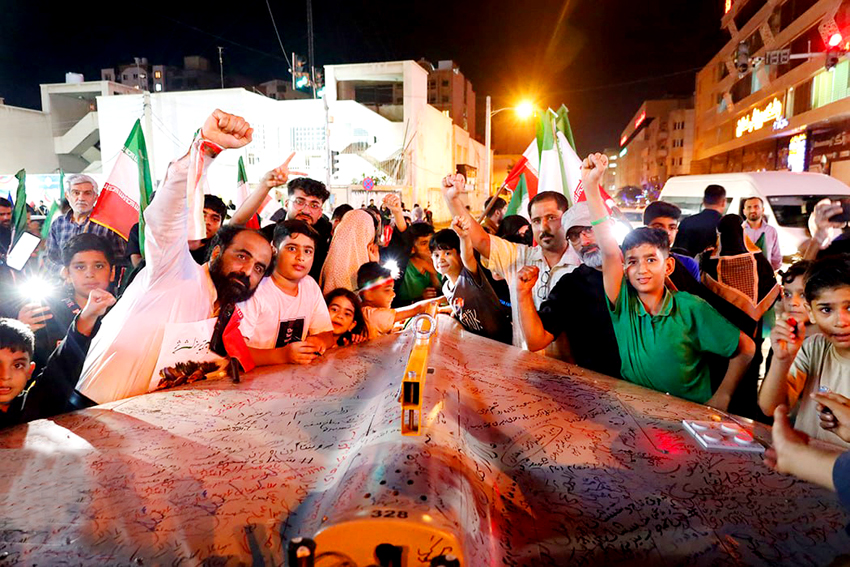
This consensus has created unprecedented national unity in the country, providing immense political capital for military and civilian decision-makers.
Millions of Iranians today stand ready to defend their country under the banner of the ‘Sacrifice for Iran’ campaign, which has already registered over 31 million Iranians from different walks of life.
At the heart of Iran’s strategic advantage lies the narrow crucial waterway between the Persian Gulf and the Gulf of Oman – the Strait of Hormuz.
Understanding and preserving the strategic value of this critical chokepoint, and maintaining Iranian management over it, remains the demand of the entire nation and a red line in any agreement leading to the permanent end of the imposed war.
It is not merely a geographical feature. It is the key to realising many of Iran’s historical demands: the lifting or neutralising of sanctions, the freeing of blocked Iranian assets, and the restoration of Iran’s rightful economic standing.
Every day that Iran maintains control over this passage – through which approximately 20 million barrels of oil pass daily – is a day that the enemy’s economic warfare strategy fails.
Iran will not back down from this position. The country’s leadership has been explicit: preserving the Strait and Iranian sovereignty over its management are non-negotiable.